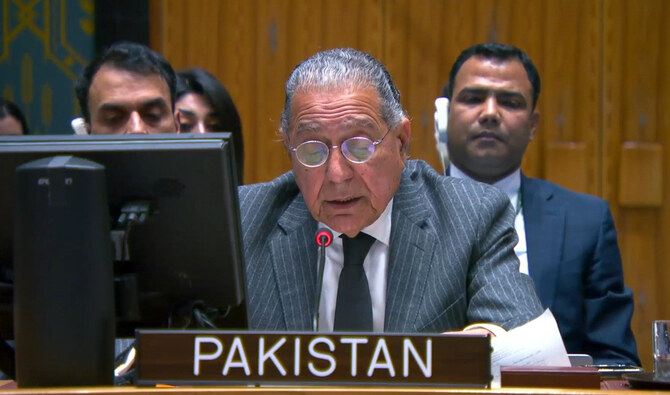
ISLAMABAD: Pakistan’s United Nations Ambassador Munir Akram this week raised alarm at the Security Council over the worsening food security situation in Sudan, urging both warring parties to agree to an immediate and unconditional ceasefire as civil war in the African country rages on.
The UN-backed Famine Review Committee of the Integrated Food Security Phase Classification (IPC) published a report last month outlining famine in five areas, including in Sudan’s largest displacement camp, Zamzam, in North Darfur province. The IPC’s report also warned that famine will likely spread to another five areas— Um Kadadah, Melit, el-Fasher, Tawisha and Al-Lait, by May 2025.
Sudanese people have suffered due to a 20-month war between the army and a paramilitary group that has killed over 24,000 and driven over 14 million people from their homes, according to the UN. An estimated 3.2 million Sudanese have crossed into neighboring countries, including Chad, Egypt and South Sudan, to escape the horrors of the conflict.
Akram said on Monday that Pakistan was “deeply grieved” by the current ordeal of the people in Sudan by the war.
“We call for an immediate and unconditional ceasefire,” Akram said. “The parties need to find a sustainable political resolution to the conflict through dialogue. It will not be resolved on the battlefield. War will only bring more death and destruction for the Sudanese people.”
He said that the worsening food security situation in the country is “alarming,” noting that over 24.6 million people in Sudan face high levels of acute food insecurity.
“We have reviewed the 24th December report of the Integrated Food Security Phase Classification (IPC),” he said. “We note that the Sudanese government has questioned the IPC’s malnutrition data and assessment and its ability to collect data from conflict zones and those controlled by the Rapid Security Forces. These views need to be taken into account.”
The Pakistani envoy urged the international community to work with the Sudanese government in addressing the humanitarian crisis in the country, calling on Sudanese authorities to facilitate the delivery of aid to the needy.
“We appreciate the recent steps taken by the Sudanese authorities in opening additional air, sea and land borders for humanitarian aid and extending the Adre border crossing, which has brought some improvement in the humanitarian situation,” Akram noted.
The Pakistani ambassador called on the international community to alleviate the humanitarian crisis in Sudan and bridge the 36 percent funding gap for humanitarian appeals relating to Sudan.
“The international community must unite to support a common vision for return to peace and normalcy in Sudan,” he said. “Foreign interference in the internal conflict of Sudan must stop. The UNSC arms embargo on Sudan must be respected.”
As the war reached its peak in April 2023, Pakistan joined other countries in evacuating its nationals from Sudan, rescuing about 1,000 people from the African nation.


![]()

Pakistan raises alarm at Sudan’s worsening food security situation, calls for ceasefire
Short Url
https://arab.news/zhkdy
Pakistan raises alarm at Sudan’s worsening food security situation, calls for ceasefire
- United Nations-backed committee’s report in December outlined famine in five areas of Sudan
- Twenty-month-long war between Sudanese army, paramilitary group has killed over 24,000 people
Latest updates



© 2026 SAUDI RESEARCH & PUBLISHING COMPANY, All Rights Reserved And subject to Terms of Use Agreement.