

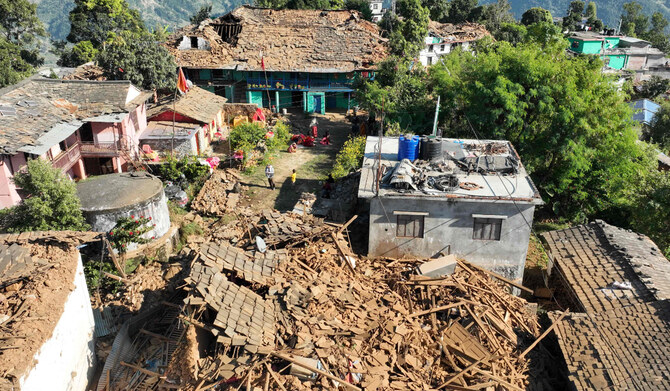

BEIJING: A devastating earthquake in China’s remote Tibet region killed at least 126 people and damaged thousands of buildings on Tuesday, state media reported, with tremors also felt in neighboring Nepal’s capital Katmandu and parts of India.
Videos published by China’s state broadcaster CCTV showed houses destroyed with walls torn apart.
Rescue workers waded through rubble strewn across the ruins in the aftermath, footage showed, while some gave locals thick blankets to keep warm in sub-zero temperatures.
The quake struck rural, high-altitude Tingri county, about 80 kilometers (50 miles) north of Mount Everest near China’s border with Nepal, at around 9:00 am (0100 GMT) on Tuesday.
“Here the houses are made from dirt so when the earthquake came... lots of houses collapsed,” said 34-year-old Sangji Dangzhi, whose supermarket in Tingri suffered considerable damage.
Speaking to AFP by phone, Sangji described the situation as “very serious,” with ambulances taking people to hospital throughout the day.
Surveillance images published by CCTV showed people running through a store’s aisles as shelves shook violently, sending objects like toys tumbling to the ground.
At least 126 people have been confirmed dead and 188 others injured, CCTV said.
Twenty-eight people in critical condition were transferred to hospital for treatment and 3,609 houses had collapsed, it added.
The China Earthquake Networks Center (CENC) measured the quake’s magnitude as 6.8, while the US Geological Survey reported it as 7.1.
When tourist Meng Lingkang arrived in the town of Lhatse, 65 kilometers from the epicenter, “the buildings had cracked open.”
“Some of the older houses collapsed, and a large part of the buildings made from bricks had cracked open, with big fissures,” the 23-year-old told AFP.
Videos geolocated by AFP to Lhatse showed debris scattered in front of streetside eateries.
The area most affected is surrounded by mountainous terrain on the Chinese side of Mount Everest.
Tingri, the epicenter, is home to around 62,000 people, and is much less developed than urban centers like Tibet’s capital Lhasa.
Many of the fallen houses appeared to be constructed using traditional materials such as stone, mud bricks and wooden beams.
CCTV, citing the emergency command center, reported that the earthquake emergency response status in the region was raised to the highest level.
Chinese President Xi Jinping has called for “all-out search and rescue efforts, minimizing casualties to the greatest extent possible, properly resettling affected residents, and ensuring their safety and warmth through the winter,” the state broadcaster said.
Temperatures in Tingri are projected to drop to minus 16 degrees Celsius (3.2 Fahrenheit) overnight, according to the China Meteorological Administration.
Authorities said more than 3,400 rescuers and over 340 medical workers had been deployed.
Aid including cotton tents, quilts and cold-weather equipment had been dispatched by central authorities, state news agency Xinhua said.
Tingri is under the administration of the prefecture-level city of Shigatse, home to the traditional seat of the Panchen Lama, one of the most important spiritual figures in Tibetan Buddhism after the Dalai Lama.
The Dalai Lama said he was “deeply saddened.”
“I offer my prayers for those who have lost their lives and extend my wishes for a swift recovery to all who have been injured,” the exiled spiritual leader said in a statement.
French President Emmanuel Macron offered assistance to those affected, while Russian President Vladimir Putin expressed his “sincerest condolences.”
As well as Katmandu, areas around Lobuche — in the high mountains near Everest in Nepal — were also rattled by the tremor and aftershocks.
“It shook quite strongly here,” said government official Jagat Prasad Bhusal in Namche region, which lies closer to Everest.
Security forces had been deployed but no damage or deaths had been reported so far, Nepali home ministry spokesman Rishi Ram Tiwari said.
Nepal lies on a major geological faultline where the Indian tectonic plate pushes up into the Eurasian plate, forming the Himalayas, and earthquakes are a regular occurrence.
In 2015, nearly 9,000 people died and more than 22,000 were injured when a 7.8-magnitude quake struck Nepal, destroying more than half a million homes.
Some tremors were felt in Bihar state in India but no injuries were reported.
Tuesday’s quake was the most powerful recorded within a 200-kilometer (124-mile) radius in the last five years, the CENC said.
A quake in December 2023 in northwest China killed 148 people and displaced thousands in Gansu province.


