Al-Rajhi, Sanders win 48-hour stages at Dakar Rally

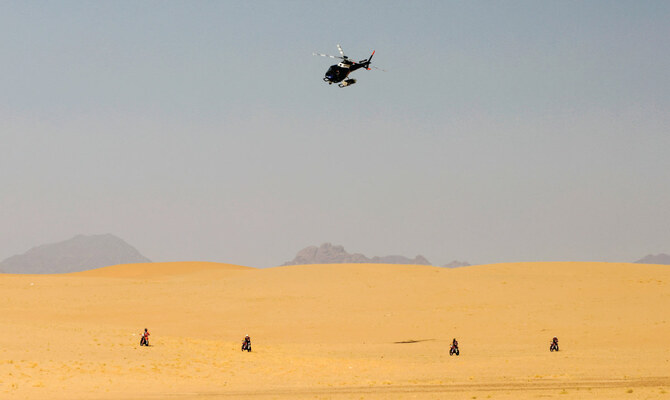
General view of bikes in action during Stage 2 of the Dakar Rally that started and ended at Bisha on Monday. (Reuters)
Short Url
Updated 06 January 2025
Follow

Al-Rajhi, Sanders win 48-hour stages at Dakar Rally

  • For this long stage, which started on Sunday, the competitors had to bivouac in the desert

BISHA, Saudi Arabia: Saudi driver Yazeed Al-Rajhi held on to his overnight lead to win the second stage of the Dakar 2025 rally on Monday, the fearsome “48-hour Chrono” while defending champion Carlos Sainz limped in 1h 30min behind.

The 43-year-old racing in his home country completed the 967km special stage, spread over two days, in 10h 56min 54sec, despite a 2min penalty for speeding.

He was followed by South African Henk Lategan at 4min 16sec with Qatari Nasser Al-Attiyah, who overtook Al-Rahji briefly to hold the lead for 142k, finishing third.

“It was really, really hard. I feel like this is our tenth day on the Dakar,” said Al Rajhi on his arrival at the bivouac of the rally, which began on Friday.

“The navigation was very, very difficult in some places, due to the divots and dust. You needed a rocket, not a car to pass through them. It wasn’t easy.”

For this long stage, which started on Sunday, the competitors had to bivouac in the desert and did not benefit from the assistance of their teams at the night stop.

Sainz seriously damaged his Ford Raptor when he rolled it on Sunday but managed to finish the stage although the Spaniard is now 26th in the standings.

Nine-time world rally champion Sebastien Loeb, who is still looking for his first Dakar victory, was half an hour behind at the camp on Sunday evening, after a fan problem caused his engine to overheat.

But the Frenchman had a better Monday, making up much of the deficit to finish seventh, 13min 10sec behind the leader.

South African Lategan tops the provisional standings, 4min 45sec ahead of Al Rajhi with Al Attiyah in third. Loeb is sixth, 18min 56sec off the lead.

“We looked after the car for the stage because we knew it was really, really long,” said Lategan.

“If you don’t look after the car, it won’t look after you. It’s actually a big surprise to be first because we haven’t been really focusing on it. But I’m happy with that.”

Australian Daniel Sanders continues to dominate on the bikes, his victory in their “48-hour Chrono” making it three in a row after he also won the prologue and first stage.

It is the first time any rider has taken the first three stages since Spaniard Joan Barreda in 2017 between Bolivia and Argentina.

“It wasn’t too bad, pretty hard in the soft dunes, it was very tough for a lot of us,” said Sanders.

“When opening, you didn’t know if it was going to be a soft dune or a hard dune. It was pretty tough. The dust kind of ruined it a lot. Everyone was bunched up fighting in the dust for the opening bonuses. It was a bit tough on that side.”

Sanders took victory on his KTM in a time of 11hr 12min 13sec, 6min 45sec ahead of Frenchman Adrien van Beveren (Honda) with American Skyler Howes (Honda) in third.

Sanders, who is aiming to become the second Australian to win the Dakar on a bike after Toby Price, holds a 12min 36sec lead over Howes in the provisional overall standings.

Botswana’s Ross Branch (Hero) lies third, 4sec behind the American.


FIA, Formula 1 and all 11 race teams sign 9th Concorde Agreement

Updated 13 December 2025
Follow

FIA, Formula 1 and all 11 race teams sign 9th Concorde Agreement

  • FIA President Mohammed Ben Sulayem says new contract secures the FIA Formula One World Championship’s long-term future

DUBAI: The Federation Internationale de l’Automobile, the global governing body for motorsport and the federation for mobility organisations worldwide, and Formula One Group, the commercial rights holder, have announced the signing of the Concorde Governance Agreement, a contract defining the regulatory framework and governance terms of the FIA Formula One World Championship until 2030.

This follows the announcement in March that the 2026 Commercial Concorde Agreement had been signed by all the teams and Formula One Group.

Together, these agreements constitute the ninth Concorde Agreement, a major step forward in the professionalisation and global development of the sport.

First introduced in 1981, the Concorde Agreements are designed to promote sporting fairness, technological innovation and operational excellence, and align all key stakeholders around a shared vision for structured governance and continued growth of the sport.

Each iteration of the Concorde Agreements has shaped the FIA Formula One World Championship into the global spectacle it is today.

The ninth Concorde Agreement announced today marks the beginning of a new era of collaboration between the FIA and Formula One Group, who have worked together to write the next chapter in Formula One history, demonstrating mutual respect, transparency and shared purpose between the two organisations.

It confirms the participation of all FIA Formula One World Championship teams, including the incoming Cadillac Formula One team, through the end of the decade, and provides a stable foundation for the sporting and technical evolution of the sport.

The Concorde Agreement underscores the commitment of the FIA, Formula One Group and all teams to continue growing and developing the sport, and to keep driving the momentous expansion it has enjoyed in recent years.

The new contract enables the FIA to invest further in improved race regulation, race direction, stewarding and technical expertise for the benefit of the championship, and means the sport can continue to evolve, providing exciting technological innovation and sporting action for fans, broadcasters and partners, all within a stable and structured regulatory framework.

Combined with record viewership growth, a dynamic race calendar, and increasing engagement from younger audiences, the FIA Formula One World Championship enters this next chapter with unprecedented momentum.

Mohammed Ben Sulayem, president of the FIA, said: “The ninth Concorde Agreement secures the FIA Formula One World Championship’s long-term future and I am proud of the dedication that has been invested in this process.

“I would like to thank Stefano Domenicali and his team in what has been a strong collaboration, building a framework grounded in fairness, stability, and shared ambition. This agreement allows us to continue modernising our regulatory, technological, and operational capabilities, including supporting our race directors, officials, and the thousands of volunteers whose expertise underpin every race.

“We are ensuring that Formula One remains at the forefront of technological innovation, setting new standards in global sport.”

Domenicali, president and CEO of Formula One Group, said: “Today is an important day for Formula One. As we celebrate 75 years of this incredible sport, we are proud to write the next chapter in our long and amazing history.

“This agreement ensures that Formula One is in the best possible position to continue to grow around the world. I want to thank the president of the FIA, Mohammed Ben Sulayem and all the teams for the collaboration and determination to achieve the best results for the entire sport in our discussions.

“We have a huge amount to be proud of, but we also are focused on the opportunities and exciting potential for Formula One in the years ahead.”