South Korea’s military says North Korea fired missile into eastern sea

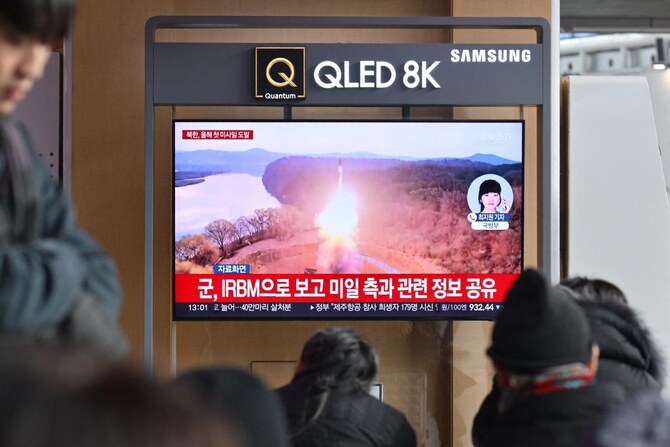
Above, people watch a television showing a news broadcast with file footage of a North Korean missile test at a railway station in Seoul on Jan. 6, 2025. (AFP)
Short Url
Updated 06 January 2025
Follow

South Korea’s military says North Korea fired missile into eastern sea

  • The South’s Joint Chiefs of Staff said the missile was fired from an area near Pyongyang
  • Seoul denounces the launch as a provocation that poses a serious threat on the Korean Peninsula

SEOUL: North Korea on Monday fired a ballistic missile that flew 1,100 kilometers before landing in waters between the Korean Peninsula and Japan, South Korea’s military said, extending its heightened weapons testing activities into 2025 weeks before Donald Trump returns as US president.
The South’s Joint Chiefs of Staff said the missile was fired from an area near the North Korean capital of Pyongyang and that the launch preparations were detected in advance by the US and South Korean militaries. It denounced the launch as a provocation that poses a serious threat to peace and stability on the Korean Peninsula.
The joint chiefs said the military was strengthening its surveillance and defense posture in preparation for possible additional launches and sharing information on the missile with the United States and Japan.
The launch came as US Secretary of State Antony Blinken was visiting Seoul for talks with South Korean allies over the North Korean nuclear threat and other issues.
Blinken’s visit comes amid political turmoil in South Korea following President Yoon Suk Yeol’s short-lived martial law decree and subsequent impeachment by parliament last month, which experts say puts the country at a disadvantage in getting a steady footing with Trump ahead of his return to the White House.
In a year-end political conference, North Korean leader Kim Jong Un vowed to implement the “toughest” anti-US policy and criticized the Biden administration’s efforts to strengthen security cooperation with Seoul and Tokyo, which he described as a “nuclear military bloc for aggression.”
North Korean state media did not specify Kim’s policy plans or mention any specific comments about Trump. During his first term, Trump met Kim three times for talks on the North’s nuclear program.
Many experts, however, say a quick resumption of Kim-Trump summitry is unlikely as Trump would first focus on conflicts in Ukraine and the Middle East. North Korea’s support for Russia’s war against Ukraine also poses a challenge to efforts to revive diplomacy, experts say.
Before his presidency faltered over the ill-conceived power grab, Yoon worked closely with US President Joe Biden to expand joint military exercises, update nuclear deterrence strategies and strengthen trilateral security cooperation with Tokyo.


Britain needs ‘AI stress tests’ for financial services, lawmakers say

Updated 20 January 2026
Follow

Britain needs ‘AI stress tests’ for financial services, lawmakers say

  • Lawmakers urge AI-specific stress tests for financial firms

LONDON: Britain’s financial watchdogs are not doing enough to stop artificial ​intelligence from harming consumers or destabilising markets, a cross-party group of lawmakers said on Tuesday, urging regulators to move away from what it called a “wait and see” approach.
In a report on AI in financial services, the Treasury Committee said the Financial Conduct Authority and the Bank of England should start running AI-specific stress tests to help firms prepare for market shocks triggered by automated systems.
The committee also called on the FCA to ‌publish detailed guidance ‌by the end of 2026 on how ‌consumer ⁠protection ​rules apply to ‌AI, and on the extent to which senior managers should be expected to understand the systems they oversee.
“Based on the evidence I’ve seen, I do not feel confident that our financial system is prepared if there was a major AI-related incident and that is worrying,” committee chair Meg Hillier said in a statement.

TECHNOLOGY CARRIES ‘SIGNIFICANT RISKS’

A race among banks to adopt agentic AI, which ⁠unlike generative AI can make decisions and take autonomous action, runs new risks for retail customers, the ‌FCA told Reuters late last year.
About three-quarters ‍of UK financial firms now use ‍AI. Companies are deploying the technology across core functions, from processing insurance claims ‍to performing credit assessments.
While the report acknowledged the benefits of AI, it warned the technology also carried “significant risks” including opaque credit decisions, the potential exclusion of vulnerable consumers through algorithmic tailoring, fraud, and the spread of unregulated financial advice through AI chatbots.
Experts ​contributing to the report also highlighted threats to financial stability, pointing to the reliance on a small group of US tech ⁠giants for AI and cloud services. Some also noted that AI-driven trading systems may amplify herding behavior in markets, risking a financial crisis in a worst-case scenario.
An FCA spokesperson said the regulator welcomed the focus on AI and would review the report. The regulator has previously indicated it does not favor AI-specific rules due to the pace of technological change.
The BoE did not respond to a request for comment.
Hillier told Reuters that increasingly sophisticated forms of generative AI were influencing financial decisions. “If something has gone wrong in the system, that could have a very big impact on the consumer,” she said.
Separately, Britain’s finance ‌ministry appointed Starling Bank CIO Harriet Rees and Lloyds Banking Group ‘s Rohit Dhawan as “AI Champions” to help steer AI adoption in financial services.