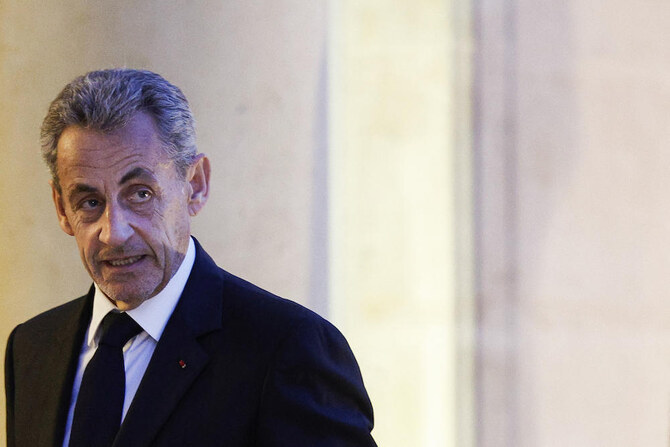
PARIS: Former French president Nicolas Sarkozy, already convicted twice in separate cases since leaving office, on Monday goes on trial charged with accepting illegal campaign financing in an alleged pact with the late Libyan dictator Muammar Qaddafi.
The career of Sarkozy has been shadowed by legal troubles since he lost the 2012 presidential election. But he remains an influential figure for many on the right and is also known to regularly meet President Emmanuel Macron.
The fiercely ambitious and energetic politician, 69, who is married to the model and singer Carla Bruni and while in power from 2007-2012 liked to be known as the “hyper-president,” has been convicted in two cases, charged in another and is being investigated in connection with two more.
Sarkozy will be in the dock at the Paris court barely half a month after France’s top appeals court on December 18 rejected his appeal against a one year prison sentence for influence peddling, which he is to serve by wearing an electronic bracelet rather than in jail.
The latest trial is the result of a decade of investigations into accusations that Sarkozy accepted illegal campaign financing — reportedly amounting to some 50 million euros — from Qaddafi to help his victorious 2007 election campaign.
In exchange, it is alleged, Sarkozy and senior figures pledged to help Qaddafi rehabilitate his international image after Tripoli was blamed for bombing attacks on Pan Am Flight 103 in 1988 over Lockerbie in Scotland and UTA Flight 772 in 1989 that killed hundreds of passengers.
Sarkozy has denounced the accusations as part of a conspiracy against him, insisting that he never received any financing for the campaign from Qaddafi and that there is no evidence of any such transfer.
At a time when many Western countries were courting Qaddafi for energy deals as the maverick dictator sought to emerge from decades of international isolation, the Libyan leader in December 2007 visited Paris, famously installing his tent in the center of the city.
But France then backed the UN-sanctioned military action that helped in 2011 oust Qaddafi, who was then killed by rebels. Sarkozy has said allegations from former members of Qaddafi’s inner circle over the alleged campaign financing are motivated by revenge.
If convicted, Sarkozy faces up to 10 years in prison under the charges of concealing embezzlement of public funds and illegal campaign financing. The trial is due to last until April 10.
Sarkozy “is awaiting these four months of hearings with determination. He will fight the artificial construction dreamed up by the prosecution. There was no Libyan financing of the campaign,” said his lawyer Christophe Ingrain.
Among 12 others facing trial over the alleged Libyan financing are heavyweights such as Sarkozy’s former right-hand man, Claude Gueant, his then-head of campaign financing, Eric Woerth, and former minister Brice Hortefeux.
“Claude Gueant will demonstrate that after more than ten years of investigation, none of the offenses he is accused of have been proven,” said his lawyer Philippe Bouchez El Ghozi, denouncing the cases as amounting to “assertions, hypotheses and other approximations.”
For the prosecution, the pact started in 2005 when Qaddafi and Sarkozy, then interior minister, met in Tripoli for a meeting ostensibly devoted to fighting illegal migration. But Sarkozy’s defense counters that no trace of the illegal financing was ever found in the campaign coffers.
The scandal erupted in April 2012, while Sarkozy was in the throes of his re-election campaign, when the Mediapart website published a bombshell article based on a document purportedly from December 2006 it said showed a former Libyan official evoking an agreement over the campaign financing.
Sarkozy has long contended that the document is not genuine.
An embittered Sarkozy would later narrowly lose the second round of the election to Socialist Francois Hollande.
Franco-Lebanese businessman Ziad Takieddine, a key figure in the case, had claimed several times that he helped deliver up to five million euros ($5.4 million at current rates) in cash from Qaddafi to Sarkozy and his chief of staff in 2006 and 2007.
But in 2020, Takieddine suddenly retracted his incriminating statement, raising suspicions that Sarkozy and close allies may have paid the witness to change his mind.
In a further twist, Sarkozy was charged in October 2023 with illegal witness tampering while Carla Bruni was last year charged with hiding evidence in the same case.
Sarkozy’s second conviction, in another campaign financing case, was confirmed last year by a Paris appeals court which ruled he should serve six months in prison, with another six months suspended. This verdict can still go to a higher domestic appeals court.


![]()

France’s ex-president Sarkozy on trial over alleged Qaddafi pact
Short Url
https://arab.news/ns9k9
France’s ex-president Sarkozy on trial over alleged Qaddafi pact
- The career of Nicolas Sarkozy has been shadowed by legal troubles since he lost the 2012 presidential election
- Latest trial is the result of a decade of investigations into accusations that Sarkozy accepted illegal campaign financing


Latest updates


© 2026 SAUDI RESEARCH & PUBLISHING COMPANY, All Rights Reserved And subject to Terms of Use Agreement.