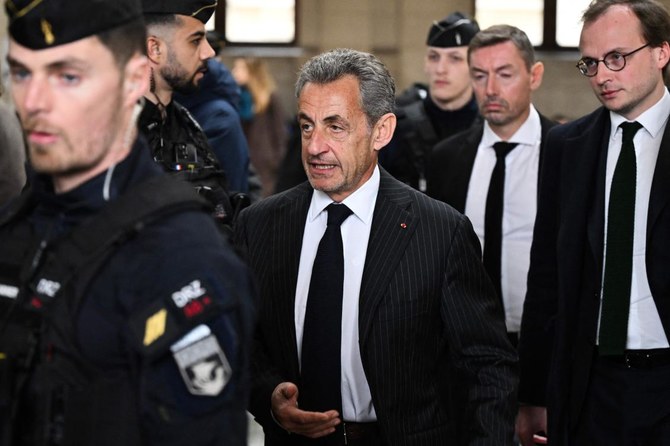
PARIS: Former French President Nicolas Sarkozy was found guilty on Wednesday by a Paris appeals court of illegal campaign financing over his failed 2012 re-election bid, confirming a previous ruling by a lower court.
He was sentenced to one-year year prison sentence, half of which suspended, that can be served through alternative means like wearing an electronic bracelet without going to jail.
Sarkozy had been handed a one-year prison sentence in 2021 when first found guilty, though that was suspended while he launched his appeal.
Sarkozy, who was president from 2007 to 2012, remained an influential figure among conservatives and is on friendly terms with President Emmanuel Macron — despite a string of trials and investigations linked to various legal issues surrounding his campaign finances.
He has always denied accusations that his party Les Republicains, then known as the UMP, worked with a public relations firm named Bygmalion to hide the true cost of his campaign — marked by lavish show events previously unseen in French politics.
During a hearing, Sarkozy put the blame on some members of his campaign team: “I didn’t choose any supplier, I didn’t sign any quotation, any invoice,” he told the court.
France sets strict limits on campaign spending. Prosecutors allege that the firm invoiced UMP rather than the campaign. They say Sarkozy spent 42.8 million euros on his 2012 campaign, almost double the permitted amount.

France’s Sarkozy found guilty of illegal campaign financing, appeals court confirms
Short Url
https://arab.news/66afr
France’s Sarkozy found guilty of illegal campaign financing, appeals court confirms
- He was sentenced to one-year year prison sentence, half of which suspended, that can be served through alternative means
- During a hearing, Sarkozy put the blame on some members of his campaign team
Germany to take in more than 500 stranded Afghans from Pakistan
BERLIN: The German government said Thursday it would take in 535 Afghans who had been promised refuge in Germany but have been stuck in limbo in Pakistan.
Interior Minister Alexander Dobrindt told the RND media network Berlin wanted to complete the processing of the cases “in December, as far as possible” to allow them to enter Germany.
The Afghans were accepted under a refugee scheme set up by the previous German government, but have been stuck in Pakistan since conservative Chancellor Friedrich Merz took office in May and froze the program.
Those on the scheme either worked with German armed forces in Afghanistan during the war against the Taliban, or were judged to be at particular risk from the Taliban after its return to power in 2021 — for example, rights activists and journalists, as well as their families.
Pakistan had set a deadline for the end of the year for the Afghans’ cases to be settled, after which they would be deported back to their homeland.
Dobrindt said that “we are in touch with the Pakistani authorities about this,” adding: “It could be that there are a few cases which we will have to work on in the new year.”
Last week, the interior ministry said it had informed 650 people on the program they would not be admitted, as the new government deemed it was no longer in Germany’s “interest.”
The government has offered those still in Pakistan money to give up their claim of settling in Germany, but as of mid-November, only 62 people had taken up the offer.
Earlier this month, more than 250 organizations in Germany, including Amnesty International, Save the Children and Human Rights Watch, said there were around 1,800 Afghans from the program in limbo in Pakistan, and urged the government to let them in.
Interior Minister Alexander Dobrindt told the RND media network Berlin wanted to complete the processing of the cases “in December, as far as possible” to allow them to enter Germany.
The Afghans were accepted under a refugee scheme set up by the previous German government, but have been stuck in Pakistan since conservative Chancellor Friedrich Merz took office in May and froze the program.
Those on the scheme either worked with German armed forces in Afghanistan during the war against the Taliban, or were judged to be at particular risk from the Taliban after its return to power in 2021 — for example, rights activists and journalists, as well as their families.
Pakistan had set a deadline for the end of the year for the Afghans’ cases to be settled, after which they would be deported back to their homeland.
Dobrindt said that “we are in touch with the Pakistani authorities about this,” adding: “It could be that there are a few cases which we will have to work on in the new year.”
Last week, the interior ministry said it had informed 650 people on the program they would not be admitted, as the new government deemed it was no longer in Germany’s “interest.”
The government has offered those still in Pakistan money to give up their claim of settling in Germany, but as of mid-November, only 62 people had taken up the offer.
Earlier this month, more than 250 organizations in Germany, including Amnesty International, Save the Children and Human Rights Watch, said there were around 1,800 Afghans from the program in limbo in Pakistan, and urged the government to let them in.
© 2025 SAUDI RESEARCH & PUBLISHING COMPANY, All Rights Reserved And subject to Terms of Use Agreement.


