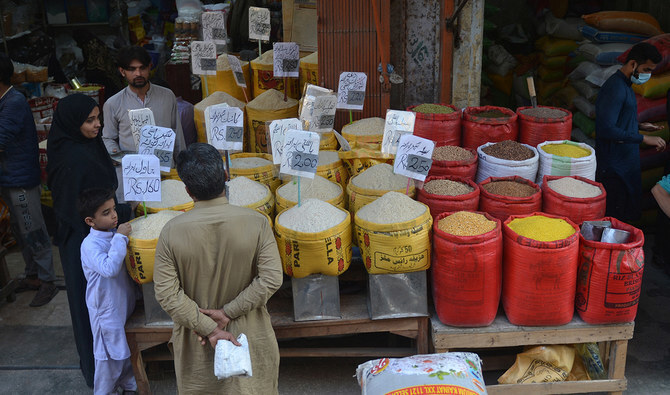
ISLAMABAD: Short-term inflation, measured by the Sensitive Price Index (SPI), has witnessed a slight decrease in Pakistan, the country’s statistics bureau said this week, after increasing for three weeks in a row.
The SPI, which comprises 51 essential items collected from 50 markets in 17 cities, is computed on a weekly basis to assess the price movement of essential commodities at a shorter interval of time to review the price situation in the country.
The SPI for the week ending on Jan. 2 decreased 0.26 percent on a week-on-week basis, according to the Pakistan Bureau of Statistics (PBS). Weekly inflation last decreased by 0.34 percent in Pakistan in the week ending on Dec. 5.
“During the week, out of 51 items, prices of 18 (35.29 percent) items increased, 10 (19.61 percent) items decreased and 23 (45.10 percent) items remained stable,” the PBS said in its report.
Major decrease was observed in the prices of tomatoes (13.48 percent), electricity charges for Q1 (7.48 percent), potatoes (5.59 percent), eggs (0.23 percent), garlic (0.21 percent), liquefied petroleum gas (0.18 percent) and wheat flour (0.09 percent).
The items whose prices increased during the week included chicken (10.28 percent), onions (4.93 percent), bananas (1.68 percent), diesel (1.18 percent), sugar (0.95 percent), jaggery (0.58 percent), vegetable ghee 2.5 Kg (0.53 percent) and petrol (0.21 percent).
Pakistan’s annual consumer inflation eased further to 4.1 percent in Dec. 2024, according to the PBS. Consumer inflation cooled from 4.9 percent in November, a sharp drop from a multi-decade high of nearly 40 percent in May 2023.

Pakistan weekly inflation records slight decrease after rising for three consecutive weeks
https://arab.news/gkg7j
Pakistan weekly inflation records slight decrease after rising for three consecutive weeks
- Major decrease observed in prices of tomatoes, electricity, potatoes, eggs, liquefied petroleum gas and wheat flour
- Pakistan’s annual consumer inflation eased further to 4.1 percent in Dec. 2024, according to the country’s statistics bureau
Imran Khan not a ‘national security threat,’ ex-PM’s party responds to Pakistan military
- Pakistan’s military spokesperson on Friday described Khan’s anti-army narrative as a “national security threat”
- PTI Chairman Gohar Ali Khan says words used by military spokesperson for Khan were “not appropriate”
ISLAMABAD: Former prime minister Imran Khan’s Pakistan Tehreek-e-Insaf (PTI) party on Saturday responded to allegations by Pakistan military spokesperson Lt. Gen. Ahmed Sharif Chaudhry from a day earlier, saying that he was not a “national security threat.”
Chaudhry, who heads the military’s media wing as director general of the Inter-Services Public Relations (ISPR), spoke to journalists on Friday, in which he referred to Khan as a “mentally ill” person several times during the press interaction. Chaudhry described Khan’s anti-army narrative as a “national security threat.”
The military spokesperson was responding to Khan’s social media post this week in which he accused Chief of Defense Forces Field Marshal Asim Munir of being responsible for “the complete collapse of the constitution and rule of law in Pakistan.”
“The people of Pakistan stand with Imran Khan, they stand with PTI,” the party’s secretary-general, Salman Akram Raja, told reporters during a news conference.
“Imran Khan is not a national security threat. Imran Khan has kept the people of this country united.”
Raja said there were several narratives in the country, including those that created tensions along ethnic and sectarian lines, but Khan had rejected all of them and stood with one that the people of Pakistan supported.
PTI Chairman Gohar Ali Khan, flanked by Raja, criticized the military spokesperson as well, saying his press talk on Thursday had “severely disappointed” him.
“The words that were used [by the military spokesperson] were not appropriate,” Gohar said. “Those words were wrong.”
‘NATURAL OUTCOME’
Speaking to reporters earlier on Saturday, Pakistan’s Defense Minister Khawaja Asif defended the military spokesperson’s remarks against Khan.
“When this kind of language is used for individuals as well as for institutions, then a reaction is a natural outcome,” he said.
“The same thing is happening on the Twitter accounts being run in his [Khan’s] name. If the DG ISPR has given any reaction to it, then I believe it was a very measured reaction.”
Khan, who was ousted after a parliamentary vote of confidence in April 2022, blames the country’s powerful military for removing him from power by colluding with his political opponents. Both deny the allegations.
The former prime minister, who has been in prison since August 2023 on a slew of charges he says are politically motivated, also alleges his party was denied victory by the army and his political rivals in the 2024 general election through rigging.
The army and the government both deny his allegations.


