



RIYADH: The Imam Turki bin Abdullah Royal Reserve in northern Saudi Arabia was established in 2018 to help preserve a thriving natural environment and to promote a sustainable local economy, free from overgrazing and unregulated hunting.
Committed to enhancing the quality of life for the local community, the Imam Turki bin Abdullah Royal Reserve Development Authority works to protect biodiversity while engaging residents as stakeholders in advancing its environmental and development goals.
Headquartered in the Saudi capital, Riyadh, the authority invites residents to take part in educational programs, workshops, and collaborations to actively protect the environment and promote sustainable livelihoods.

This collaboration includes specialized training courses held in partnership with educational and development institutions, including the University of Hail, Northern Border University, and the Human Resources Development Fund.
These courses are designed to equip the community with the skills needed to support the reserve’s environmental and development goals, including the effort to increase vegetation through tree planting and the prevention of logging.
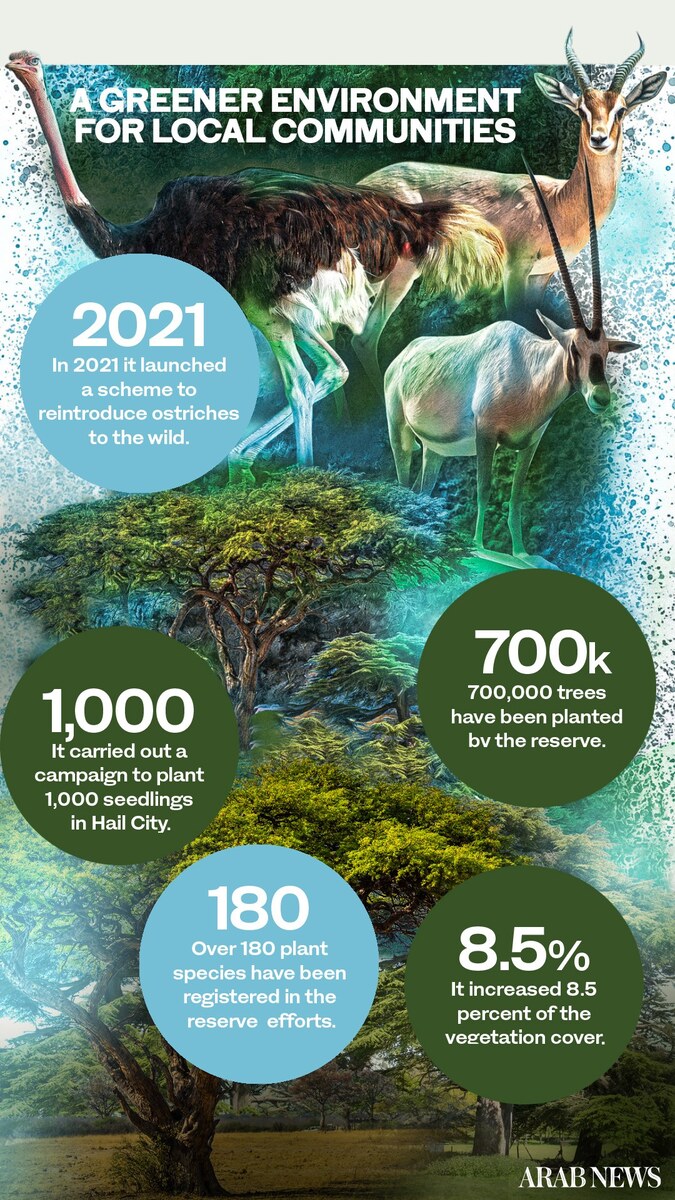
“Seven hundred thousand trees have been planted” since the reserve was established, Mohammed Al-Shaalan, the authority’s CEO, told Arab News on the sidelines of the UN conference on biodiversity, COP16, in Riyadh last month.
“Because of the plantation and the protection, the normalized difference vegetation index has increased from 2 percent to 8 percent over the past four years, which tells us that if we give a little bit of breath for the environment, it could restore itself very fast.”
Opinion
This section contains relevant reference points, placed in (Opinion field)
The index is a measure for assessing vegetation health and density using sensor data, helping track changes in plant health.
The reserve’s efforts align with the Kingdom’s goal of planting 10 billion trees by 2100 as part of the Saudi Green Initiative, which aims to rehabilitate more than 74 million hectares of land.
To date, more than 70 million trees have been planted nationwide.

The 91,500-square kilometer Imam Turki bin Abdullah Royal Reserve spreads across Hail, Qassim, Al-Jouf, the Northern Borders, and the Eastern Province. (SPA)
In addition to its commitment to enhancing biodiversity, the reserve provides valuable resources for the local community. It grants controlled access to local herders, allowing their animals to graze and maintain a healthy biocycle for plants.
The reserve issues special permits for grazing in designated areas, allowing livestock owners to sustainably utilize the vegetation. This organized grazing process helps mitigate risks associated with excessive growth, including the potential for wildfires.
Among the local herders who frequently visits the reserve to graze his cattle is Farhan Al-Rughailan. He believes allowing livestock to graze helps maintain plant health, prevents diseases, and ensures sustainable use of the reserve’s resources.

The Imam Turki bin Abdullah Royal Reserve is home to various wildlife, including the Arabian oryx, sand gazelles, and Arabian ostriches. (SPA)
hen plants are growing, they must be cut regularly, otherwise they become poisonous if they stay for too long without animals grazing on them,” he told Arab News.
Like other herders, Al-Rughailan is only permitted to visit the reserve during specific times specified on his permit. The policy has helped reduce the economic cost of feeding livestock.
“As a royal reserve, one of our mandates is the local community, and we have to take care of it,” said authority CEO Al-Shaalan.
“Today, we have more than 150 livestock, between camels and sheep, and livestock breeders in the local community are used to paying SAR 100 million ($26.6 million) to SAR 120 million to buy food for livestock. So, instead of buying hay and livestock feed, we allow them to graze.”
In addition to sustainable grazing, the authority has introduced sustainable hunting in a designated area located in the northern part of the reserve, which is also intended to support the local community without harming the ecosystem.
Although the sustainable hunting area makes up just 2.18 percent of the reserve’s total area, it provides a valuable boost to the local economy. Prey is raised in a controlled environment to ensure the sustainability of targeted species while preserving the reserve’s ecosystem.
DID YOUKNOW?
• The Imam Turki Royal Reserve employs 180 rangers to monitor and address issues related to wildlife and plants.
• According to its CEO, nearly 90 percent of the reserve is now protected.
• The Royal Reserve’s Development Authority uses drone technology to monitor and protect the environment.
• The reserve offers volunteer opportunities, fostering cooperation and environmental responsibility within the community.
Hunting is a popular activity for both locals and tourists in Saudi Arabia, but it has historically had a negative impact on native wildlife. Overhunting in the past has led to the decline of species such as the Arabian leopard, ibex, and oryx.
Today, the Kingdom’s Environmental Law and executive regulations prohibit the trade, killing, or hunting of endangered wildlife species, along with their derivatives and products. Violators can face fines of up to SAR 30 million, 10 years in prison, or both.

The Imam Turki bin Abdullah Royal Reserve is home to various wildlife, including the Arabian oryx, sand gazelles, and Arabian ostriches. (SPA)
“Instead of people going and hunting in the wilderness, we provide a sustainable production of wildlife that we can release for hunting,” said Al-Shaalan.
This model was adopted by the UN in 1992, with the biodiversity agreement recognizing sustainable hunting as a conservation tool, affirming that wildlife can be preserved by allowing controlled hunting.
“There are always people who want to hunt,” he said. “But if you give them a legitimate way to hunt, it will reduce the pressure on wildlife.”


