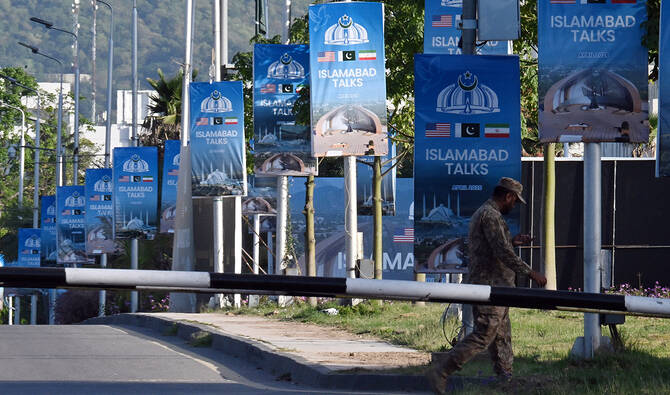

ISLAMABAD: Pakistan’s Interior Minister Mohsin Naqvi said on Thursday he expected “positive progress” from Iran in talks with the United States, even as Tehran has ruled out negotiating with Washington in Islamabad while a US naval blockade of its ports continues.
Naqvi made the remarks during a meeting with US Chargé d’Affaires Natalie Baker as the two officials discussed the regional situation and ongoing diplomatic efforts to hold a second round of negotiations between Washington and Tehran.
The talks come after weeks of war that began with joint US-Israeli strikes on Tehran and has since disrupted global energy markets and maritime trade, with Iran targeting shipping in the Strait of Hormuz, a key route for roughly one-fifth of global oil and gas supplies, and the United States enforcing a counter-blockade.
Pakistan has sought to position itself as a mediator, helping bring both sides to the table in Islamabad on Apr. 11 under a two-week ceasefire, though the interaction did not yield an agreement. A second round was expected this week after Washington extended the truce, but Iran has not confirmed participation, saying it will not negotiate under pressure.
“The extension of the ceasefire by President Donald Trump is welcome,” Naqvi told Baker, according to a statement issued by his ministry. “This is an important step toward de-escalation. We also expect positive progress from Iran.”
He added that Prime Minister Shehbaz Sharif and Chief of Army Staff Field Marshal Asim Munir were making “full efforts at all levels” to help resolve the crisis, expressing hope that all parties would give diplomacy and a peaceful solution a chance.
Naqvi also stressed the need for continued engagement through diplomatic channels to reach a lasting resolution to the war.
Baker appreciated Pakistan’s “constructive role” in promoting peace and resolving the conflict in the region, the statement said.
A day earlier, Iran’s foreign ministry also expressed gratitude for Pakistan’s mediation efforts while reaffirming its readiness to defend itself against any threat.
“Diplomacy is a tool to secure national interests and security,” foreign ministry spokesperson Esmail Baghaei said, adding that Iran would engage when it deemed the necessary conditions were in place to protect its interests.
Baghaei said Iran was closely monitoring developments and would take “necessary and appropriate measures” to safeguard its security, emphasizing that its actions were in line with its right to self-defense.
Despite signals of backchannel contacts, officials in Tehran have not issued a formal statement endorsing the extension of the truce.
Iran’s parliament speaker and chief negotiator Mohammad Bagher Ghalibaf said a full ceasefire would only make sense if the US naval blockade was lifted.
“You did not achieve your goals through military aggression and you will not achieve them by bullying either,” he said on the social media in response to Trump’s announcement. “The only way is recognizing the Iranian people’s rights.”