

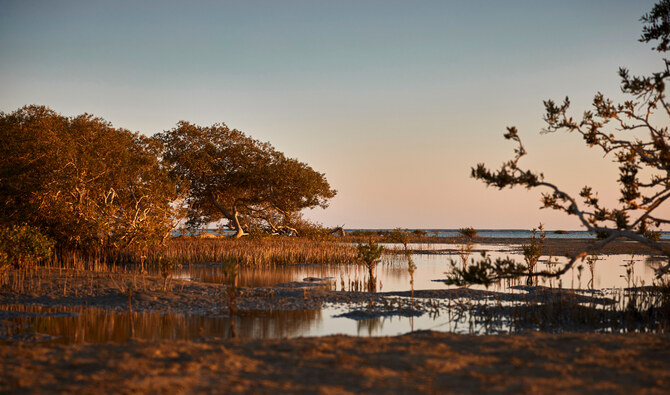
Why restoring ecosystem balance is crucial for economies, societies, and wildlife

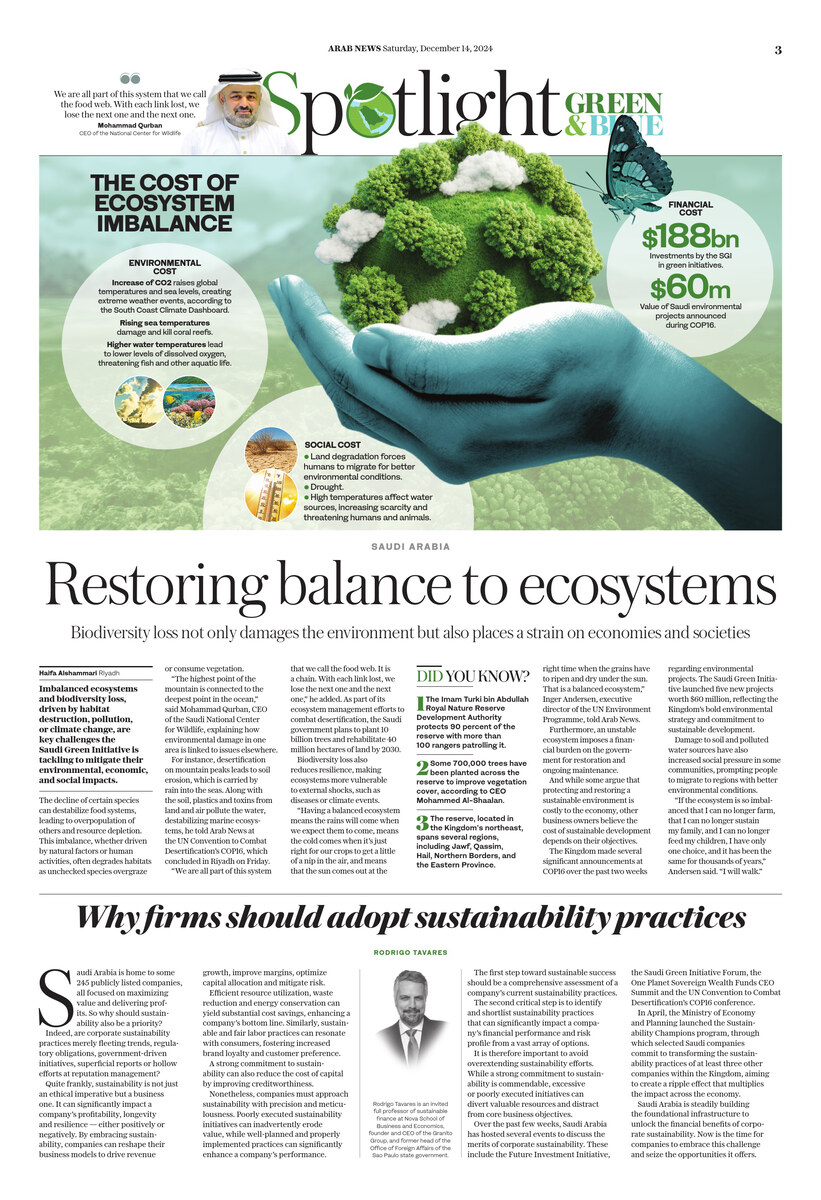
Imbalanced ecosystems and biodiversity loss, driven by habitat destruction, pollution, or climate change, are key challenges the Saudi Green Initiative is tackling to mitigate their environmental, economic, and social impacts. (SGI)
Short Url
Updated 14 December 2024
Follow

Why restoring ecosystem balance is crucial for economies, societies, and wildlife

  • Biodiversity loss weakens ecosystems, driving migration and potential conflict, says UN Environment Programme director
  • Saudi Green Initiative announces $60 million in environmental projects as 12-day COP16 conference concludes in Riyadh

RIYADH: Imbalanced ecosystems and biodiversity loss, driven by habitat destruction, pollution, or climate change, are key challenges the Saudi Green Initiative is tackling to mitigate their environmental, economic, and social impacts.

The decline of certain species can destabilize food systems, leading to overpopulation of others and resource depletion. This imbalance, whether driven by natural factors or human activities, often degrades habitats as unchecked species overgraze or consume vegetation.

“The highest point of the mountain is connected to the deepest point in the ocean,” said Mohammad Qurban, CEO of the Saudi National Center for Wildlife, explaining how environmental damage in one area is linked to issues elsewhere.

For instance, desertification in mountain peaks leads to soil erosion, which is carried by rain into the seas. Along with the soil, plastics and toxins from land and air pollute the water, destabilizing marine ecosystems, he told Arab News at the UN Convention to Combat Desertification’s COP16, which concluded in Riyadh on Friday.

“Where does this go? It goes to the ecosystem,” Qurban said, referring to the movement of toxins from land to the sea. “So, we start losing coral reefs, seagrass, and we start losing fish.

“We are all part of this system that we call the food web. It is a chain. With each link lost, we lose the next one and the next one.”
As part of its ecosystem management efforts to combat desertification, the Saudi government plans to plant 10 billion trees and rehabilitate 40 million hectares of land by 2030.

The Kingdom also aims to protect 30 percent of its land and marine areas by 2030 through the 30x30 initiative, which Qurban discussed last week during the session “MEAs Synergies for Strengthened Environmental Governance: Insights from the Bern III Conference,” held on the sidelines of COP16.

Qurban said disturbances in one animal population can have consequences elsewhere, such as the overpopulation of another species. In his recent interview with Arab News, he recounted an incident in which a farmer once reached out to the NCW, concerned about snakes on his land and requested their removal.

The center explained that while they could address the situation, it was important to consider the ecological balance. Snakes play a key role in maintaining this balance by controlling rodent populations and removing them could disrupt the natural harmony of the habitat.
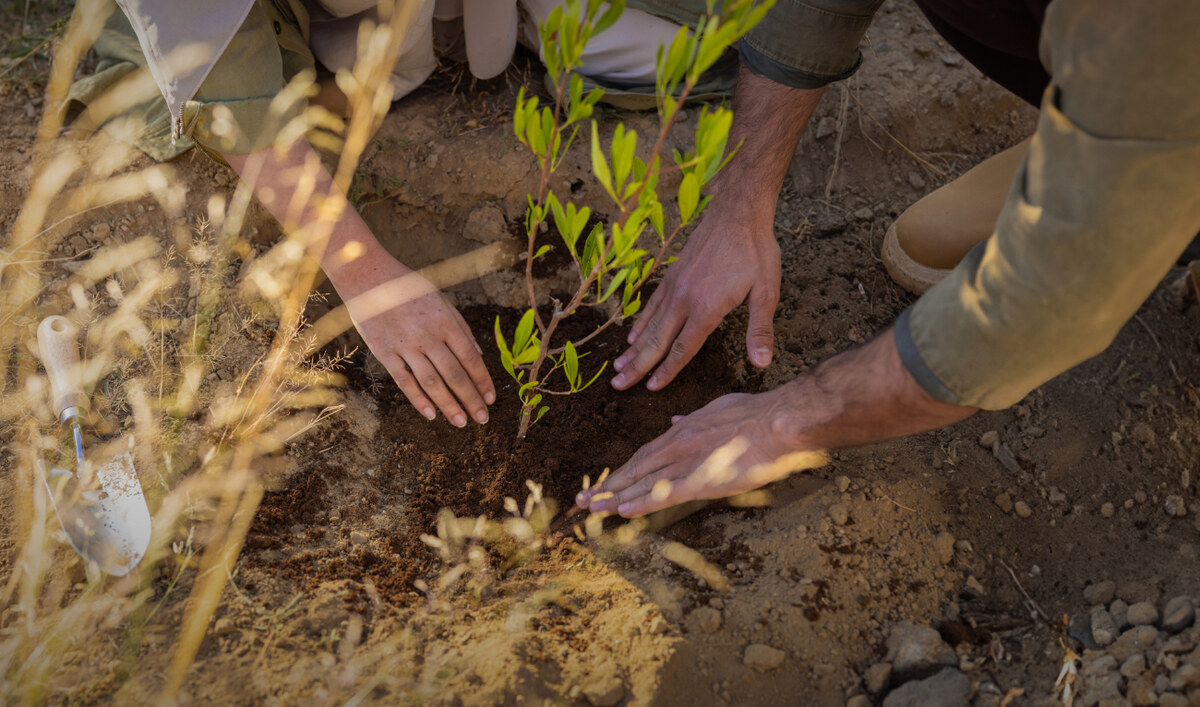


As part of its ecosystem management efforts to combat desertification, the Saudi government plans to plant 10 billion trees and rehabilitate 40 million hectares of land by 2030. (SGI)

The UN has said that a million animal and plant species worldwide are at risk of extinction as a result of human-induced environmental issues.

Biodiversity loss also reduces resilience, making ecosystems more vulnerable to external shocks, such as diseases or climate events.

“Having a balanced ecosystem means the rains will come when we expect them to come, means the cold comes when it’s just right for our crops to get a little of a nip in the air, and means that the sun comes out at the right time when the grains have to ripen and dry under the sun. That is a balanced ecosystem,” Inger Andersen, executive director of the UN Environment Programme, told Arab News.

Opinion

This section contains relevant reference points, placed in (Opinion field)

Restoring balance is essential for maintaining healthy ecosystems, which sustain life on Earth, including human communities that depend on these natural systems for resources and services.

“Some people who are living in the cities may not think that they are relying on the ecosystem because they get their food from the grocery store,” Andersen said. “But the reality, of course, is that there is an ecosystem somewhere in the world that provides that food that they purchased. So, we are all relying on that ecosystem.”

DID YOU KNOW?

  • The Imam Turki bin Abdullah Royal Nature Reserve Development Authority protects 90 percent of the reserve with more than 100 rangers patrolling it.
  • About 700,000 trees have been planted in the reserve to improve vegetation cover, according to CEO Mohammed Al-Shaalan.
  • The reserve, which is in the Kingdom’s northeast, spans several regions, including Jawf, Qassim, Hail, Northern Borders, and the Eastern Province.

Furthermore, an unstable ecosystem imposes a financial burden on the government for restoration and ongoing maintenance.

In Asir, in the Kingdom’s southwest, the decline in Arabian leopard populations led to a significant increase in the baboon population. Large troops of baboons, typically found in the southern mountain ranges, have negatively affected local communities. As a result, despite the region’s stunning landscapet, tourism in the area has declined in recent years.

“People lost tourists in Asir because of the baboons,” said Qurban, citing safety concerns. “Some people abandoned their farms; they abandoned their farms completely in Asir and Al-Baha.”

And while some argue that protecting and restoring a sustainable environment is costly to the economy, other business owners believe the cost of sustainable development depends on their objectives.



In Asir, in the Kingdom’s southwest, the decline in Arabian leopard populations led to a significant increase in the baboon population. (SPA)

During a panel discussion at COP16, Prince Khaled bin Alwaleed, CEO of the asset management company KBW Ventures, discussed the economics of ecosystems and the real financial costs of implementing green development.

He said that solutions vary by location and must align with the private sector’s objectives to effectively implement sustainable development goals.

“It is not a one size fits all,” he said. “It is a bouquet of opportunities that you have to be customized for it to be actually scalable and profitable for the private sectors and industries in these private sectors to actually flourish.”
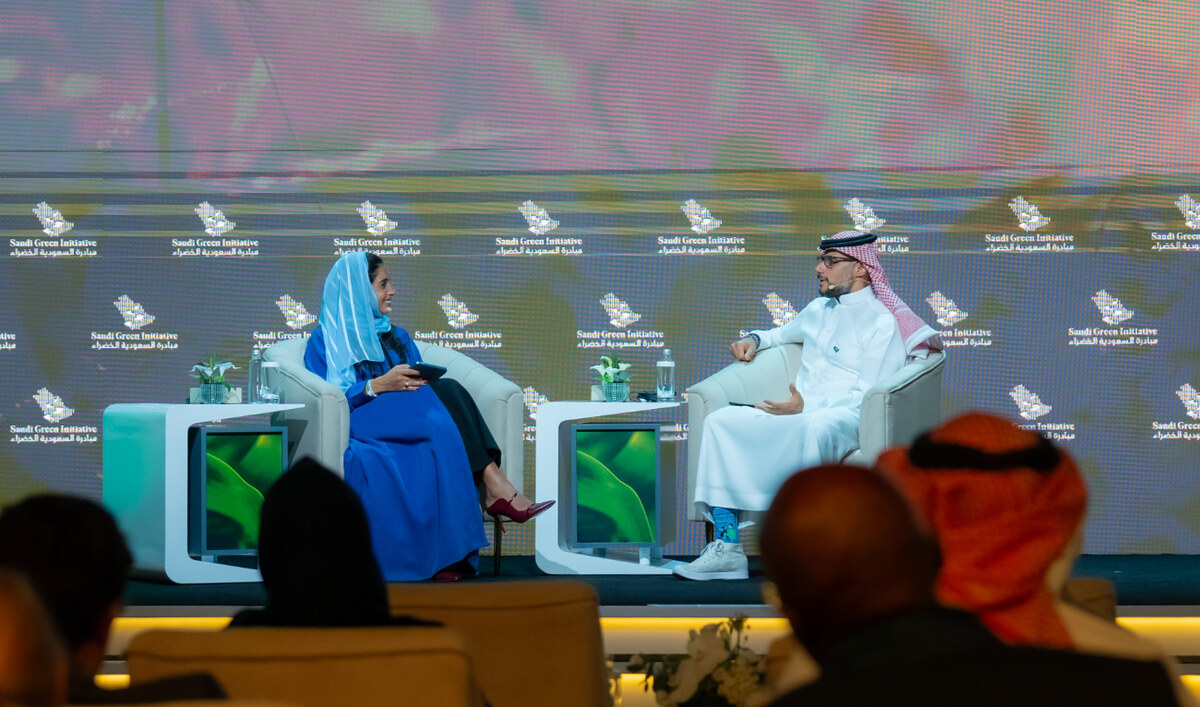


During a panel discussion at COP16, Prince Khaled bin Alwaleed, CEO of the asset management company KBW Ventures, discussed the economics of ecosystems and the real financial costs of implementing green development. (AN Photo by Huda Bashatah)

Although securing a balanced ecosystem may be costly, the Kingdom made several significant announcements at COP16 over the past two weeks regarding environmental projects.

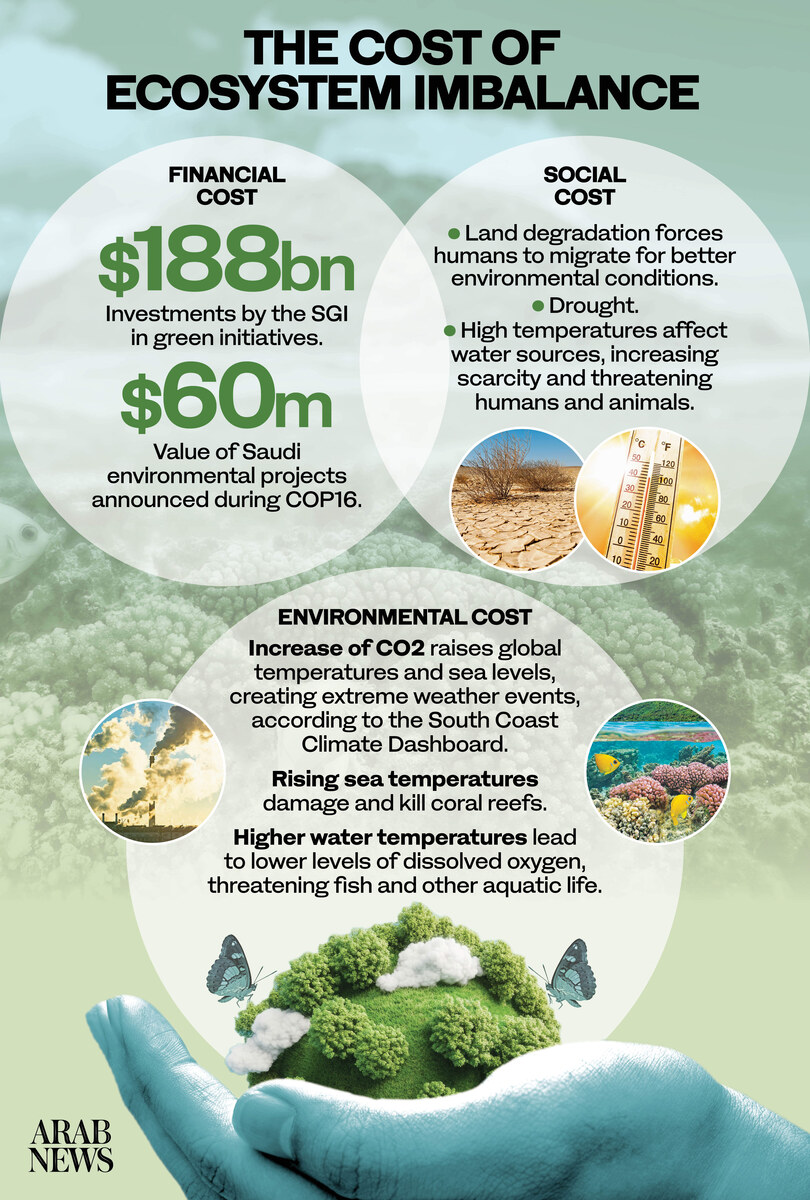
The Saudi Green Initiative launched five new projects worth $60 million, reflecting the Kingdom’s bold environmental strategy and commitment to sustainable development. This brings the total investment in SGI projects to more than $188 billion.

But Saudi Arabia is not alone in its commitment to green development; many countries share this goal. However, some urban activities can inadvertently harm the environment despite efforts to protect it.

Damage to soil and polluted water sources have also increased social pressure in some communities, prompting people to migrate to regions with better environmental conditions for their families and future.

“If the ecosystem is so imbalanced that I can no longer farm, that I can no longer sustain my family, and I can no longer feed my children, I have only one choice, and it has been the same for thousands of years,” Andersen said. “I will walk.” 


How AI is powering Saudi Arabia’s video games industry

Updated 13 March 2026
Follow

How AI is powering Saudi Arabia’s video games industry

  • Technology is boosting efficiency and supporting local content development

RIYADH: Artificial intelligence is becoming a central force in Saudi Arabia’s rapidly expanding gaming and esports sector, shaping everything from game development and publishing to player analytics and competitive tournaments.

As the Kingdom accelerates its ambitions under Vision 2030, AI is increasingly being deployed not only as a technical tool but also as a strategic driver for industry growth and global competitiveness.

Saudi Arabia is integrating AI across studios, publishing platforms and esports operations to improve efficiency, expand local content creation, attract international investment and streamline tournament management. The broader goal is to position the Kingdom not only as one of the world’s largest gaming markets but also as a global hub for game development and esports infrastructure.

For Saudi studios seeking international audiences, understanding how AI systems generate results is also critical to maintaining cultural accuracy and relevance in game content. (Unsplash.com photo)

According to Saudi Arabia’s National Gaming and Esports Strategy, the Kingdom is home to more than 23.5 million gamers — around 67 percent of the population. Market revenues are projected to reach $1.36 billion by 2026. By 2030, the sector aims to contribute more than SR50 billion to the national GDP and create about 39,000 jobs.

Women represent 42 percent of gamers and 18 percent of esports players, among the highest participation rates in the region.

The Public Investment Fund, through its gaming arm Savvy Games Group, has invested billions of dollars in game studios, publishers and esports platforms worldwide. The investments are designed to strengthen local content creation while attracting global developers and investors to Saudi Arabia.

INNUMBERS

23.5 million Number of gamers in Saudi Arabia, representing about 67% of the population

$1.36 billion Revenue the Kingdom’s gaming market is expected to reach by 2026

SR50 billion Amount the gaming and esports sector aims to add to GDP to create 39,000 jobs by 2030

A spokesperson for Savvy Games Group told Arab News that AI is already integrated across its portfolio, particularly within ESL FACEIT Group.

“AI is used across our businesses. At ESL FACEIT Group, AI is already embedded in operations, particularly around data analytics and fair play,” the spokesperson told Arab News. “For example, EFG uses Minerva, an AI-powered moderation system that identifies and reduces toxic or abusive behavior by analyzing player communications and behavior patterns at scale. This enables faster and more consistent decisions and helps create healthier competitive environments for players.”

However, the spokesperson said AI itself does not automatically create a competitive advantage.

“AI tools are increasingly accessible to studios everywhere, which means they are not a competitive advantage on their own,” the spokesperson told Arab News. “The advantage comes from how clearly studios define their use cases and how effectively they apply AI to support their goals.”

For Saudi studios seeking international audiences, understanding how AI systems generate results is also critical to maintaining cultural accuracy and relevance in game content.

Within development studios, AI is helping accelerate production while lowering costs. AI-powered tools assist with concept art, 3D modeling, animation and world design, while automated testing systems can simulate thousands of gameplay scenarios to identify bugs and balance issues before release.

Steer Studios, for example, is applying AI in asset production and testing workflows. Automating repetitive tasks allows creative teams to devote more time to storytelling, gameplay design and world-building — key elements that distinguish successful games.

AI is also playing an important role in localizing content for Arabic-speaking audiences. Studios including Fahy Studios, Starvania Studio and Lobah Game Studio use AI for dialogue generation, translation and other localization tasks, helping Saudi-developed games reach global markets more quickly without losing cultural context.

For live-service and mobile games, maintaining player engagement is crucial to long-term revenue. AI systems track player behavior in real time, adjust difficulty levels, refine matchmaking systems and personalize in-game experiences.

Publishing platforms such as Nine66 and Sandsoft also rely on AI-driven analytics to support developers. These tools help predict player lifetime value, optimize marketing campaigns and manage online gaming communities.

“Our approach aligns closely with KSA’s focus on digital transformation, innovation and long-term capability building under Vision 2030,” the Savvy Games Group spokesperson told Arab News. “We see AI as an enabler of productivity, operational efficiency and ecosystem sustainability.”

The spokesperson added that partnerships, including collaboration with Humain, allow Saudi companies to explore scalable and responsible applications of AI across studios.

Opinion

This section contains relevant reference points, placed in (Opinion field)

“We take a pragmatic approach,” the spokesperson told Arab News. “We focus on technologies that provide real benefits. Any AI solution we use must improve efficiency and make day-to-day work easier.”

Artificial intelligence is also transforming the esports ecosystem.

Esports Infra — a platform created by Singapore-based Samarium in partnership with Saudi AI firm Wakeb — is designed to streamline the management of players, teams and content creators.

“Esports suffers from fragmentation,” Jonas Moaz, Esports Infra founder, told Arab News. “Talented players often don’t have a clear path to professionalism. Organizations struggle to find players, and content creators lack tools to connect with audiences.”

The platform uses machine learning to classify player skill levels, computer vision to analyze gameplay and predictive analytics to forecast development potential.

“We expect to improve the efficiency of building esports organizations — particularly in talent discovery and time management — by up to 50 percent,” Moaz told Arab News.

In addition to player analytics, the platform assists with scheduling, contract management and sponsorship evaluation, giving teams and brands clearer insights into performance and commercial value.

Saudi Arabia’s gaming sector is steadily evolving from a consumer-driven market into a center for game creation and esports infrastructure. (Unsplash.com photo)

Despite AI’s growing role, its use in esports competition itself remains tightly regulated. Organizations such as the International Esports Federation prohibit AI from influencing live matches.

“We fully respect those regulations,” Moaz told Arab News. “Our tools support analysis but do not play on behalf of players. AI operates outside match time or as a statistical layer.”

Protecting player data and ensuring fairness remain key priorities for developers and platform providers.

“This is a top priority for us,” Moaz told Arab News. “Player data is encrypted and used only to improve the experience. To ensure fairness, we regularly audit our algorithms to prevent bias.”

Saudi Arabia’s gaming sector is steadily evolving from a consumer-driven market into a center for game creation and esports infrastructure. AI is embedded throughout this transformation — from accelerating game development and localization to analyzing player behavior and professionalizing competitive gaming.

If the targets outlined in Vision 2030 are achieved, AI will play a defining role not only in improving industry operations but also in helping Saudi Arabia compete globally in a sector increasingly driven by data, efficiency and advanced technology.