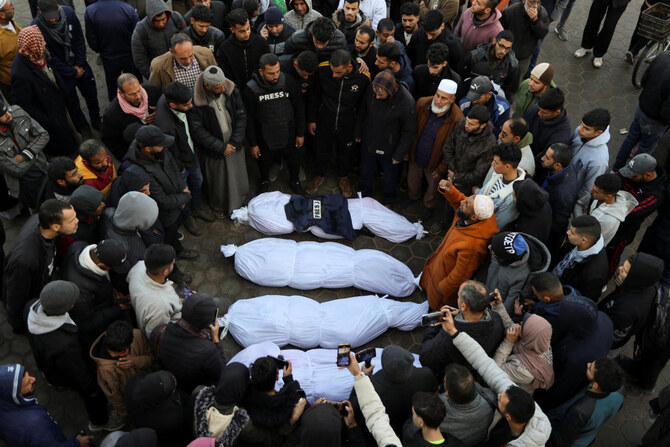
DEIR AL-BALAH, Gaza Strip: Israeli strikes killed at least 42 people in Gaza, including children, overnight and into Friday, hospital and emergency response workers said, as health workers and Israel’s military traded claims over reported evacuation orders for two hospitals in the territory’s largely isolated north.
The assertions over Al-Awda and Indonesian hospitals occurred as stalled ceasefire talks to end nearly 15 months of war were set to resume in Qatar.
Staff at the Al-Aqsa Martyrs Hospital said that more than a dozen women and children were killed in strikes in central Gaza, including in Nuseirat, Zawaida, Maghazi and Deir Al-Balah. Dozens of people were killed across the enclave the previous day.
“We woke up to the missile strike. We found the whole house disintegrated,” Abdul Rahman Al-Nabrisi said in the Maghazi refugee camp.

An Israeli strike hits Deir Al-Balah in the central Gaza Strip on Friday. (Reuters)
Later Friday, officials at Al-Aqsa Martyrs Hospital said that an airstrike killed three people in a car in Zawaida in central Gaza. And the Civil Defense, first responders affiliated with the Hamas-run government, said that an airstrike killed seven people, including four children and a woman, in the Shijaiyah neighborhood outside Gaza City, and another strike killed two people at Al-Samer junction in Gaza City.
The Israeli army said in a statement that during the past day it had struck dozens of Hamas gathering points and command centers throughout Gaza. And it warned people to leave an area of central Gaza, saying that it would attack following launches toward Israel. The military said that a few projectiles entered from central and northern Gaza, with no injuries reported.
Freelance journalist Omar Al-Derawi was among those killed Friday. A press vest was placed on his shroud. The Committee to Protect Journalists said last month that more than 130 Palestinian reporters have been killed in the war.
Israelis also woke up to attacks. Israel said that missiles were fired from Yemen, setting off air raid sirens in Jerusalem and central Israel and sending people scrambling to shelters. There were no immediate reports of injuries or damage. The Iran-backed Houthi rebels in Yemen often claim responsibility.
Opinion
This section contains relevant reference points, placed in (Opinion field)
While the UN Security Council met Friday to discuss the war’s effects on hospitals in Gaza, a hospital in the north, Al-Awda, said in a statement that Israel’s military had told staff and patients to immediately evacuate. It didn’t give details.
And a nurse at the Indonesian Hospital in northern Gaza told The Associated Press they had received orders to evacuate. Speaking on condition of anonymity because they weren’t authorized to speak publicly, the nurse said that they were still there with 19 people, including eight patients, and staffers had asked for ambulances.
Israel’s military said that it wasn’t “operating to evacuate” Al-Awda or Indonesian hospitals.
“Messages were sent to reiterate to officials in the health authorities that there is no need to evacuate the hospital,” it said of Indonesian.
Neither side’s statements could be immediately verified. The Israeli military heavily restricts the movements of Palestinians in Gaza and has barred foreign journalists from entering the territory throughout the war, making it difficult to verify information.
The war’s effect on hospitals has been a contentious issue as the health system has been largely devastated. Israel has repeatedly accused Hamas of operating out of hospitals and said that the military tries to protect the facilities. The military has carried out raids on several hospitals, including Al-Awda and Indonesian, during the war.
UN human rights chief Volker Türk told the Security Council on Friday that a recent report by his office documented “at least 136 strikes on at least 27 hospitals and 12 other medical facilities in Gaza, which caused significant death and injury among doctors, nurses, medical staff and other civilians and damaged or destroyed many of the buildings targeted.” He said both sides must protect the facilities.
Indirect ceasefire negotiations were expected to resume Friday.
Israeli Prime Minister Benjamin Netanyahu’s office has said that he authorized a delegation from the Mossad intelligence agency, the Shin Bet internal security agency and the military to continue negotiations in Qatar.
The US-led talks have repeatedly stalled. Netanyahu has vowed to press ahead in Gaza until Hamas is destroyed. But the militants, while greatly weakened, have repeatedly regrouped, often after Israeli forces withdraw from areas.
The war was sparked by Hamas-led militants’ attack into Israel on Oct. 7, 2023. They killed around 1,200 people, mostly civilians, and abducted around 250. Around 100 hostages are still inside Gaza, at least a third believed to be dead.
Israel’s offensive in retaliation has killed more than 45,500 Palestinians in Gaza, according to the territory’s Health Ministry, which says women and children make up more than half the dead. The ministry doesn’t distinguish between civilians and combatants in its tally.
Israel’s military says it only targets militants and blames Hamas for civilian deaths because its fighters operate in dense residential areas. The army says it has killed 17,000 militants, without providing evidence.
The war has caused widespread destruction and displaced about 90 percent of Gaza’s population of 2.3 million, many of them multiple times. Winter has now arrived, and hundreds of thousands are sheltering in tents near the sea.