

Investigators seek clues to New Orleans attacker’s path to radicalization

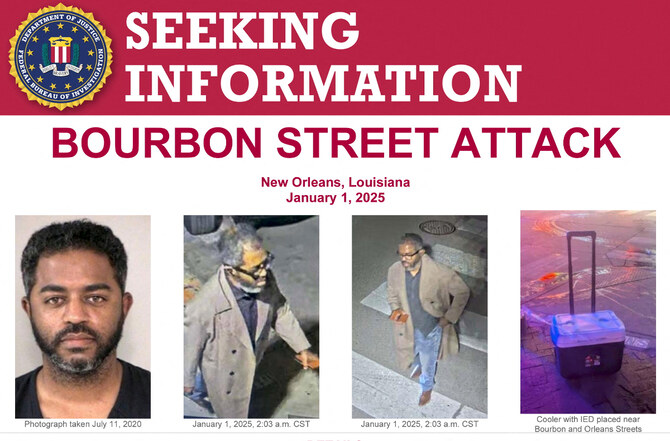
This FBI wanted poster shows Shamsud-Din Jabbar's July 11, 2020 photograph alongside video surveillance still images of him walking along a street, before he drove a truck into a crowd in New Orleans, Louisiana, on January 1, 2025. Also seen is a photo of one of the coolers containing an improvised explosive device placed by Jabbar near the intersection of Bourbon and Orleans Street. (REUTERS)
Short Url
Updated 03 January 2025
Follow

Investigators seek clues to New Orleans attacker’s path to radicalization

  • Jabbar’s profile atypical for Daesh recruits, says former FBI agent
  • Jabbar is a former US veteran who worked for a major corporation
  • Daesh uses online platforms for recruitment, experts say

WASHINGTON: As investigators learn more about the man who pledged allegiance to the Daesh group, or ISIS, and killed 14 people with a truck on New Year’s Day in New Orleans, a key question remains: How did a veteran and one-time employee of a major corporation become radicalized?
FBI Deputy Assistant Director Christopher Raia said on Thursday that videos made by Shamsud-Din Jabbar just before the attack showed the 42-year-old Texas native supported Daesh, claimed to have joined the militant group before last summer and believed in a “war between the believers and nonbelievers.”
While the FBI was looking into his “path to radicalization,” evidence collected since the attack showed that Jabbar was “100 percent inspired by ISIS,” said Raia.
Jabbar, who authorities said acted alone, was killed in a shootout with police.
His half-brother, Abdur Jabbar, said in an interview that Jabbar, who had worked for audit firm Deloitte, abandoned Islam in his 20s or 30s, but had recently renewed his faith.


Abdur Jabbar told Reuters in Beaumont, Texas, where Jabbar was born and raised, that he had no idea when his half-brother became radicalized.
Ali Soufan, a former FBI agent who investigated terrorism cases and is on an advisory council to Homeland Security Secretary Alejandro Mayorkas, said Jabbar did not fit the typical profile of those radicalized by Daesh.
Jabbar served for 10 years in the US Army and was in his 40s, Soufan noted, explaining that people who fall prey to Daesh recruitment are typically much younger.
“This is a guy who … went from being a patriot to being an Daesh terrorist,” said Soufan.
Attackers responsible for a range of deadly strikes have claimed a link to Daesh and other jihadist groups.
They included the lone survivor of the Islamist squad that killed 130 people across Paris in 2015, the man who killed 49 people at a gay nightclub in Florida in 2016, and the man who drove a truck into a crowded bike path in 2017 in New York City, killing eight people.
Some attacks, like those in 2015 in Paris, were carried out by trained Daesh operatives. But investigators found no evidence of a direct role for the terrorist group in others.


Online recruitment

It is still unclear what contact Jabbar might have had with overseas extremist groups.
US officials and other experts say Daesh conducts most of its recruiting in online chatrooms and over encrypted communications apps since losing the “caliphate” it overran in 2014 in Iraq and Syria to a US-led military coalition. Even as the coalition continues hitting the group’s remaining holdouts, Daesh has stepped up operations in Syria while its Afghanistan- and Africa-based affiliates have kept recruiting, expanding their networks and inspiring attacks.
US officials say Daesh has used the deaths of tens of thousands of Palestinians in Israel’s war in Gaza to boost its recruitment.
Nate Snyder, a former US Department of Homeland Security (DHS) counterterrorism official, said both international and US-based extremist groups follow a similar playbook to draw in new recruits.
The groups use social media to push their message and then move discussions to encrypted app such as Telegram, which could evolve into one-on-one conversations, Snyder said.
“Then people feel like they’re part of a community,” said Snyder, who left DHS in December and joined the race to chair the Democratic National Committee.
Recruits could either receive direct orders or self-radicalize to take action, Snyder said.
Individuals susceptible to recruitment “might have lost their jobs, might have had a mental health crisis, might have just concluded that however hard they’ve tried, they never belong,” said Edmund Fitton-Brown, a former British diplomat who led a UN team that monitors Daesh and Al-Qaeda.
The main appeal of Daesh is its determination to establish a Sunni Muslim “caliphate” ruled by Islamic law, unlike the Taliban, which “has sold out to Afghan nationalism,” or Al-Qaeda, members of which have cooperated with Iran’s Shiite Muslim-run government, he said.
“People that are carrying out those attacks may never in their lives have actually met somebody who is a member of Daesh,” said Fitton-Brown, a senior adviser to the Counter-Extremism Project, a policy and research organization. “But that doesn’t mean they can’t carry out an Daesh-inspired attack.” Crashing cars into crowds or staging stabbing rampages “are unsophisticated, very low-budget attacks (that) are almost impossible to defend against,” he continued. “If you are determined enough to kill unsuspecting public, you are going to be able to do it.”


Pakistan killed over 80 militants in strikes on TTP camps in Afghanistan — official

Updated 5 sec ago
Follow

Pakistan killed over 80 militants in strikes on TTP camps in Afghanistan — official

  • Saturday’s airstrikes followed a series of attacks inside Pakistan amid a surge in militancy
  • The Afghan Taliban authorities accuse Pakistani forces of killing civilians in the airstrikes

ISLAMABAD: Pakistan’s airstrikes in Afghanistan destroyed seven Tehreek-e-Taliban Pakistan (TTP) camps and killed over 80 militants, a Pakistani security official said on Sunday, with the Afghan Taliban accusing Pakistani forces of killing civilians in the assault.

Saturday’s airstrikes followed a series of attacks inside Pakistan amid a surge in militancy. Authorities say the attacks, particularly in Khyber Pakhtunkhwa province and the Pakistani capital of Islamabad, were carried out by the TTP and allied groups that Islamabad alleges are operating from sanctuaries in Afghanistan. Kabul denies this.

According to Pakistan’s information ministry, recent incidents included a suicide bombing at a Shiite mosque in Islamabad, separate attacks in Bajaur and Bannu, and another recent incident in Bannu during the holy month of Ramadan, which started earlier this week. The government said it had “conclusive evidence” linking the attacks to militants directed by leadership based in Afghanistan.

“Last night, Pakistan’s intelligence-based air strikes destroyed seven centers of Fitna Al-Khawarij TTP in three provinces of Nangarhar, Paktika and Khost, in which more than eighty Khawarij (TTP militants) have been confirmed killed, while more are expected,” a Pakistani security official, who spoke on condition of anonymity, told Arab News.

An earlier statement from Pakistan’s information ministry said the targets included a camp of a Daesh regional affiliate, the Islamic State Khorasan Province (ISKP), which claimed a suicide bombing at an Islamabad Shiite mosque that killed 32 people this month.

In an X post, Afghan government spokesperson Zabihullah Mujahid said Pakistani forces had violated Afghan territory.

“Pakistani special military circles have once again trespassed into Afghan territory,” Mujahid said. “Last night, they bombed our civilian compatriots in Nangarhar and Paktika provinces, martyring and wounding dozens of people, including women and children.”

 The Afghan Taliban’s claims of civilian casualties could not be independently verified. Pakistan did not immediately comment on the allegation that civilians had been killed in the strikes.

In a post on X, Afghanistan’s foreign ministry said it had summoned Pakistan’s charge d’affaires to Afghanistan Ubaid-ur-Rehman Nizamani and lodged protest through a formal démarche in response to the Pakistani military strikes.

“IEA-MoFA (The Islamic Emirate of Afghanistan’s Ministry of Foreign Affairs) vehemently condemns the violation of Afghanistan’s airspace and the targeting of civilians, describing it as a flagrant breach of Afghanistan’s territorial integrity & a provocative action,” it said in a statement.

“The Pakistani side was also categorically informed that safeguarding Afghanistan’s territorial integrity is the religious responsibility of the Islamic Emirate of Afghanistan; henceforth, the responsibility for any adverse consequences of such actions will rest with the opposing side.”

Tensions between Islamabad and Kabul have escalated since the Afghan Taliban returned to power in 2021. Pakistan says cross-border militant attacks have increased since then and has accused the Taliban of failing to honor commitments under the 2020 Doha Agreement to prevent Afghan soil from being used for attacks against other countries. The Taliban deny allowing such activity and have previously rejected similar accusations.

Saturday’s exchange of accusations marks one of the most direct confrontations between the two neighbors in recent months and risks further straining already fragile ties along the volatile border.