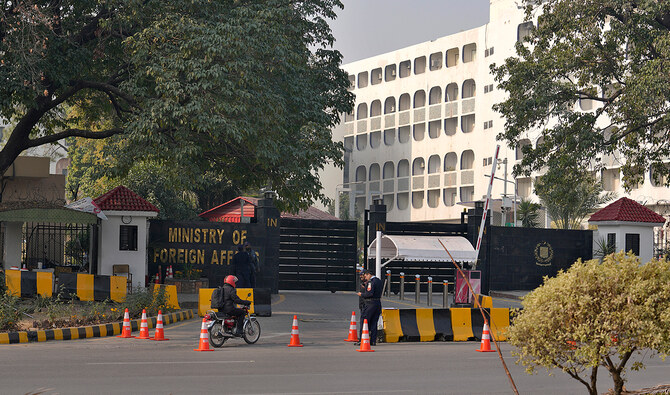
ISLAMABAD: Pakistan’s foreign office spokesperson confirmed on Thursday that Islamabad has not established direct contact with the new Syrian leadership yet, reiterating that it supports a solution that upholds the unity and territorial integrity of the Middle Eastern state.
Opposition forces in Syria, after lightening military campaigns, seized the capital Damascus in December 2024 as then-President Bashar Assad fled to Russia. The Syrian leader was ousted after 13 years of civil war and more than 50 years of his family’s rule over the country.
Days after Assad was ousted, Pakistan said it supported an “inclusive political process” in Syria and believed that the Middle Eastern nation’s future should be determined by its people without foreign interference.
“I would not like to comment on specific details, but at this stage we do not have direct contacts with the leadership of Syria,” Foreign Office Spokesperson Mumtaz Zahra Baloch said in response to a question. “But our embassy remains active in Syria.”
She said the Pakistani government has consistently supported efforts aimed at finding a “comprehensive solution” to the situation in Syria.
“The solution that upholds the unity, sovereignty and territorial integrity of Syria,” Baloch said, adding that Pakistan believes the future of Syria should correspond to the aspirations of the Syrian people for security, stability and development.
“And Pakistan will continue to promote peace and stability in Syria,” she said.
Following Assad family’s ouster after over five decades in power, opposition forces’ leader Ahmad Al-Sharaa’s Hayat Tahrir Al-Sham (HTS) stamped its authority on the Syrian state with the same lightning speed it seized the country.
The HTS deployed police, installed an interim government and has been meeting foreign envoys, raising concerns over how inclusive Damascus’ new rulers intend to be.
The appointment of Mohammed Al-Bashir, the head of the regional government in HTS’ enclave of Idlib, as Syria’s new interim prime minister last month underlined the group’s status as the most powerful of the armed groups that battled for more than 13 years to end Assad’s iron-fisted rule.


Pakistan says not in contact with new Syrian leadership, supports efforts to uphold country’s unity
https://arab.news/6zzpx
Pakistan says not in contact with new Syrian leadership, supports efforts to uphold country’s unity

- Pakistan believes Syria’s future should correspond to aspirations of the Syrian people, says foreign office
- Opposition forces in Syria ousted former president Bashar Assad in December after lightening offensives

Saudi Arabia preparing for strategic economic pact with Pakistan, Saudi envoy says
- The statement follows the signing of a bilateral defense agreement in Sept. to enhance joint deterrence
- Both nations also agreed on an economic framework to prioritize energy, industry, mining and other projects
ISLAMABAD: Saudi Arabia is preparing to sign a strategic economic pact with Pakistan to further strengthen ties between the two brotherly nations, the Saudi ambassador to Pakistan said on Tuesday, months after both countries signed a Strategic Mutual Defense Agreement (SMDA).
The statement by Saudi Ambassador Nawaf bin Said Al-Malki came during his interaction with Arab News on the sidelines of the launch of the King Salman Humanitarian Aid and Relief Center’s (KSrelief) Ramadan food assistance program for deserving Pakistanis.
It followed a landmark defense pact between the two countries, signed in Sept. last year, under which Islamabad and Riyadh pledged that aggression against one would be treated as an attack on both.
The move was widely viewed as formalization of longstanding military cooperation into a binding commitment, while both countries agreed a month later to launch an economic cooperation framework to strengthen trade and investment ties.
“Three months ago, we signed, you know, the Strategic Mutual Defense agreement. Today, god willing, we will be preparing for another, you know, strategic plan for the economy of Pakistan and Saudi Arabia,” the Saudi ambassador told Arab News, adding the economic plan would be signed “soon.”
Saudi Arabia and Pakistan agreed to launch the economic cooperation framework to strengthen trade and investment ties during Prime Minister Shehbaz Sharif’s visit to Riyadh in Oct. last year.
A joint statement issued after Sharif’s meeting with Crown Prince Mohammed said the framework would include several strategic, high-impact projects, prioritizing energy, industry, mining, information technology, tourism, agriculture and food security.
“This framework represents an extension of both countries’ efforts to strengthen their fraternal relations and reaffirms their shared vision toward building a sustainable partnership across various economic, trade and investment fields,” the joint statement said in Oct.
The two countries have already signed a memorandum of understanding for an electricity interconnection project.
Saudi Arabia and Pakistan have enjoyed close relations for decades but have moved to broaden their cooperation in recent years. In 2024, the two countries had also signed 34 memorandums of understanding (MoUs) worth $2.8 billion across multiple sectors.
The KSrelief Ramadan food assistance program, launched on Tuesday, aimed to distribute 27,000 food baskets to support 192,500 vulnerable individuals in 30 districts across Pakistan.
Each food package includes 80 kilograms of wheat flour, 5 liters of cooking oil, 5 kilograms of sugar, 2 kilograms of dates, and 5 kilograms of gram pulse, according to the charity. The contents are calculated to sustain an average household for the entire month of Ramadan.
“The project reflects the Center’s broader humanitarian mandate to alleviate suffering, enhance resilience, and support vulnerable communities,” the Saudi charity said.
“KSrelief reaffirms its continued commitment to addressing food security challenges in Pakistan.”