LONDON: Suspected people smugglers will face severe curbs under new laws in Britain, the government said on Thursday, as it steps up efforts to fight illegal migration and strengthen border security.
Those suspected will face travel bans, social media blackouts and restrictions on phone usage to help the government “dismantle organized immigration crime networks,” the statement added.
“We will give law enforcement stronger powers they need to pursue and stop more of these vile gang networks,” interior minister Yvette Cooper said, describing border security as one of the foundations of the government’s recently laid out ‘plan for change’.
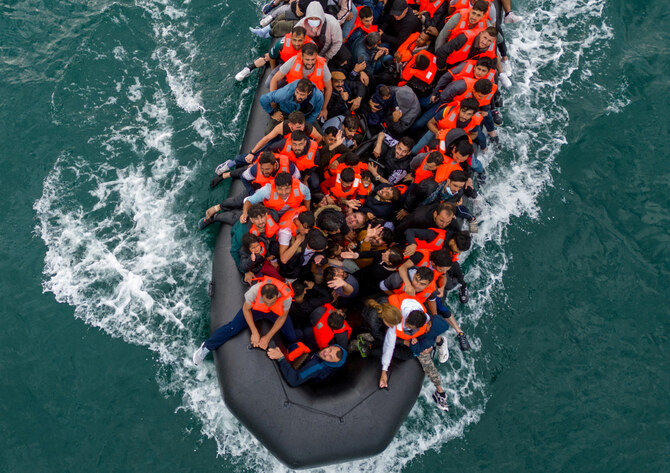
Prime Minister Keir Starmer, elected to office in July, has prioritized tackling illegal migration by cracking down on the gangs who smuggle people across the English Channel, one of the world’s busiest shipping lanes, into Britain from France.
Over 36,800 people made the dangerous crossings to arrive in Britain in 2024, a 25 percent year-on-year surge, according to government data. Several dozen have died attempting to do so, with the Refugee Council charity terming it the deadliest year on record for such crossings.
The planned interim serious crime prevention orders (SCPO) will allow immediate action to disrupt and deter suspected serious criminality, including organized immigration crime, the statement said.
The fresh powers are designed to mirror those already used to disrupt other offenses such as knife crime, slavery and trafficking.
Currently, securing an SCPO on suspects can be a complex and lengthy process. The interim orders will speed up the process.

UK plans tough laws to fight people smugglers
https://arab.news/589ez
UK plans tough laws to fight people smugglers
- PM Keir Starmer has prioritized tackling illegal migration by cracking down on the gangs who smuggle people across the English Channel
- Government data show that over 36,800 people made the dangerous crossings to arrive in Britain in 2024, a 25 percent year-on-year surge
France demands EU-Mercosur trade pact signing be put off
- “France asks that the deadlines be pushed back to continue work on getting the legitimate measures of protection for our European agriculture,” said the statement
PARIS, France: France on Sunday urged the European Union to postpone the deadlines set for signing a free trade agreement with South American bloc Mercosur, rejecting the deal in its current form.
In a statement from Prime Minister Sebastien Lecornu’s office, Paris said the conditions were not in place for EU member states to vote on the agreement.
“France asks that the deadlines be pushed back to continue work on getting the legitimate measures of protection for our European agriculture,” said the statement.
European Commission President Ursula von der Leyen is due in Brazil on Monday for talks to finalize the landmark pact with the Mercosur bloc, which includes Brazil, Argentina, Uruguay, and Paraguay.
But Brussels first has to get the approval of the EU member states over the coming week.
“Given a Mercosur summit is announced for December 20 (Saturday), it is clear in this context that the conditions have not been met for any vote (by states) on authorizing the signing of the agreement,” said the statement from Paris.
Earlier Sunday, in an interview published in the Germany financial daily Handelsblatt, France’s Finance Minister Roland Lescure made France’s objections clear.
“As it stands, the treaty is simply not acceptable,” he said.
Securing robust and effective safeguard clauses was one of the three key conditions France set before giving its blessing to the agreement, he added.
The other key points were requiring the same production standards faced by EU farmers and establishing “import controls.”
“Until we have obtained assurances on these three points, France will not accept the agreement,” said Lescure.
European nations are poised to vote on the trade agreement between Tuesday and Friday, according to EU sources.
The European Parliament votes Tuesday on safeguards to reassure farmers — particularly those in France — who are fiercely opposed to the treaty.
If approved, the EU-Mercosur agreement would create a common market of 722 million people.
It is intended to allow the EU to export more cars, machinery, wine, and other goods, and will also facilitate the entry into the European Union of beef, poultry, sugar, honey, and other products.
Farmers in France and some other European countries say it will create unfair competition due to less stringent standards, which they fear could destabilize already fragile European food sectors.


