

Pakistani province vows to enforce writ in Karachi after police’s clash with sit-in protesters

Police personnel (front) disperse protesters (back) during a demonstration in Karachi on December 31, 2024, to condemn sectarian clashes in Pakistan’s Kurram district. (AFP)
Short Url
Updated 01 January 2025
Follow

Pakistani province vows to enforce writ in Karachi after police’s clash with sit-in protesters

  • Majlis Wahdat-e-Muslimeen party is leading sit-in protests in Karachi to protest violence in northwestern Kurram district 
  • Karachi police say eight cops wounded during Tuesday’s clashes, out of which three were injured due to protesters’ firing

KARACHI: The home minister of Pakistan’s southern Sindh province on Wednesday warned members of a religio-political party of stern action if they did not move their sit-in protests from Karachi’s busy locations to designated spots, a day after law enforcers clashed with the demonstrators in the port city. 
Karachi police and the paramilitary Rangers force cracked down on protesters belonging to the Majlis Wahdat-e-Muslimeen (MWM) party on Tuesday morning, using tear gas to disperse them from the city’s busy Numaish Chowrangi, Malir and other locations. Demonstrators pelted the law enforcers with stones in response and chanted slogans against them. 
The MWM has been leading sit-in protests at over 10 locations in Karachi since last week to protest violence in the northwestern Kurram district. With a population of around 600,000, Kurram has been plagued by tribal and sectarian violence for decades. A devastating ambush on a convoy of Shias on Nov. 21 in which gunmen killed 52 people, gave rise to sectarian clashes in the area that have since then claimed the lives of at least 136 people. 
Karachi police has charged protesters under the country’s anti-terror law, saying that over 150 protesters fired directly at police officers with the intention to kill during Tuesday’s clashes in the city’s Malir district. Two police constables, Zaeem Abbas and Ayaz Gul, were injured in the gunfire, as per the police complaint. All in all, police said eight cops were injured during the clashes out of which three were injured due to firing by protesters.  
“It is not possible for us to let the city fall victim to violence,” Sindh Home Minister Zia Ul Hassan Lanjar told reporters at a news conference. “It’s not possible for us to not protect the lives and property of citizens while sitting idle,” he added. 
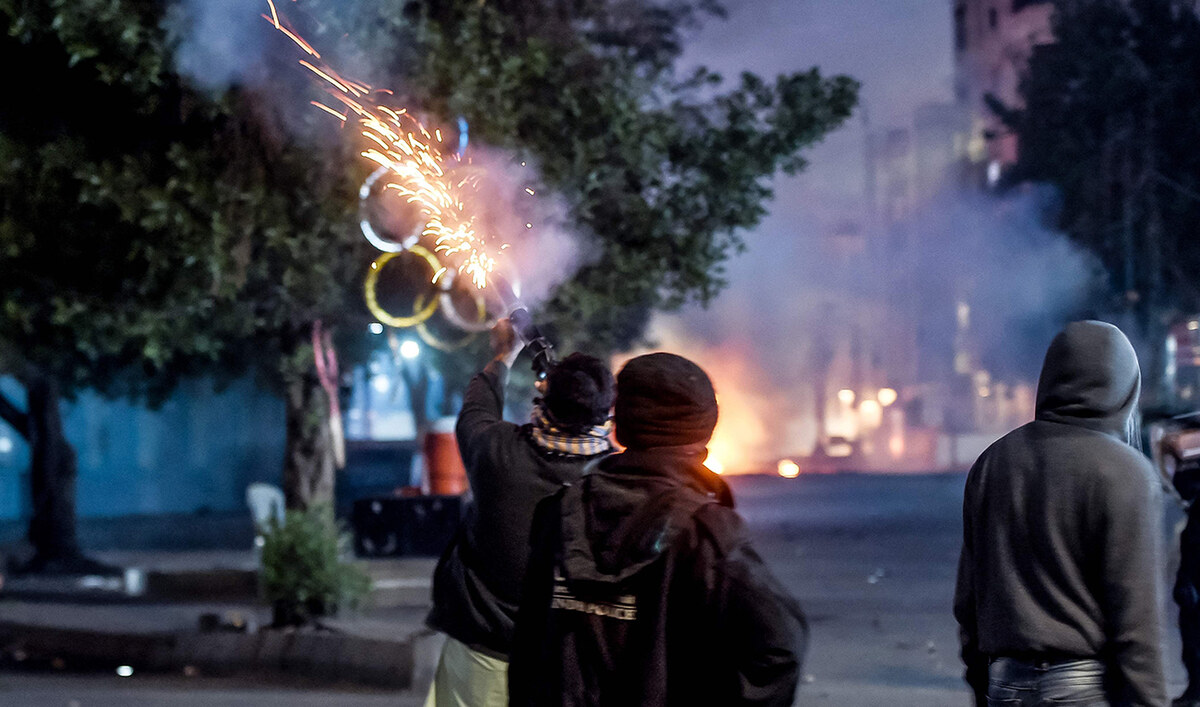


Police personnel fire tear gas shells to disperse protesters during a demonstration in Karachi on December 31, 2024, to condemn sectarian clashes in Pakistan’s Kurram district. (AFP)

He said the government was ready for talks with protesters but also warned that it would enforce its writ in the city. 
“Against any illegal actions, the government will stand firm, the police will do its job, the Rangers will do their job and law enforcement agencies will carry out their responsibilities,” the minister said. 
He said the Sindh government had extended protesters the offer to move their protests to designated spots across the city. 
“We will stand with you, but this is not the way for our main Saddar area to be closed, for Shahra-e-Faisal to be closed, for the Ancholi area to be closed, for the Malir area to be closed, and to turn the city into a battlefield,” he said, referring to Karachi’s areas where the MWM is holding protests.
 “You cannot do this. We will not compromise on this under any circumstances.”
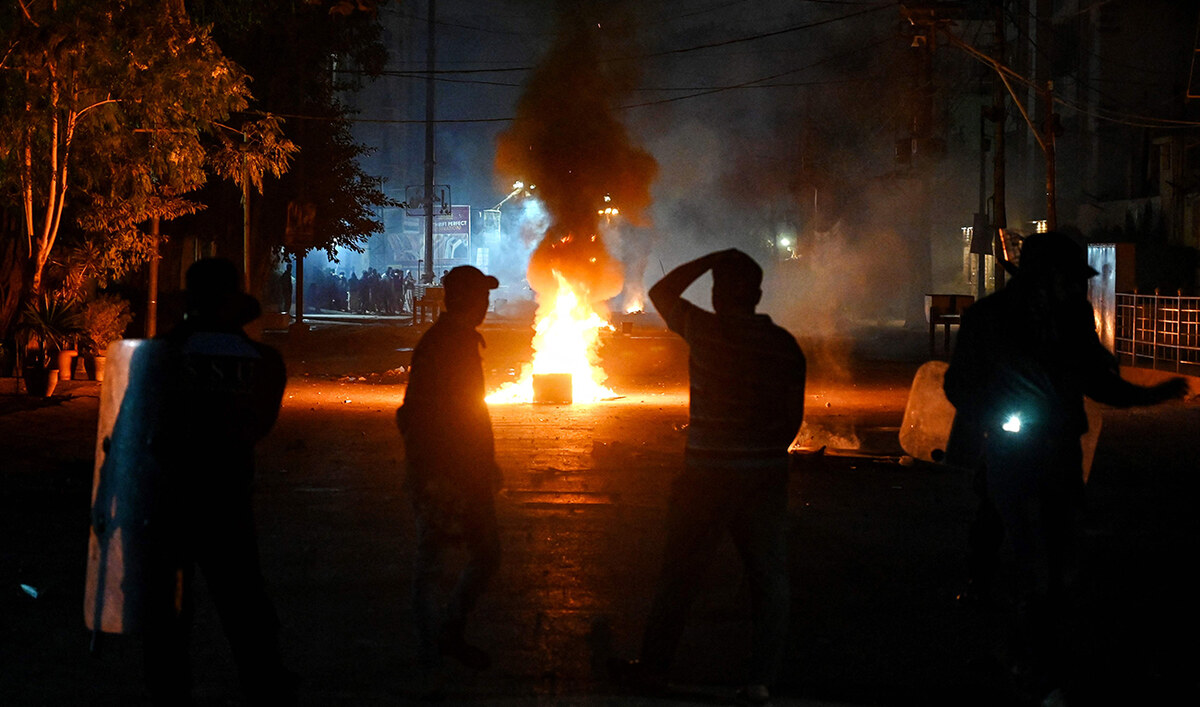


Police personnel (front) disperse protesters (back) during a demonstration in Karachi on December 31, 2024, to condemn sectarian clashes in Pakistan’s Kurram district. (AFP)

Reiterating his offer of negotiations, Lanjar said Karachi’s additional Inspector-general of police and the city’s commissioner will hold talks with MWM since Sindh’s senior ministers had already met representatives of the party. 
Meanwhile, senior MWM leader Allama Baqir Hussain Zaidi announced that the party’s protests in Karachi will continue. 
“The ongoing sit-ins will continue wherever they are being held and alternative routes will remain open,” Zaidi said in a video message. “The community is urged to participate in the sit-ins in an organized manner and to consider it both a personal and religious obligation to join tomorrow evening’s protest gathering.”
He announced that the group will hold a protest rally on Thursday at 4:00 p.m. at Numaish Chowrangi, stressing that it will be a peaceful one. 
A grand jirga — a traditional council of political and tribal elders — has been attempting to mediate between the rival factions in Kurram to enforce peace.


Islamabad dismisses claims about paying up to 8 percent interest on foreign loans as ‘misleading’

Updated 22 February 2026
Follow

Islamabad dismisses claims about paying up to 8 percent interest on foreign loans as ‘misleading’

  • Pakistan has long relied on external loans to help bridge persistent gaps in public finances and foreign exchange reserves
  • Pakistan’s total external debt, liabilities stand at $138 billion at an overall average cost of around 4 percent, ministry says

KARACHI: Pakistan’s finance ministry on Sunday dismissed as “misleading” claims that the country is paying up to 8 percent interest on external loans, saying the overall average cost of external public debt is approximately 4 percent.

Pakistan has long relied on external loans to help bridge persistent gaps in public finances and foreign exchange reserves, driven largely by a narrow tax base, chronic trade deficits, rising debt-servicing costs and repeated balance-of-payments pressures.

Over the decades, successive governments have turned to multilateral and bilateral lenders, including the International Monetary Fund, the World Bank and the Asian Development Bank, to support budgetary needs and shore up foreign exchange reserves.

The finance ministry on Sunday issued a clarification in response to a “recent press commentary” regarding the country’s external debt position and associated interest payments, and said the figures required contextual explanation to ensure accurate understanding of Pakistan’s external debt profile.

“Pakistan’s total external debt and liabilities currently stand at $138 billion. This figure, however, encompasses a broad range of obligations, including public and publicly guaranteed debt, debt of Public Sector Enterprises (both guaranteed and non-guaranteed), bank borrowings, private-sector external debt, and intercompany liabilities to direct investors. It is therefore important to distinguish this aggregate figure from External Public (Government) Debt, which amounts to approximately $92 billion,” it said.

“Of the total External Public Debt, nearly 75 percent comprises concessional and long-term financing obtained from multilateral institutions (excluding the IMF) and bilateral development partners. Only about 7 percent of this debt consists of commercial loans, while another 7 percent relates to long-term Eurobonds. In light of this composition, the claim that Pakistan is paying interest on external loans ‘up to 8 percent’ is misleading.

The overall average cost of External Public Debt is approximately 4 percent, reflecting the predominantly concessional nature of the borrowing portfolio.”

With respect to interest payments, public external debt interest outflows increased from $1.99 billion in Fiscal Year (FY) 2022 to $3.59 billion in FY2025, representing an increase of 80.4 percent, not 84 percent as reported. In absolute terms, interest payments rose by $1.60 billion over this period, not $1.67 billion, it said.

According to the State Bank of Pakistan’s records, Pakistan’s total debt servicing payments to specific creditors during the period under reference were as follows: the IMF received $1.50 billion, of which $580 million constituted interest; Naya Pakistan Certificates payments totaled $1.56 billion, including $94 million in interest; the Asian Development Bank received $1.54 billion, including $615 million in interest; the World Bank received $1.25 billion, including $419 million in interest; and external commercial loans amounted to nearly $3 billion, of which $327 million represented interest payments.

“While interest payments have increased in absolute terms, this rise cannot be attributed solely to an expansion in the debt stock,” the ministry said. “Although the overall debt stock has increased slightly since FY2022, the additional inflows have primarily originated from concessional multilateral sources and the IMF’s Extended Fund Facility (EFF) under the ongoing IMF-supported program.”

Pakistan secured a $7 billion IMF bailout in Sept. 2024 as part of Prime Minister Shehbaz Sharif’s efforts to stabilize the South Asian economy that narrowly averted a default in 2023. The government has since been making efforts to boost trade and bring in foreign investment to consolidate recovery.

“It is also important to note that the increase in interest payments reflects prevailing global interest rate dynamics. In response to the inflation surge of 2021–22, the US Federal Reserve raised the federal funds rate from 0.75-1.00 percent in May 2022 to 5.25–5.50 percent by July 2023. Although rates have since moderated to around 3.75 percent, they remain significantly higher than 2022 levels,” the finance ministry said.

“The government remains committed to prudent debt management, transparency, and the continued strengthening of Pakistan’s macroeconomic stability,” it added.