India caps 2024 with first space docking mission, eyes launching orbital station

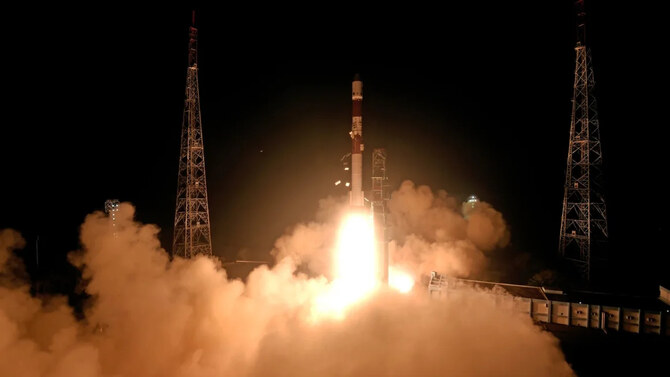
The Indian Space Research Organisation launches its first space docking mission at Satish Dhawan Space Centre in Sriharikota on Dec. 30, 2024. (ISRO/X)
Short Url
Updated 31 December 2024
Follow

India caps 2024 with first space docking mission, eyes launching orbital station

  • SpaDeX mission marks ‘first step’ in establishing India’s space station
  • Earlier this year, India announced $116 million fund for space startups

NEW DELHI: India has launched its first space docking mission on a home-made rocket, capping 2024 with a major technological feat in efforts to establish its position in the global space industry after last year’s successful moon landing and a solar observation project.

The Space Docking Experiment, or SpaDeX, mission launched on Monday evening from the Indian Space Research Organization’s Satish Dhawan Space Center in Sriharikota island off the Bay of Bengal.

About 15 minutes after liftoff aboard the ISRO’s PSLV rocket, the mission director confirmed the launch as a success and reaching “another milestone in India’s space journey” when the spacecraft reached an altitude of 470 km.

The SpaDeX mission involves launching two small spacecraft, each weighing about 220 kg, into a 470 km circular orbit.

“SpaDeX (Space Docking Experiment) is a pioneering mission to establish India’s capability in orbital docking, a key technology for future human spaceflight and satellite servicing missions,” the ISRO said in a statement.

“In-space docking technology is essential when multiple rocket launches are required to achieve common mission objectives. Through this mission, India is marching toward becoming the fourth country in the world to have space docking technology ... This technology is essential for India’s space ambitions such as Indian on Moon, sample return from the Moon, the building and operation of Bharatiya Antariksh Station (BAS), etc.”

India is planning to build its modular space station, the Bharatiya Antariksh Station, by 2035. The docking mission is the “first step” toward that endeavor, said Syed Maqbool Ahmed, a former ISRO scientist who was part of the Chandrayaan program — the Indian Lunar Exploration Program.

“When we want to build a space station, the very first thing we have to do is continuously coming and going back to the station, and that is where the docking is needed,” Ahmed told Arab News.

“That is amazing. Only three countries have done so till now: America, USSR and China. And we will be the fourth country.”

In the past few years, India has been establishing its position in the global space industry.

In August last year, it became the fourth nation to ever soft-land a spacecraft on the moon. A month later, it launched its solar mission, becoming the second country, after the US, to have explored the sun.

But what counts is not only the recent achievements but creating the environment and long-term investment for the space industry to flourish and involve the private sector as well.

“India has approved a space policy just a few months ago. They have also taken almost 1,000 crores ($116 million) separately to help the aerospace industry,” Ahmed said.

“India is encouraging each and every person ... lots of startups to come into the aerospace field.”


NASA’s new moon rocket heads to the pad ahead of astronaut launch as early as February

Updated 5 sec ago
Follow

NASA’s new moon rocket heads to the pad ahead of astronaut launch as early as February

  • The 98-meter rocket began its 1.6 kph creep from Kennedy Space Center’s Vehicle Assembly Building at daybreak
  • The six-kilometer trek could take until nightfall

CAPE CANAVERAL, USA: NASA’s giant new moon rocket headed to the launch pad Saturday in preparation for astronauts’ first lunar fly-around in more than half a century.
The out-and-back trip could blast off as early as February.
The 322-foot (98-meter) rocket began its 1 mph (1.6 kph) creep from Kennedy Space Center’s Vehicle Assembly Building at daybreak. The four-mile (six-kilometer) trek could take until nightfall.
Thousands of space center workers and their families gathered in the predawn chill to witness the long-awaited event, delayed for years. They huddled together ahead of the Space Launch System rocket’s exit from the building, built in the 1960s to accommodate the Saturn V rockets that sent 24 astronauts to the moon during the Apollo program. The cheering crowd was led by NASA’s new administrator Jared Isaacman and all four astronauts assigned to the mission.
Weighing in at 11 million pounds (5 million kilograms), the Space Launch System rocket and Orion crew capsule on top made the move aboard a massive transporter that was used during the Apollo and shuttle eras. It was upgraded for the SLS rocket’s extra heft.
The first and only other SLS launch — which sent an empty Orion capsule into orbit around the moon — took place back in November 2022.
“This one feels a lot different, putting crew on the rocket and taking the crew around the moon,” NASA’s John Honeycutt said on the eve of the rocket’s rollout.
Heat shield damage and other capsule problems during the initial test flight required extensive analyzes and tests, pushing back this first crew moonshot until now. The astronauts won’t orbit the moon or even land on it. That giant leap will take come on the third flight in the Artemis lineup a few years from now.
Commander Reid Wiseman, pilot Victor Glover and Christina Koch — longtime NASA astronauts with spaceflight experience — will be joined on the 10-day mission by Canadian astronaut Jeremy Hansen, a former fighter pilot awaiting his first rocket ride.
They will be the first people to fly to the moon since Apollo 17’s Gene Cernan and Harrison Schmitt closed out the triumphant lunar-landing program in 1972. Twelve astronauts strolled the lunar surface, beginning with Neil Armstrong and Buzz Aldrin in 1969.
NASA is waiting to conduct a fueling test of the SLS rocket on the pad in early February before confirming a launch date. Depending on how the demo goes, “that will ultimately lay out our path toward launch,” launch director Charlie Blackwell-Thompson said on Friday.
The space agency has only five days to launch in the first half of February before bumping into March.