

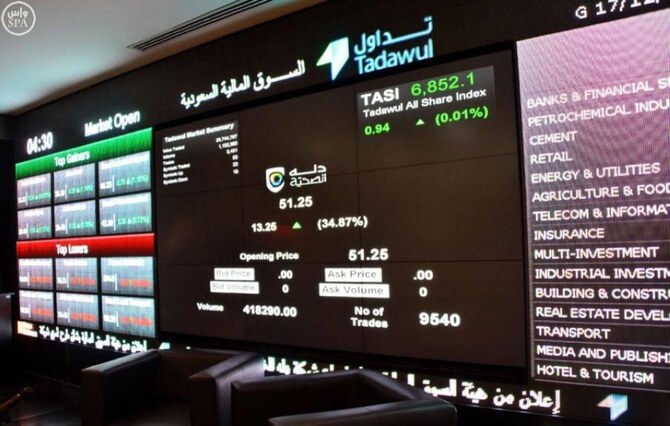

RIYADH: Saudi Arabia’s Tadawul All Share Index gained 0.91 percent, or 108.17 points, to reach 12,000.92 points on Monday.
The total trading turnover of the benchmark index was SR5.1 billion ($1.3 billion), as 172 of the listed stocks advanced, while 65 retreated.
The MSCI Tadawul Index also increased by 11.41 points, or 0.76 percent, to close at 1,505.97.
The Kingdom’s parallel market Nomu also reported increases, gaining 460.61 points, or 1.48 percent, to close at 31,513.42. This comes as 39 of the listed stocks advanced, while as many as 47 retreated.
The index’s top performer, Saudi Reinsurance Co., saw a 10 percent increase in its share price to close at SR51.70.
Other top performers included Saudi Industrial Development Co., which saw an 8.98 percent increase to reach SR30.95, while Walaa Cooperative Insurance Co.’s share price rose by 7.42 percent to SR19.68.
Middle East Specialized Cables Co. recorded a positive trajectory, with share prices rising 6.17 percent to reach SR43.90. Fawaz Abdulaziz Alhokair Co. also witnessed positive gains, with 5.07 percent reaching SR12.84.
Alkhaleej Training and Education Co. was TASI’s worst performer, with the company’s share price falling by 3.26 percent to SR31.15.
Sustained Infrastructure Holding Co. followed with a 2.86 percent drop to SR32.25. National Medical Care Co. also saw a notable decline of 2.11 percent to settle at SR167.40.
Elm Co. and Arriyadh Development Co. were among the top five worst performers, with shares dropping by 2.06 percent to settle at SR1,114.80 and by 2.03 percent to sit at SR33.85, respectively.
On the announcement front, WSM for Information Technology Co. has finalized its acquisition of Wasl Technology Information Systems Limited Co., marking the conclusion of a transaction valued at SR8.5 million.
The company announced the signing of the final purchase agreement on Dec. 29 with Tanabw for Information Technology, effectively transferring Wasl Technology Information Systems into a branch of Tanabw.
The acquisition process began with the signing of a non-binding memorandum of understanding on Oct. 27, followed by regulatory approval on Nov.10 when WSM received a No Notification Required Certificate from the General Authority for Competition. Value Capital acted as the financial adviser for the deal.
The transaction is expected to expand WSM’s technology capabilities and strengthen its presence in the IT sector. Further details on integration plans and strategic objectives post-acquisition have yet to be disclosed, the company stated in a bourse statement.
WSM closed Monday’s trading session with a 4.30 percent increase to reach SR49.70.
Also, Waja Co. has announced the signing of a Shariah-compliant bank facility agreement with Alinma Bank, securing financing worth SR16 million. The agreement, finalized on Dec.30, has a tenure of one year.
The facility is backed by a promissory note from the company and will be used to support Islamic financing for letters of credit, various Islamic bank guarantees, and tawarruq transactions.
Waja’s move aligns with its strategy to enhance its financial capabilities while adhering to Islamic banking principles.
The financing is expected to bolster the company’s liquidity and operational flexibility, enabling it to pursue its business objectives effectively. Further updates regarding the utilization of funds were not disclosed, according to a bourse filing.
Waja Co.’s share price dropped 0.25 percent on Monday to settle at SR7.86.


