For the first time, Syrians ‘not afraid’ to talk politics

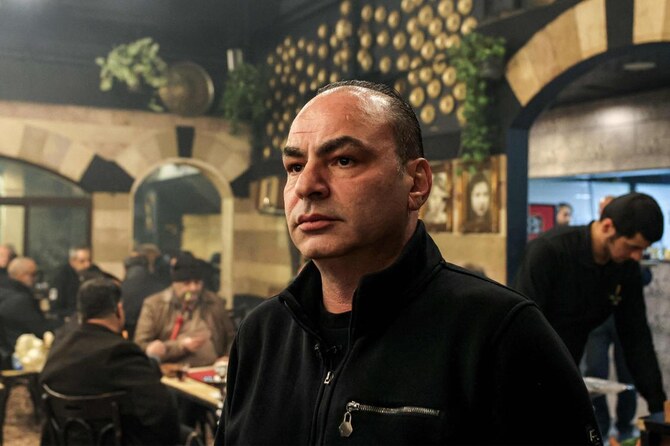
Ahmad Kozorosh, owner of Damascus’ Al-Rawda coffee shop, looks on as he stands among customers on December 28, 2024. (AFP)
Short Url
Updated 30 December 2024
Follow

For the first time, Syrians ‘not afraid’ to talk politics

  • For over 50 years, the Assads maintained their vice grip on society, in large part through the countless informants that walked among the population

DAMASCUS: For decades, any Syrian daring to broach political topics got used to speaking in hushed tones and with a watchful eye trained for a listener among the crowd.
“There were spies everywhere,” Mohannad Al-Katee said in Al-Rawda cafe in Damascus, adding almost in disbelief: “It’s the first time that I sit in a cafe and I can talk about politics.
“It was a dream for Syrians,” said Katee, 42, a researcher in political and social history.
Until now, he like thousands of others had grown accustomed to watching for the proverbial flies on the walls of Damascus’s renowned cafes.
Today, those same cafes are alive and buzzing with the voices of patrons speaking freely about their country for the first time.
Such discussions “were banned under the previous regime, then there was a relative opening during the Damascus Spring,” Katee said.
He was referring to the year 2000, when Bashar Assad took over from his late father Hafez and slightly loosened the reins on political life in Syria.
Initially, the young Assad had opened up an unprecedented space, allowing for political salons to flourish alongside calls for reform in a country that had long grown accustomed to fear and silence.
“But it didn’t last,” said Katee.
A few months after his succession, Assad rolled back those gains, putting an end to the short-lived “Damascus Spring.”
In the subsequent years, according to Katee, informants were ubiquitous, from “the hookah waiter to the man at the till, it could have been anyone.”
“Political life consisted of secret meetings,” he said. “We were always taught that the walls have ears.”
Today, “Syrians can never go back to obscurantism and dictatorship, to accepting single-party rule,” he said.
A little further on, in the Havana cafe once known as a meeting point for intellectuals and activists in a distant past, Fuad Obeid is chatting with a friend.
Himself a former owner of a cafe he had to shut down, the 64-year-old said: “The intelligence services spent their time at my place. They drank for free as though they owned the place.”
For over 50 years, the Assads maintained their vice grip on society, in large part through the countless informants that walked among the population.
On Saturday, Syria’s new intelligence chief, Anas Khattab, announced that the service’s various branches would be dissolved.
Obeid said: “I used to keep a low profile so they wouldn’t know I was the owner. I told customers not to talk politics for fear of reprisals.”
Now, he noted, in Havana cafe as in others, the difference is like “night and day.”
Back in Al-Rawda, discussions are in full swing over hookahs and games of backgammon.
The owner Ahmad Kozorosh still can’t believe his eyes, having himself witnessed numerous arrests in his own cafe over the years.
“I am now seeing almost exclusively new faces,” he said. “People who had been sentenced to death, imprisoned.”
To celebrate the new era, he is holding weekly symposiums in the cafe, and will even launch a new political party to be named after it.
Real estate agent Nesrine Shouban, 42, had spent three years in prison for carrying US dollars, a punishable offense in Assad’s Syria.
Alongside thousands of others who found freedom when the doors of prisons were flung open, she was released on December 8 from the notorious Adra prison.
“They had dangled in front of us the possibility of an amnesty” from Assad’s administration, she said. “Thankfully, the amnesty came from God.”
“At cafes, we didn’t dare say anything. We were even afraid that our phones were bugged,” she said.
Now, for the first time, she said she felt “truly free.”
Despite concerns over the extremist background of Syria’s new rulers, a breath of freedom has washed over the country for the first time, with public demonstrations being organized — an unthinkable prospect just one month earlier.
“We are not afraid anymore,” said Shouban. “If Jolani makes mistakes, we will denounce them,” she added, referring to Syria’s new leader Ahmed Al-Sharaa, known by his nom de guerre Abu Mohammad Al-Jolani.
“In all cases, it can’t be worse than Bashar Assad.”


Gaza authorities ‘levy fees on some privately imported goods’

Palestinians sell fish during a ceasefire between Israel and Hamas, at the seaport of Gaza City, November 12, 2025. (REUTERS)
Updated 10 sec ago
Follow

Gaza authorities ‘levy fees on some privately imported goods’

  • Ghaith Al-Omari, a senior fellow at the Washington Institute think tank, said Hamas’ actions aimed to show Gazans and foreign powers alike that it cannot be bypassed

CAIRO: From regulating the price of chicken to levying fees on cigarettes, Hamas is seeking to widen control over Gaza as US plans for its future slowly take shape, Gazans say, adding to rivals’ doubts over whether it will cede authority as promised.
After a ceasefire began last month, Hamas swiftly reestablished its hold over areas from which Israel withdrew, killing dozens of Palestinians it accused of collaborating with Israel, theft, or other crimes. Foreign powers demand that the group disarm and leave the government, but have yet to agree on who will replace them.
Now, a dozen Gazans say they are increasingly feeling Hamas’ control in other ways. 

The prices are high. There’s no income, circumstances are difficult, life is hard, and winter is coming.

Mohammed Khalifa, Shopper in Nuseirat area

Authorities monitor everything entering areas of Gaza held by Hamas, levying fees on some privately imported goods, including fuel and cigarettes, and fining merchants seen as overcharging for goods, according to 10 Gazans, three of them merchants with direct knowledge.
Ismail Al-Thawabta, head of the media office of the Gaza government, said accounts of authorities taxing cigarettes and fuel were inaccurate, denying that the government was raising any taxes.
The authorities were only carrying out urgent humanitarian and administrative tasks whilst making “strenuous efforts” to control prices, Al-Thawabta said. 
He reiterated Hamas’ readiness to hand over to a new technocratic administration, saying it aimed to avoid chaos in Gaza: “Our goal is for the transition to proceed smoothly.”
Hatem Abu Dalal, owner of a Gaza mall, said prices were high because not enough goods were coming into Gaza. Government representatives were trying to bring order to the economy — touring around, checking goods and setting prices, he said.
Mohammed Khalifa, shopping in central Gaza’s Nuseirat area, said prices were constantly changing despite attempts to regulate them. “It’s like a stock exchange,” he said.
“The prices are high. There’s no income, circumstances are difficult, life is hard, and winter is coming,” he said.
Reuters, citing multiple sources, reported this week that Gaza’s de facto partition appeared increasingly likely, with Israeli forces still deployed in more than half the territory and efforts to advance the plan faltering.
Nearly all of Gaza’s 2 million people live in areas controlled by Hamas.
Ghaith Al-Omari, a senior fellow at the Washington Institute think tank, said Hamas’ actions aimed to show Gazans and foreign powers alike that it cannot be bypassed.
“The longer that the international community waits, the more entrenched Hamas becomes,” Omari said.
Asked for comment on Gazans’ accounts of Hamas levying fees on some goods, among other reported activities, a US State Department spokesperson said: “This is why Hamas cannot and will not govern in Gaza.”
The PA is pressing for a say in Gaza’s new government, though Israel rejects the idea of it running Gaza again.
Munther Al-Hayek, a Fatah spokesperson in Gaza, said Hamas’ actions “give a clear indication that Hamas wants to continue to govern.”
In the areas held by Israel, small Palestinian groups that oppose Hamas have a foothold, a lingering challenge to it.
Gazans continue to endure dire conditions, though more aid has entered since the ceasefire.
A senior Gazan food importer said Hamas hadn’t returned to a full taxation policy, but they “see and record everything.”
They monitor everything that enters, with checkpoints along routes, and stop trucks and question drivers, he said, declining to be identified. 
Price manipulators are fined, which helps reduce some prices, but they are still much higher than before the war began, and people complain they have no money.
The Gaza government employed up to 50,000 people, including policemen, before the war. 
Al-Thawabta said that thousands of them were killed, and those remaining were ready to continue working under a new administration.
Gaza authorities continued paying them salaries during the war, though it cut the highest, standardizing wages to 1,500 shekels ($470) a month, Hamas sources and economists familiar with the matter said. 
It is believed that Hamas drew on stockpiled cash to pay the wages, a diplomat said.
The Gaza government replaced four regional governors who were killed, sources close to Hamas said. 
A Hamas official said the group also replaced 11 members of its Gaza politburo who died.
Gaza City activist and commentator Mustafa Ibrahim said Hamas was exploiting delays in the US plan “to bolster its rule.”
“Will it be allowed to continue doing so? I think it will continue until an alternative government is in place,” he said.