

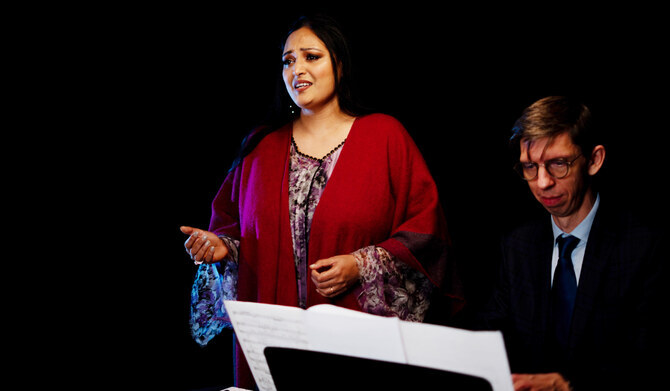

RIYADH: British-Pakistani soprano Saira Peter has captivated on the world stage, made history by becoming the world’s first Sufi opera singer, and even received praise from King Charles III for her recording of the British national anthem.
After hearing about Saudi Arabia’s changes in recent years, Peter decided to explore the country’s arts and culture scene herself. In Riyadh, she spoke to Arab News about her musical journey, her upcoming Sufi opera project, and her impressions of Saudi Arabia.
“It’s so wonderful to see how your country is growing and (how) you are embracing the advanced technology,” she said.
When I discovered that I could sing, I decided for myself that I would use music to serve people, to spread the message of peace and reconciliation around the world.
Saira Peter, British-Pakistani soprano
“You’re having so many events around you. And it’s quite enormous and very interesting to see the musical events as well. I met some people and I told them that I’m an opera singer…
“The way I saw Saudi people, their reaction towards music, it’s unbelievable. You have such a great rhythm and tempo inside you.”
The London-based singer, who is the director of NJ Arts London where she also gives lessons, has starred on many stages across the globe, often performing with her husband, musician Stephen Smith, and has an extensive discography that features music in 17 languages.
In 2019 she received an award for Best Music Performance at Islamabad Art Fest, Pakistan’s largest international arts event.
But her acclaimed career was no surprise: Music was part of her life from childhood and she grew up listening to classical music in her household.
Peter admired the likes of Benjamin Britten, Mozart, Beethoven, and Arabic and Eastern singers like Umm Kulthum, but doing her first master’s in physical chemistry really helped her understand the intricacies of music.
Peter said: “In Greek history they used to put music into science and into arts as well. All the notes are composed of different frequencies and each and every note has specific frequencies, which is actually science, which is physics.
“Music is everywhere in the world, even if you hear the sea breeze or when the wind blows. Everything is music.”
But only after receiving her second master’s in history from Queen Mary University of London, and delving deeper into Islamic and Western histories, did she decide to pursue a professional career in music.
She said: “I think music is very important; it’s a language. You can express your emotions, you can express your thoughts, in a very mild way. And you can communicate to the whole world.
“My passion and my vision when I sing, I think, is how I can serve my audience and how I can deliver the message of peace and reconciliation to my audience.”
Reflecting her aim to bring people together, the soprano’s genre of Sufi opera aims to bridge the gap between Eastern and Western classical music.
Peter said: “Fusion means that when you blend two cultures, two musical genres together, when they come together, they should celebrate each other. They should, also, enhance the beauty of what they already contain.”
She is currently working with her team in London to develop the first full-scale opera of this kind, titled “Marvi’s Tears.” Inspired by the ancient Indus Valley Civilization in what is now Pakistan, Afghanistan and India, the story follows a teenage girl, Marvi, and her brave journey in bringing justice to her village.
The opera recently underwent a workshop at Oxford University with renowned British composer Paul Knight, who is also Peter’s vocal coach, and director Johnny Danziger. It is set to be staged in 2025.
Peter said: “The opera is a very unique kind of opera, because it’s a blend of two worlds which are, you know, Western classical and Eastern classical. So if you sing Western classical, there are certain things you are not allowed to do when you sing. For example, you are not allowed to sing in portamento, which is a sliding note.
“Arab singers are wonderful in sliding notes and they have quarter tones and all these vibratos, which are beautiful.”
Considering her ethnic background, Peter’s vantage point is her ability to utilize her voice on both ends of the spectrum — and everywhere in between. This discovery was made by her coach, Knight.
Peter said: “He said ‘You have a very unique kind of vocal force that you can sing both Western classical and Eastern classical without changing the quality of the sound.’
“Because I’m from the East, I have that kind of DNA, that kind of sound.”
During her stay in Riyadh Peter performed a few arias to a small group of Saudis in a home setting, where she was met with claps and cheers. She said: “I never had this kind of experience and response from any audience. Of course I love all my audiences, but here it was very different, and I was so moved.
“It was overwhelming because they were in tears and they were appreciating me with all their heart.”
As Saudi Arabia orchestrates a notable cultural shift, opera is slowly gaining ground and blending with its rich musical heritage, marking a new chapter in its artistic evolution, most recently demonstrated by the staging of the first Saudi opera “Zarqa Al-Yamama” back in April.
While the soprano believes there is no shortcut to hard work and training, she offers a piece of advice to aspiring artists and professionals.
She said: “You need to know what your vision is, and your goal for life. If you have a message, then it becomes whatever you do, whether you want to become a singer or scientist or dramatic artist, you first need to search within yourself.
“When I discovered that I could sing, I decided for myself that I would use music to serve people, to spread the message of peace and reconciliation around the world.”


