Pakistan repels Afghan-based militant incursion amid escalating tensions — security sources

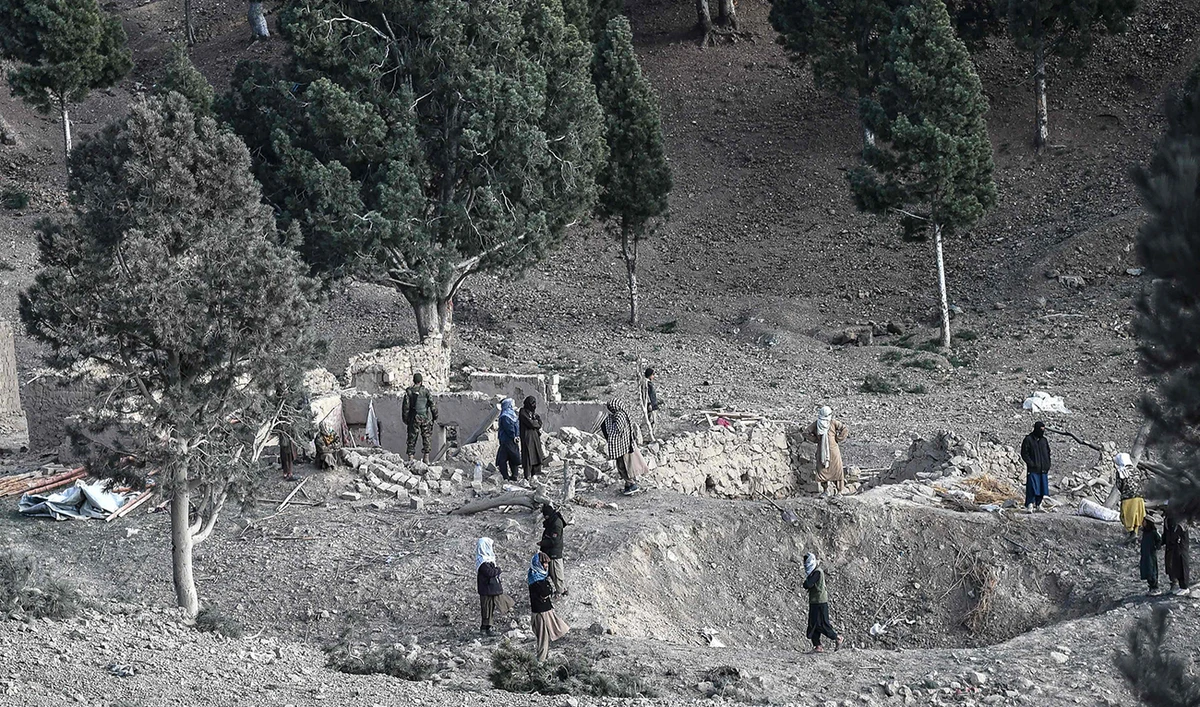
Residents gather near a damaged house two days after air strikes by Pakistan in the Barmal district of eastern Paktika province on December 26, 2024. (AFP)
Short Url
Updated 28 December 2024
Follow

Pakistan repels Afghan-based militant incursion amid escalating tensions — security sources

  • Sources accuse Afghan Taliban of ‘persistently assisting’ armed militants instead of apprehending them
  • They say no fatalities happened on Pakistan’s side, but over 15 militants and Afghan Taliban were killed

KARACHI: Pakistan’s security forces thwarted an attempted cross-border incursion by militants allegedly facilitated by Afghan Taliban authorities, security sources said on Saturday after Afghanistan’s defense ministry claimed its forces targeted several locations in Pakistan in response to airstrikes earlier this week.
Pakistan has repeatedly accused Kabul of sheltering Tehreek-e-Taliban Pakistan (TTP) militants and has urged Afghan officials not to allow armed factions to use their soil to target neighboring states. Afghan authorities deny these allegations, saying Pakistan’s security challenges are its internal matter.
On Thursday, Afghan authorities reported airstrikes by Pakistan’s military in an eastern border town that they said had killed 46 people. The strikes came days after the TTP claimed responsibility for killing 16 Pakistani soldiers near the Afghan border.
“On the night of December 27-28, 20 to 25 khawarij [TTP militants], using Afghan Taliban border posts, attempted to infiltrate Pakistan at two locations in Kurram and North Waziristan,” Pakistani security sources said. “Pakistani forces acted promptly, thwarting the incursion.”
They reported yet another incursion in the morning, saying it was also repelled.
“In retaliation, khawarij and Afghan Taliban jointly opened unprovoked heavy fire on Pakistani posts,” they added.
Pakistan’s forces responded decisively, reportedly inflicting significant losses on the attackers.
“Initial reports indicate that over 15 khawarij and Afghan Taliban personnel were killed, with many others injured,” the sources said. “Effective counter-fire forced the Afghan Taliban to abandon six posts.”
No fatalities were reported on the Pakistani side, though three soldiers sustained injuries. Security sources also noted Afghanistan’s unwillingness to control TTP elements operating freely on its soil, saying it strained bilateral relations.
“Instead of curbing these terrorist elements, the Afghan Taliban persistently assist them,” the sources maintain. “TTP militants operate with impunity in Afghanistan, using its territory for anti-Pakistan activities.”

Pakistan says multilateralism in peril, urges global powers to prioritize diplomacy over confrontation

Updated 8 sec ago
Follow

Pakistan says multilateralism in peril, urges global powers to prioritize diplomacy over confrontation

  • The country tells the UN international security system is eroding, asks rival blocs to return to dialogue
  • It emphasizes lowering of international tensions, rebuilding of channels of communication among states

ISLAMABAD: Pakistan warned the world community on Monday that multilateralism was “in peril” amid rising global tensions, urging major powers to revive diplomacy and dialogue to prevent a further breakdown in international security.

Speaking at a UN Security Council briefing, Pakistan’s ambassador to the UN, Asim Iftikhar Ahmad, said the world was drifting toward confrontation at a time when cooperative mechanisms were weakening.

His comments came during a session addressed by Finland’s foreign minister Elina Valtonen, chairing the Organization for Security and Co-operation in Europe (OSCE), the world’s largest regional security body.

Formed out of the 1975 Helsinki Final Act, the OSCE was designed during the Cold War to reduce tensions, uphold principles of sovereignty and human rights and promote mechanisms for peaceful dispute resolution.

“Today, the foundational ethos of international relations, multilateralism, cooperation and indivisible security, as envisaged in the preamble of Helsinki Final Act, is perhaps facing its biggest challenge in decades,” Ahmed said. “The OSCE, too, is navigating a difficult geopolitical landscape, with conflict raging in the heart of Europe for nearly four years, depletion of trust and unprecedented strains on peaceful co-existence.”

He said a return to the “Helsinki spirit” of dialogue, confidence-building and cooperative security was urgently needed, not only in Europe but globally.

“This is not a matter of choice but a strategic imperative to lower tensions, rebuild essential channels of communication, and demonstrate that comprehensive security is best preserved through cooperative instruments, and not by the pursuit of hegemony and domination through military means,” he said. “Objective, inclusive, impartial, and principle-based approaches are indispensable for success.”

Ahmed’s statement came in a year when Pakistan itself fought a brief but intense war after India launched missile strikes at its city in May following a militant attack in Indian-administered Kashmir. New Delhi blamed Pakistan for the assault, an allegation Islamabad denied while calling for a transparent international investigation.

The Pakistani diplomat said the international system was increasingly defined by bloc politics, mistrust and militarization, warning that such trends undermine both regional stability and the authority of multilateral institutions, including the UN itself.

He urged member states to invest more in preventive diplomacy and the peaceful settlement of disputes as reaffirmed by the Council in Resolution 2788.

Ahmad said Pakistan hoped the OSCE would continue reinforcing models of cooperative security and that the Security Council would back partnerships that strengthen international law and the credibility of multilateral frameworks.

The path forward, he added, required “choosing cooperation over confrontation, dialogue over division, and inclusive security over bloc-based divides.”