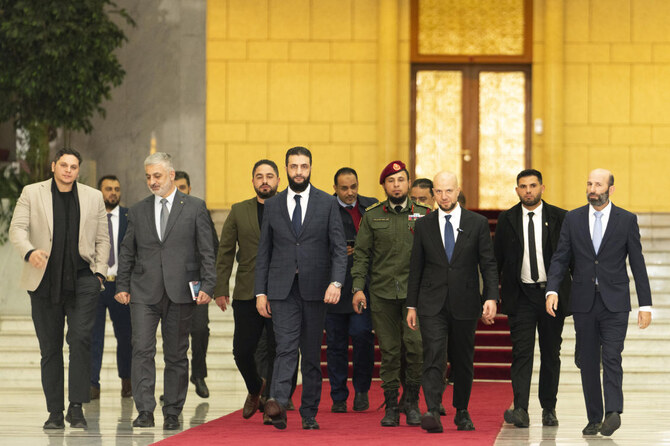
DAMASCUS: A senior official from Libya’s UN-recognized government met Syria’s new leader Ahmed Al-Sharaa on Saturday and discussed issues including diplomatic relations, energy and migration.
“We expressed our full support for the Syrian authorities in the success of the important transitional phase,” Libyan Minister of State for Communication and Political Affairs Walid Ellafi told reporters after the meeting.
“We emphasized the importance of coordination and cooperation... particularly on security and military issues,” he said, while they also discussed cooperation “related to energy and trade” and “illegal immigration.”
Syrians fleeing war since 2011 and seeking a better life have often traveled to Libya in search of work or passage across the Mediterranean on flimsy boats toward Europe.
Ellafi said they also discussed “the importance of raising diplomatic representation between the two countries.”
“Today the charge d’affaires attended the meeting with me and we are seeking a permanent ambassador,” he added.
Power in Libya is divided between the UN-recognized government based in the capital Tripoli and a rival administration in the east, backed by military strongman Khalifa Haftar who also controls the south.
Representatives of Haftar’s rival administration in March 2020 opened a diplomatic mission in Damascus.
Before that, Libya had not had any representation in Damascus since 2012, following the fall and killing of longtime dictator Muammar Qaddafi in a NATO-backed uprising.
It was not immediately clear whether the charge d’affaires had been appointed since Sharaa’s Islamist group Hayat Tahrir Al-Sham (HTS) and allied factions toppled Assad on December 8 after a lightning offensive.
Also on Saturday, images published by Syrian state news agency SANA also showed Sharaa meeting Bahrain’s strategic security bureau chief Sheikh Ahmed bin Abdulaziz Al-Khalifa.
No details of the discussions were provided.
On December 14, top diplomats from eight Arab countries including Bahrain called for a peaceful transition in Syria with United Nations and Arab League support following Assad’s overthrow.
A day earlier, the official BNA news agency reported that Bahrain’s King Hamad had told Sharaa that his country was ready to “continue consultations and coordination with Syria.”
Damascus’s new authorities have received envoys from across the Middle East and beyond since taking control as countries look to establish contact with Sharaa’s administration.


![]()

Visiting Libyan official says discussed energy, migration with new Syria leader
Short Url
https://arab.news/6tt27
Visiting Libyan official says discussed energy, migration with new Syria leader
- Syrians fleeing war since 2011 and seeking a better life have often traveled to Libya in search of work or passage
- Power in Libya is divided between the UN-recognized government based in the capital Tripoli and a rival administration in the east


Latest updates


Recommended


© 2026 SAUDI RESEARCH & PUBLISHING COMPANY, All Rights Reserved And subject to Terms of Use Agreement.