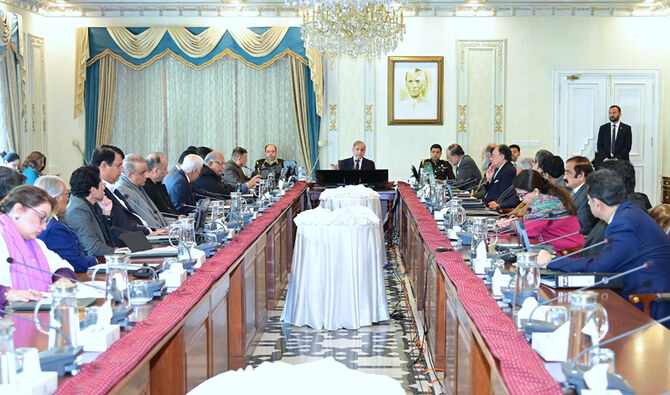
ISLAMABAD: Pakistan’s federal cabinet on Friday approved policy guidelines for trade in carbon markets that help channel financial resources to reduce carbon emissions and mitigate their contribution to climate change.
Carbon markets are carbon pricing mechanisms enabling governments and non-state actors to trade greenhouse gas emission credits. There are two types of carbon markets: compliance and voluntary. In compliance markets such as national or regional emissions trading schemes, participants act in response to an obligation established by a regulatory body.
In voluntary carbon markets, participants are under no formal obligation to achieve a specific target. Instead, non-state actors such as companies, cities or regions seek to voluntarily offset their emissions, for example, to achieve mitigation targets such as climate neutral, net zero emissions.
The new guidelines aim to establish a clear regulatory framework for governing both voluntary and compliance carbon market activities in Pakistan, following international requirements and good practices.
“The federal cabinet approved policy guidelines for trading in the carbon market on the recommendation of the Ministry of Climate Change and Climate Coordination,” Prime Minister Shehbaz Sharif’s office said in a statement after the meeting.
Pakistan’s Ministry of Climate Change marked Nov. 16 as the Pakistan Pavillion’s “Carbon Market Day” and organized a high-level event on carbon markets at the UN COP29 climate summit to cement Pakistan’s commitment to participation in the new global carbon market.
Nearly 200 governments agreed on the framework that sets up a centralized global mechanism with clear rules and procedures for countries and companies involved in carbon credit transactions.
Pakistan’s policy guidelines aim to foster investments in energy, agriculture and forestry sectors, according to state media. Through these carbon markets, businesses will be encouraged to adopt eco-friendly technologies and reduce greenhouse gas emissions.
Under Article 6 of the Paris Agreement Crediting Mechanism (PACM), developing countries can host emissions reduction and removal projects and trade the resulting carbon credits internationally as a means to generate new revenue streams and unlock investment in ambitious climate action.
Pakistan’s “Carbon Market Policy Guidelines” outline a cohesive strategy and authorization criteria, which prioritizes investment in resilience and climate change adaptation, and works closely with provincial governments, the UN Environment Program says on its website.
“While these guidelines offer cultural and geographical nuance for each province’s differential needs, they set stringent quality control criteria, thus ensuring high-quality project development with substantial co-benefits. Finally, countries will experience a competitive and cost-efficient framework that emphasizes fairness in benefit distribution,” the document says.
A number of project opportunities have already been identified on the basis of which the government of Pakistan intends to initiate dialogues on Article 6 collaboration, according to the UN.


![]()

Pakistan’s cabinet approves policy guidelines for trade in carbon market
Short Url
https://arab.news/vyz7d
Pakistan’s cabinet approves policy guidelines for trade in carbon market
- The new guidelines will establish regulatory framework for governing both voluntary and compliance carbon market activities
- These markets are carbon pricing mechanisms that enable governments, non-state actors to trade greenhouse gas emission credits
Latest updates


Recommended


© 2026 SAUDI RESEARCH & PUBLISHING COMPANY, All Rights Reserved And subject to Terms of Use Agreement.