

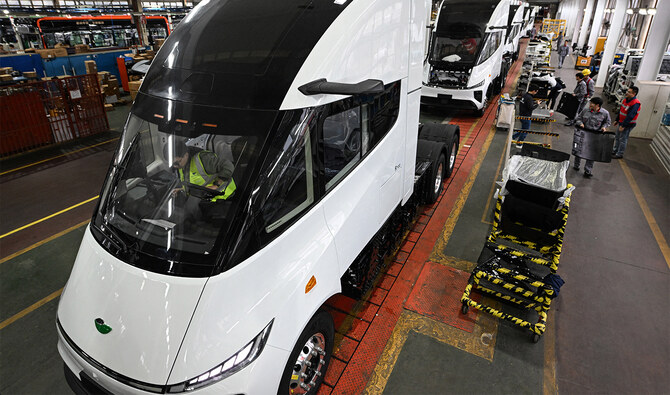

KARACHI: Dewan Farooque Motors Limited, a Pakistani automobile importer and manufacturer based in Karachi, will assemble Chinese electric trucks locally, with the vehicle’s launch scheduled for the first quarter of next year, a project director at the company said.
Pakistan approved an ambitious National Electric Vehicles Policy (NEVP) in 2019 with the goal that electric vehicles would comprise 30 percent of all passenger vehicles and heavy-duty truck sales by 2030. It has set an even more ambitious target of electric vehicles comprising 90 percent of all vehicle sales by 2040.
“The ‘Kama,’ our new Chinese electric truck, leverages the robust structure of our diesel-powered Shehzore model. For Test trial, CBU (completely built) units have already arrived in Pakistan for further proceeding to local assembly, with a launch planned within first quarter of 2025,” Kashif Riaz, Director Projects at Dewan Farooque Motors, told Arab News.
“Traditionally, commercial trucks have a voracious appetite for fuel. Electrifying them dramatically reduces operating costs. This light commercial vehicle has a 300 Kilometer e-range and supports rapid charging.”
Riaz said the widespread adoption of electric vehicles in Pakistan could bring international acclaim and even secure carbon credits from the World Bank, presenting a “golden opportunity” as Pakistan possessed the necessary capacity, skilled workforce, and infrastructure for domestic manufacturing.
“With abundant lithium resources and the potential for in-country battery production, 100 percent localized electric vehicle manufacturing is within reach,” the project direxctor added.
“By eliminating the need for traditional engines and transmissions, and by localizing production of key components like batteries, Pakistan can position itself as a global exporter of electric vehicles. Stronger support for domestic EV manufacturing will undoubtedly accelerate production.”
NEW EV POLICY
Hybrid electric vehicle sales in Pakistan have more than doubled in the past year. BYD Pakistan, a partnership between China’s BYD and Pakistani car group Mega Motors, said in September up to 50 percent of all vehicles bought in Pakistan by 2030 will be electrified in some form in line with global targets.
The Warren Buffett-backed Chinese electric vehicle giant BYD announced its entry into Pakistan in August, making the nation of 250 million people one of its newest markets.
Local media reported in August that standards for EV charging stations had been drafted by the power ministry, with the government considering offering them affordable electricity.
Under the new EV policy, the government has introduced subsidies of Rs50,000 for electric motorcycles and Rs200,000 for three-wheelers like rickshaws, with a total allocation of Rs4 billion. These subsidies will be distributed through auctions. So far, two companies have been granted licenses, and 31 more applications are under review.
The policy also incorporates a reduction in the policy rate from 22 to 15 percent, with financing available at a three percent Kibor (Karachi Interbank Offered Rate) and the government covering the financial cost. Consumers will pay monthly installments of around Rs9,000 over two years, an amount lower than their projected fuel savings.
A Credit Loss Guarantee managed by the Finance Division will ensure no financial burden on the Ministry of Industries or consumers.
Additional initiatives include offering free electric bikes or scooters to 120 high-achieving students and reducing duties on EV components to encourage local manufacturing. The government is also set to establish a New Energy Fund and a New Energy Vehicle Center to support these measures.
BYD Pakistan is also collaborating with two oil marketing companies to establish a charging infrastructure network and aims to establish 20 to 30 charging stations within the initial phases concurrent with the rollout of its cars.
BYD Pakistan will initially sell fully assembled vehicles, which are subject to higher import charges than vehicles shipped in parts and assembled locally. Dewan Motors is also set to launch its EVs under the completely knocked down (CKD) license.


