
‘Shogun’

Historical drama “Shogun” was reportedly years in the making, and it shows. Each episode is like its own mini big-budget movie. Few foreign-language shows (the majority of the dialogue is Japanese) have managed to grab the attention of the Western world in the way “Shogun” has. The adaptation of James Clavell’s 1975 novel centers on John Blackthorne (Cosmo Jarvis), loosely based on the English navigator William Adams, who became a samurai for the founder of the Tokugawa shogunate in the early 17th century. But it’s the women, particularly Blackthorne’s translator Lady Mariko (a hugely impressive Anna Sawai) who are the real heroes of the show, which is a beautifully paced mix of political intrigue and brutal combat.
‘Industry’

The high-stakes, high-paced financial drama’s third season was its best yet, as the stress levels of the employees of London investment bank Pierpoint & Co skyrocketed. The introduction of Kit Harington as Henry Muck (no, not Musk, definitely not. Right?) — the horribly wealthy, horribly privileged creator of a green-energy startup whose doomed desperation to be liked was a constant source of glee for viewers — was a stroke of genius, as was the jaw-dropping chaos of the finale, stunning not least because there had already been so many instances of jaw-dropping chaos throughout that it was a surprise they had anything left. But “Industry” always seems to have plenty more in the tank. Roll on season four.
‘Slow Horses’

No, the fourth season of Apple TV+’s espionage drama didn’t really break any new ground. But when what’s in place is already so good, why mess with it? Gary Oldman continues to have a ball as the foul-mouthed, foul-smelling former superspy Jackson Lamb, lording it over his ragtag crew of MI5 cast-offs in Slough House, and his team of misfits continue to defy expectations by actually being quite good at spy work — even if only by accident at times. The show continues to mine familiar tropes of the genre, but also continues to make them feel fresh thanks to brilliant performances and direction, and the strength of the source material — Mick Herron’s novels.
‘Somebody Somewhere’

Rarely have big themes been tackled with such lightness and joy as in Hannah Bos’ and Paul Thureen’s coming-of-middle-age comedy drama. The third (and sadly final) season of this underrated gem keeps up the remarkable consistency of the previous two, and the remarkable Bridget Everett continues to shine as the main protagonist, forty-something Sam — a flawed but entirely relatable woman searching for acceptance and love, while continually self-sabotaging. The supporting cast are equally brilliant, and fans will feel bereft at their disappearance.
‘Baby Reindeer’

Back in the spring, Richard Gadd’s autobiographical drama was the most high-profile show in the world — though not always for the reasons its creator — or Netflix — would have wanted. The streamer’s ethical failures aside, its water-cooler status was earned just as much by Gadd’s raw depiction of a wannabe comedian (himself) and his relationship with a female stalker, Martha (a superb, emotionally harrowing performance by Jessica Gunning). Equal parts hilarious and horrifying, this is one of the most original shows in years and Gadd’s performance and writing are both unflinchingly self-aware.
‘Only Murders in the Building’

The fourth season of the comedy drama about an unlikely trio of true-crime podcasters (Steve Martin, Martin Short, Selena Gomez) was arguably it strongest since its debut run, helped in no small part by its introduction of a host of new guest stars (Zach Galifianakis, Eva Longoria, and Eugene Levy) and returning ones (Meryl Streep and Paul Rudd, among others). This season’s murder investigation was deeply personal, and allowed the main characters to show greater depth than ever before, while retaining the sparkling comic chemistry between the three of them.
‘Fallout’

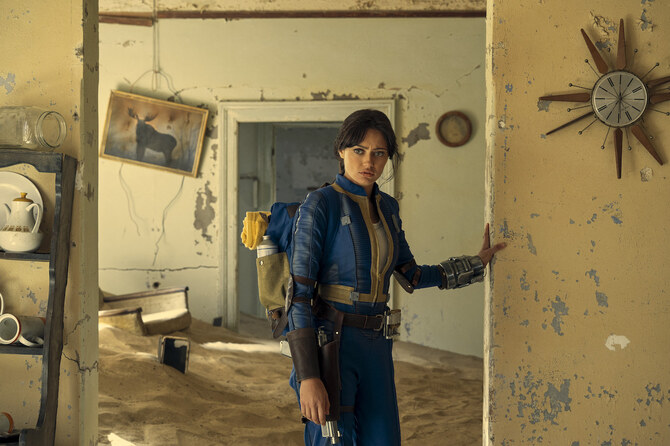
Adaptations of post-apocalyptic video games are proving hugely popular with viewers. “The Last of Us” was one of 2023’s finest shows, and the more cartoonish, but equally violent, “Fallout” thrilled us this year. Set in an alternate history in which a nuclear exchange between the US and China in 2077 drove many survivors underground into bunkers known as Vaults, “Fallout” centers on Lucy (Ella Purnell), who, more than two centuries after the bombs dropped, ventures into the wasteland that used to be Los Angeles to hunt for her father, who has been kidnapped by raiders. Having been raised in the safety and the — outwardly, at least — polite society of the Vault, Lucy is, let’s say, underprepared for the horrors that await.
‘Ripley’

Steven Zaillian’s adaptation of Patricia Highsmith’s psychological crime thriller novel “The Talented Mr. Ripley” is beautifully shot in black-and-white, with gorgeous, lingering shots of the Italian coast. If that sounds a bit highbrow, don’t worry; the plot explores the basest of human instincts. Tom Ripley (the excellent Andrew Scott), a down-on-his-luck con-man in 1960s New York, is hired by the wealthy Herbert Greenleaf to convince his wayward son Dickie to return home from Italy, where he is living a leisurely life at his father’s expense. But when Ripley sees Dickie’s leisurely luxurious life for himself, he decides he’d quite like a piece (or considerably more) of it.