ISLAMABAD: Pakistan on Tuesday defended the recent sentencing of 25 civilians by military courts for partaking in violent protests last year, dismissing concerns expressed by the United States (US), United Kingdom and the European Union (EU) regarding Islamabad’s global human rights obligations.
Pakistan’s military on Dec. 21 announced the sentencing of 25 people to “rigorous imprisonment” of two to 10 years for participating in violent protests on May 9, 2023, when hundreds carrying flags of former prime minister Imran Khan’s party attacked government and military installations.
The protests erupted after Khan’s brief detention on corruption charges, resulting in damage to major military facilities and martyrs’ monuments in the country. Khan’s party challenges the military’s version, denying it was involved in the violence and calling the May 9 incident a “false flag” operation aimed at crushing it.
The EU said on Sunday the sentencing was “inconsistent” with Pakistan’s international obligations and every person was entitled to a “fair and public trial in a court that is independent, impartial and competent.” The US and the UK joined the EU in expressing concern over the convictions, with the State Department saying on Monday the Pakistani military courts lacked “judicial independence and due process guarantees.”
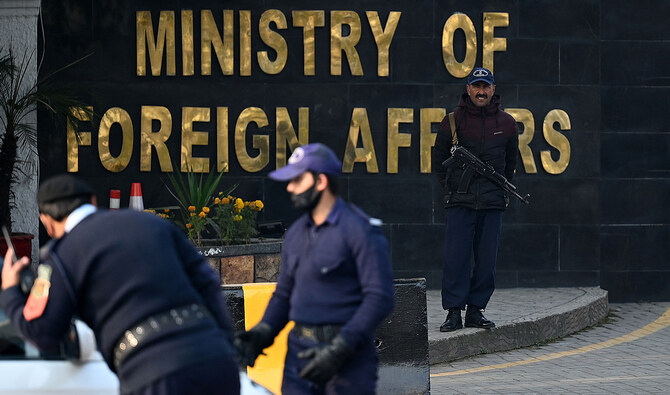
“Pakistan’s legal system is consistent with international human rights law including provisions of the International Covenant on Civil and Political Rights (ICCPR). It has remedies of judicial review by the superior courts and guarantees promotion and protection of human rights and fundamental freedoms,” the Pakistani foreign ministry said in a statement.
“Pakistan is fully committed to fulfilling all its international human rights obligations.”
The Foreign Office in London said while the UK respected Pakistan’s sovereignty over its own legal proceedings, “trying civilians in military courts lacks transparency, independent scrutiny and undermines the right to a fair trial.”
In its statement on Sunday, the EU had noted that under the its Generalized Scheme of Preferences Plus (GSP+), beneficiary countries, including Pakistan, had voluntarily agreed to effectively implement 27 international core conventions, including the ICCPR, in order to continue benefitting from the special trade arrangement. The preferential trade status under the GSP+ scheme grants Pakistani exports duty-free access to the European market.
The Pakistani foreign ministry responded by saying that the verdicts had been made under a law enacted by the Pakistan parliament and in line with a judgment of the country’s top court.
The Dec. 21 announcement of sentences by the military followed a ruling by a seven-member Constitutional Bench of the Supreme Court of Pakistan on Dec. 13, in which it allowed the military courts to share their verdicts. Prior to that, the top court had unanimously declared last year that prosecuting civilians in military courts was in violation of the Constitution.
“Pakistan believes in constructive and productive dialogue to promote principles of democracy, human rights and the rule of law. We remain fully committed to implementing our commitments under the GSP Plus Scheme and core international human rights conventions,” the foreign ministry said.
“We will continue to engage with our international partners including the European Union to uphold the international human rights law, without any discrimination and double standards.”
The sentencing of civilians in May 2023 riots cases has also raised concerns among supporters of ex-PM Khan, who has been in jail since August 2023 on a slew of charges, including inciting attacks against the armed forces, and may potentially be tried in a military court.
Pakistan has remained gripped by political unrest and uncertainty since Khan’s ouster from power through a parliamentary no-confidence vote in April 2022, which has also exacerbated Pakistan’s economic hardships.
The Pakistani government this week opened talks with Khan’s PTI opposition party in a bid to address political polarization. Senior government representatives have also recently acknowledged that the negotiations could offer a pathway out of the current political impasse.


Pakistan defends military court sentencing of civilians after US, UK and EU voice concerns
https://arab.news/8qtwk
Pakistan defends military court sentencing of civilians after US, UK and EU voice concerns

- Pakistan’s military on Dec. 21 announced the sentencing of 25 civilians for partaking in violent protests in May last year
- The US, UK and EU said the verdicts were ‘inconsistent’ with Pakistan’s international obligations and lacked ‘transparency’


Pakistan raises fuel prices by Rs55 per liter as Middle East conflict drives oil surge
- Government says adequate fuel stocks in place despite global energy shock
- Oil prices jump from about $78 to over $106 per barrel amid regional conflict
ISLAMABAD: Pakistan on Friday increased petrol and diesel prices by Rs55 ($0.20) per liter each as escalating conflict in the Middle East sent global oil prices sharply higher and disrupted energy supply routes, officials said.
Global oil markets have been rattled since coordinated strikes by the United States and Israel against Iran began last week, triggering retaliatory attacks across the region, raising fears of disruption to key energy shipping routes and pushing petroleum prices sharply upward.
The price adjustment in Pakistan was announced after a joint press conference by Finance Minister Muhammad Aurangzeb, Deputy Prime Minister and Foreign Minister Ishaq Dar and Petroleum Minister Ali Pervaiz Malik, who said the government was monitoring international energy markets and domestic supply conditions amid the crisis.
“So, the decision we have made by changing the levy a little bit is that we are going ahead with increasing the price of both fuels, petrol and diesel, by Rs55 ($0.20),” Malik told reporters.
“And as soon as this matter settles, we will revise the prices downward with the same speed and take steps on how to increase people’s income and purchasing power.”
He said Pakistan entered the crisis with “comfortable energy reserves” due to earlier planning but rising global prices had forced the government to adjust domestic fuel rates to maintain supply continuity.
He said international petrol prices had climbed from roughly $78 per barrel on March 1 to around $106.8 per barrel, while diesel prices had risen to about $150 per barrel.
Malik added that the government had taken steps to minimize the burden on consumers, noting diesel plays a critical role in agriculture, transportation and public mobility.
Malik also warned that authorities would take strict action against anyone attempting to hoard fuel or manipulate supply for profiteering.
The minister said Pakistan was working with international partners to secure additional energy supplies, including arrangements with Saudi Aramco and the use of Pakistan National Shipping Corporation vessels to transport crude oil imports.
Finance Minister Aurangzeb said a high-level government committee formed by Prime Minister Shehbaz Sharif had been meeting daily to review developments in global petroleum markets and their potential impact on Pakistan’s economy.
“Pakistan currently maintains adequate energy stocks and macroeconomic stability,” Aurangzeb said, adding that the government’s response was based on preparedness rather than panic.
He said the committee, which includes senior ministers, the governor of the State Bank of Pakistan and other officials, was assessing short-, medium- and long-term implications of the crisis for inflation, foreign exchange reserves and broader economic indicators.
Deputy PM Dar said the regional conflict had significantly disrupted global energy markets, with international petroleum prices rising by as much as 50–70 percent in recent days.
The deputy prime minister added that Pakistan was also engaged in diplomatic efforts aimed at de-escalating tensions and restoring stability in the region.
Petroleum prices will now be reviewed more frequently, potentially on a weekly basis, and any reduction in global oil prices would be passed on to consumers.
Pakistan, which relies heavily on imported fuel to meet its energy needs, is particularly vulnerable to global oil price shocks that can quickly feed into inflation and pressure the country’s external accounts.


