Morocco proposes family law reforms to improve women’s rights

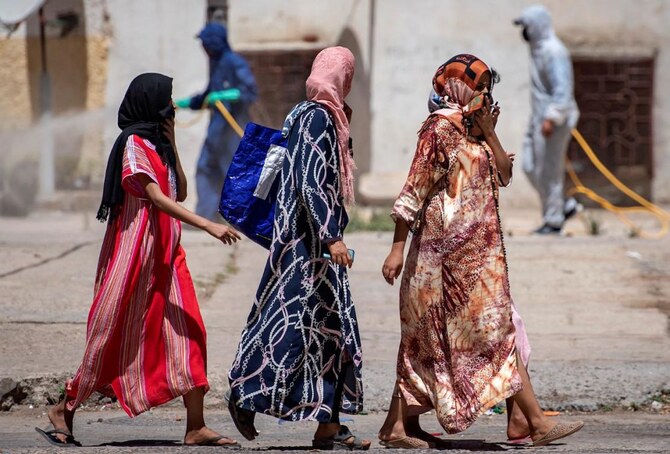
Morocco aims to grant women more rights over child custody and guardianship as well as a veto over polygamous marriage. (File/AFP) Morocco aims to grant women more rights over child custody and guardianship as well as a veto over polygamous marriage. (File/AFP)
Short Url
Updated 24 December 2024
Follow

Morocco proposes family law reforms to improve women’s rights

  • Draft code proposes more than 100 amendments, notably allowing women to stipulate opposition to polygamy in a marriage contract

RABAT: Morocco aims to grant women more rights over child custody and guardianship as well as a veto over polygamous marriage, in the first review of its family code in 20 years, the justice and Islamic affairs ministers said on Tuesday.
Women’s rights campaigners have been pushing for a revision of regulations governing the rights of women and children within the family in Morocco.
The draft code proposes more than 100 amendments, notably allowing women to stipulate opposition to polygamy in a marriage contract, justice minister Abdellatif Ouahbi told reporters.
In the absence of such opposition, a husband can take a second wife under certain circumstances such as the first wife’s infertility, he said, putting more restrictions on polygamy.
It also aims to simplify and shorten divorce procedures, considers chid custody a shared right between spouses and gives either spouse the right to retain the marital home in the event of the other’s death, he said.
Divorced women will be allowed to retain child custody upon remarriage and the code will restrict exceptions for underage marriage to 17 years, maintaining the legal marriage age of 18. While the revised code does not abolish the Islamic-based inheritance rule which grants a man twice the share of a woman, it allows individuals to gift any of their assets to their female heirs, Ouahbi said. But inheritances between spouses from different religions can only occur through wills or gifts. Moroccan women’s rights defenders, who have pushed particularly for equal inheritance laws, could not be reached for immediate comment.
King Mohammed VI, the country’s supreme religious authority, said on Monday that the amended code, which has to be submitted to parliament for approval, should be underpinned by “the principles of justice, equality, solidarity and harmony” with Islamic precepts and universal values to protect the Moroccan family.


Egypt coordinates with Greece to return victims of migrant boat, warns against irregular routes

Updated 1 min 12 sec ago
Follow

Egypt coordinates with Greece to return victims of migrant boat, warns against irregular routes

  • Egypt said 14 nationals were among the 34 migrants who died when a boat sank en route to Greece on 7 December

Egypt’s Foreign Minister Badr Abdelatty has instructed the Egyptian embassy in Athens to step up coordination with Greek authorities, Ahram Online reported on Tuesday. 

The ministry said 14 Egyptians were among the 34 migrants who died when a boat sank en route to Greece on 7 December.

The move aims to support survivors and expedite the repatriation of the victims’ bodies once legal procedures are completed.

The ministry added that the embassy has been in contact with the families of those who died to arrange the transfer of the remains back home.

Offering its condolences to the victims’ families, the ministry renewed its warning to citizens about the risks of irregular migration, urging Egyptians to safeguard their lives by using legal and regulated travel channels.

Egypt has intensified its efforts to curb irregular migration since launching a national strategy in 2016, with officials stressing that the country will not be used as a transit route to Europe.

Authorities say no migrant boats have departed from Egyptian shores since the strategy was introduced, despite Egypt hosting nearly 10 million foreign nationals, including refugees, asylum seekers, and migrants from 133 countries.

The approach has continued to evolve over the years, most recently with the adoption of the 2024–2026 national action plan by the National Committee for Combating and Preventing Illegal Migration and Trafficking in Persons.

Earlier initiatives have also supported these efforts, including the 2019 “Lifeboats” programme, which allocated EGP 250 million to create job opportunities in villages considered most vulnerable to irregular migration.

Egypt’s measures have drawn international support, with the European Union pledging €200 million in grants in March 2024 to bolster border management, search-and-rescue capabilities, and efforts to combat migrant smuggling.