

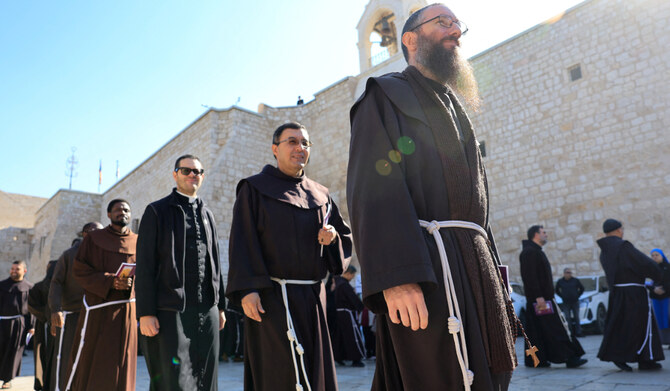

WEST BANK: For a second year running, there is no Christmas cheer in Bethlehem, with tourists shunning the Palestinian city and many residents seeking a way out as the Gaza war grinds on.
Bethlehem’s Manger Square in front of the Church of the Nativity is largely deserted and souvenir shops are shuttered.
Once again, there are no plans to put up the traditional light-festooned Christmas Tree in the ancient settlement that is venerated by Christians as the birthplace of Jesus and now sits in the Israeli-occupied West Bank.
“During these difficult times that our Palestinian cities are going through, especially in the Gaza Strip, it is difficult to show any signs of joy and happiness,” said Issa Thaljieh, an Orthodox priest who ministers at the Nativity Church.
Adding to the gloom, many local Christian families are also looking to escape, demoralized by both the tourist slump that has ravaged their economy, and the constant threat of violence hovering over the territory northeast of Gaza.
HIGHLIGHTS
• Once again, there are no plans to put up the traditional light-festooned Christmas Tree in the ancient settlement.
• Adding to the gloom, many local Christian families are also looking to escape, demoralized by both the tourist slump that has ravaged their economy.
“The emigration out of Bethlehem is increasing daily and monthly, and ... this has a negative impact on the city,” Thaljieh said.
Christian communities have been in decline across the Middle East for generations, and the West Bank is no exception.
In the last year of British rule over the region in 1947, some 85 percent of Bethlehem’s population were Christian. As of a 2017 census, the overall population of Bethlehem was 215,514 with only 23,000 Christians among them. That puts the percentage of Christians in Bethlehem in 2017 at around 10 percent.
Locals say the rate of departure has been gathering steam in recent months in the cradle of Christianity, with the economic lifeblood of the city no longer flowing and the Israeli occupation preventing freedom of movement around the territory.
Bethlehem resident Alaa Afteem, who runs a falafel restaurant, said one of his cousins had recently moved to Australia.
“Due to the bad living conditions and bad financial conditions, people have started looking for better opportunities for their children, for better education, for a better future,” he said.
Israel has built Jewish settlements, deemed illegal by most countries, across the territory. Israel disputes this, citing historical ties to the land. Several of its ministers live in settlements and favor their expansion.
Violence has surged across the hilly land since the start of the Hamas-Israel war in Gaza in October last year.
Hundreds of Palestinians — including armed fighters, stone-throwing youths and civilian bystanders — have died in clashes with Israeli security forces, while dozens of Israelis have been killed in Palestinian attacks, Israeli authorities say.
Difficult at the best of times, travel between West Bank cities has become increasingly fraught.
“There is no security if you are commuting between districts within the West Bank like between Bethlehem, Ramallah, Jericho, Hebron,” Afteem said.
Munther Isaac, a pastor at Bethlehem’s Lutheran Church, says local Muslim families have also been emigrating, squeezed by both financial problems and broader worries about the future.
“There is the fear that this war might extend to areas in the West Bank, especially after the arming of the settlers and the announcement of the possible annexation of the West Bank,” he said.
The West Bank has been transformed by the rapid growth of Jewish settlements over the past two years, with strident settlers pushing to impose Israeli sovereignty on the area.
Far-right National Security Minister Itamar Ben-Gvir said on X in October that since the start of the Gaza conflict more than 120,000 firearms had been distributed to Israeli settlers to protect themselves.
In Isaac’s church, the nativity scene has a figure of the baby Jesus lying in a pile of rubble. “We feel that this war will never end,” he said.


