Pakistan, UN agree to engage religious scholars, schools in combatting AIDS spread

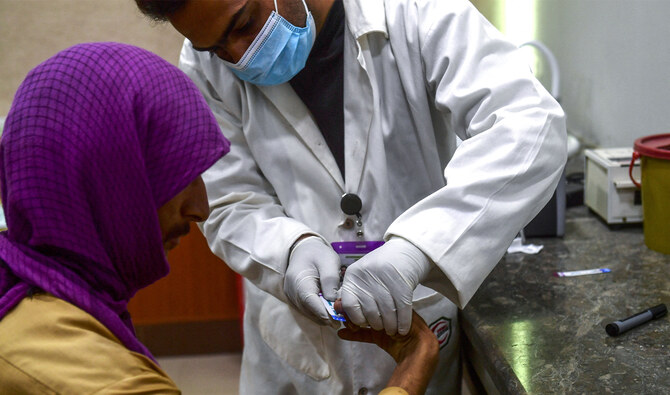
In this picture taken on March 26, 2021, a laboratory technician takes a blood sample from a man for an HIV test at a HIV treatment support centre in Rato Dero, in southern Sindh province. (AFP/File)
Short Url
Updated 24 December 2024
Follow

Pakistan, UN agree to engage religious scholars, schools in combatting AIDS spread

  • UN country director for AIDS urges Pakistani scholars to spread awareness about AIDS
  • Pakistan’s National AIDS Control Program has registered 72,515 HIV cases as of September

ISLAMABAD: Pakistan and the United Nations have agreed to strengthen cooperation to prevent Acquired Immunodeficiency Syndrome (AIDS) from spreading, state-run media reported on Tuesday, with both sides also exploring the possibility of employing religious scholars to raise awareness about the disease. 

HIV (human immunodeficiency virus) attacks and destroys infection-fighting CD4 cells (CD4 T lymphocytes) of the immune system, while AIDS is the most advanced stage of the disease. People with HIV who are not on medication and lack consistent control of the virus can transmit it through sexual intercourse, sharing needles, pregnancy, and breastfeeding. However, if HIV is properly controlled, the risk of transmission is nearly zero.

Pakistan is the second largest country in South Asia, only behind India and Nepal, in terms of the HIV epidemic, according to the National Institute of Health. Despite many efforts, the HIV infection rate has increased significantly over the past few years in the country. 

UN country director for AIDS, Trouble Chikoko, met with the Secretary of Religious Affairs and Interfaith Harmony Dr. Atta-ur-Rehman in Islamabad to discuss the various ongoing programs to curb the disease.

“Pakistan and the UN have agreed to enhance cooperation to curb the spread of AIDS,” Radio Pakistan said. “Chikoko said scholars and religious schools can play a positive role in raising awareness about AIDS prevention among the public.”

During the meeting, Rehman stressed the need for cooperation with relevant UN agencies and other partners to prevent AIDS, polio and other diseases from spreading across the country.

Pakistan’s National AIDS Control Program, established in 1986-87 aims to prevent and control the disease. It has registered 72,515 HIV cases as of September 2024, with 49,939 individuals currently on Antiretroviral Therapy (ART) in 94 centers across the country. 

According to the World Health Organization (WHO), since the start of the epidemic, 88.4 million people have been infected with HIV, and approximately 42.3 million have died from AIDS-related causes. By the end of 2023, an estimated 39.9 million people were living with HIV globally. 

Around 0.6 percent of adults aged 15–49 are living with HIV, although the impact of the epidemic varies significantly across countries and regions.


Pakistan urges equal application of international law, flags Indus treaty at UN debate

Updated 4 sec ago
Follow

Pakistan urges equal application of international law, flags Indus treaty at UN debate

  • Pakistani envoy says silence over violations of international law are fueling conflicts from South Asia to Gaza
  • He urges the UN secretary-general to use the Charter’s preventive tools more proactively to help avert conflicts

ISLAMABAD: Pakistan’s UN ambassador on Monday called for equal application of international law in resolving global conflicts, warning that India’s decision to hold the 1960 Indus Waters Treaty in abeyance and the unresolved dispute over Kashmir continued to threaten stability in South Asia.

Speaking at an open debate of the UN Security Council on “Leadership for Peace,” Ambassador Asim Iftikhar Ahmad said selective enforcement of international law and silence in the face of violations were fueling conflicts worldwide, undermining confidence in multilateral institutions.

His remarks come months after a brief but intense military escalation between India and Pakistan in May, following a gun attack on tourists in Indian-administered Kashmir. India blamed the attack on Pakistan, a charge Islamabad denied while calling for a transparent international probe.

The attack triggered a military standoff between the two South Asian nuclear neighbors and prompted New Delhi to suspend the World Bank-brokered Indus Waters Treaty, a move Pakistan says has no basis in international law and has described as “an act of war.”

“India’s unilateral suspension of the Indus Waters Treaty — a rare and enduring example of successful diplomacy — is yet another blatant breach of international obligations that undermines regional stability and endangers the lives and livelihoods of millions,” Ahmad told the council.

He said Jammu and Kashmir remained one of the oldest unresolved disputes on the Security Council’s agenda and required a just settlement in line with UN resolutions and the wishes of the Kashmiri people, a position India has long rejected.

Ahmad broadened his remarks to global conflicts, citing Gaza, Ukraine, Sudan and other crises, and said peace could not be sustained through “selective application of international law” or by sidelining the United Nations when violations occur.

The Pakistani envoy also referred to the Pact for the Future, a political declaration adopted by UN member states this year aimed at strengthening multilateral cooperation, accelerating progress toward the 2030 development goals and reforming global governance institutions.

While welcoming the pact, Ahmad warned that words alone would not deliver peace, pointing to widening development financing gaps, rising debt distress and climate shocks that he said were reversing development gains across much of the Global South.

He called for a stronger and more proactive role for the UN Secretary-General, including earlier use of preventive tools under the UN Charter, and urged the Security Council to demonstrate credibility through consistency, conflict prevention and greater respect for international court rulings.

“No nation can secure peace alone,” Ahmad said. “It is a collective endeavor, requiring leadership, cooperation and genuine multilateralism.”