

Pakistan government’s coalition partner calls for ‘digital bill of rights’ amid Internet clampdown

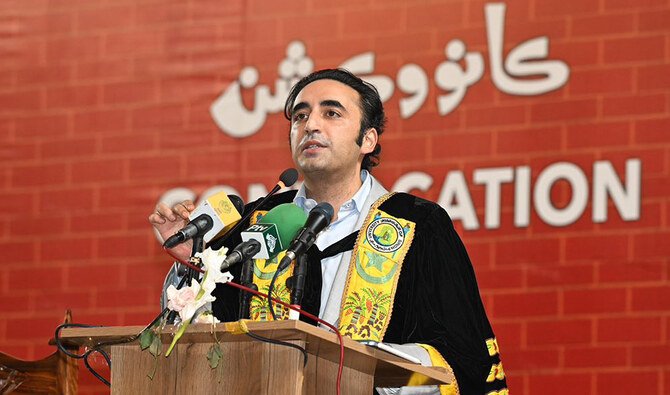
Bilawal Bhutto-Zardari, chairman of the Pakistan Peoples Party, is addressing a convocation ceremony at the University of Sindh in Jamshoro, Pakistan, on December 23, 2024. (PPP/X)
Short Url
Updated 24 December 2024
Follow

Pakistan government’s coalition partner calls for ‘digital bill of rights’ amid Internet clampdown

  • Pakistani authorities have been criticized for cracking down on VPNs, installing firewall that has curbed Internet speeds 
  • PPP Chairman Bilawal Bhutto-Zardari criticizes disconnect between Pakistan’s policymakers and citizens’ digital realities 

ISLAMABAD: A key coalition partner of Prime Minister Shehbaz Sharif’s administration on Monday called for a “digital bill of rights,” criticizing Pakistan’s restrictive Internet policies during a university graduation ceremony in southern Sindh.

The government has faced sharp criticism from activists and opposition parties for what they describe as a digital clampdown in recent months. A proposed national firewall, ostensibly designed to curb “anti-state propaganda” and “blasphemous content,” has slowed Internet speeds across the country.

The Pakistan Telecommunication Authority (PTA) has also intensified its crackdown on virtual private networks (VPNs), allowing their legal use only after users register with the government— posing challenges for freelancers and businesses relying on online access.

“We must strive for a digital bill of rights for our era,” Bilawal Bhutto-Zardari, chairman of the Pakistan Peoples Party, said at the Sindh University Jamshoro. “This digital bill of rights should not be something I write on my own, declaring, ‘These are your rights,’ and then campaign for it.”

“No,” he added. “I want us— you, me, the students and the youth of this country— to collectively draft our own digital bill of rights, based on what we believe are our inalienable rights.”

He maintained these rights could not be taken away from the people of Pakistan, though the “elders, bureaucrats, and politicians sitting in Islamabad simply do not understand them.”

Bhutto-Zardari criticized the government’s restrictions while hinting at a disconnect between policymakers and the digital realities faced by citizens.

“They don’t understand because they don’t use these technologies— it doesn’t affect them,” he said. “Whether the Internet is slowed down or VPNs are blocked, it doesn’t matter to them.

But it will make your life miserable, and it will make my life miserable. This is our democratic right, and we will fight for our rights.”

Earlier this month, Minister of State for IT and Telecom Shaza Fatima Khawaja defended Internet restrictions, citing security concerns.

“No one is interested in shutting down the Internet,” she told parliament. “Law and order is paramount for us, but we will make every effort to ensure no disruption to the industry.”


Pakistan court directs authorities to form medical board to assess Imran Khan’s eye condition

Updated 12 March 2026
Follow

Pakistan court directs authorities to form medical board to assess Imran Khan’s eye condition

  • Islamabad High Court rejects jailed ex-PM’s request for immediate transfer to private hospital
  • Medical board comprising doctors from PIMS and Shifa to submit report on possible transfer

ISLAMABAD: A Pakistani high court on Thursday directed authorities to form a medical board of government doctors to assess whether jailed former prime minister Imran Khan needs to be transferred to a hospital, his party said, following a rejection of his request to be moved to a private facility for treatment.

The development comes after the Pakistan Institute of Medical Sciences (PIMS) said last week that Khan’s vision had “improved remarkably” since he was given an Anti-VEGF injection amid concerns related to his eyesight.

Anti-VEGF injections are commonly used to treat retinal vein occlusion and other retinal vascular disorders by reducing swelling and abnormal blood vessel growth inside the eye. Prior to the development, the ex-premier had complained of rapid deterioration in vision in one of his eyes.

“The Islamabad High Court has rejected Imran Khan’s request for immediate transfer to Shifa International Hospital,” the Pakistan Tehreek-e-Insaf (PTI) party said in a post on X.

“The court directed that the Chief Commissioner immediately constitute a medical board comprising doctors from PIMS and Shifa Hospital,” it continued. “The medical board will submit a report, on the basis of which the Chief Commissioner will decide whether a hospital transfer is to take place or not.”

The PTI said the court’s decision had raised questions over the judiciary’s independence.

“Delaying a medical emergency and handing it over to administrative discretion is a violation of human rights,” it said. “The issue of Imran Khan’s health is not just about one individual but reflects the entire judicial and state system.”

The 74-year-old cricketer-turned politician has been in prison since August 2023 in cases that he and his party say are politically motivated.

Khan was taken to PIMS for a medical procedure earlier this year, as his party questioned the transparency of the medical update and demanded independent access to his care.

Khan was removed from office in April 2022 through a parliamentary vote of no confidence that he says was orchestrated at the behest of the former administration in Washington by his political rivals with backing from the military. His allegation has been denied by all parties involved.

Since his imprisonment, Khan has faced multiple convictions and ongoing legal proceedings that authorities say follow due process, while his party describes them as efforts to sideline him from politics.