Oil Updates — prices stable as data offsets surplus concerns

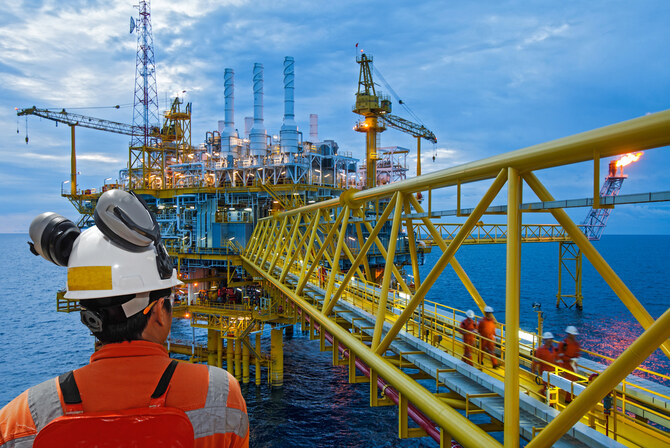
Brent crude futures rose 36 cents, or 0.5 percent, to $73.30 a barrel by 07:21 a.m. Saudi time. US West Texas Intermediate crude futures climbed 39 cents, or 0.6 percent, to $69.85 per barrel. Shutterstock
Short Url
Updated 23 December 2024
Follow

Oil Updates — prices stable as data offsets surplus concerns

  • Renewed hope on rate cuts after a benign inflation reading
  • Market surplus to drag down oil prices in 2025

LONDON: Oil prices stabilized on Monday after losses last week as lower-than-expected US inflation data offset investors’ concerns about a supply surplus next year.
Brent crude futures were down by 38 cents, or 0.52 percent, to $72.56 a barrel by 4:00 p.m. Saudi time. US West Texas Intermediate crude futures were down 34 cents, or 0.49 percent, to $69.12 per barrel.
Oil prices rose in early trading after data on Friday that showed cooling US inflation helped alleviate investors’ concerns after the Federal Reserve interest rate cut last week, IG markets analyst Tony Sycamore said.
“I think the US Senate passing legislation to end the brief shutdown over the weekend has helped,” he added.
But gains were reversed by a stronger US dollar, UBS analyst Giovanni Staunovo told Reuters.
“With the US dollar changing from weaker to stronger, oil prices have given up earlier gains,” he said.
The dollar was hovering around two-year highs on Monday morning, after hitting that milestone on Friday.
Brent futures fell by around 2.1 percent last week, while WTI futures lost 2.6 percent, on concerns about global economic growth and oil demand after the US central bank signalled caution over further easing of monetary policy. Research from Asia’s top refiner Sinopec pointing to China’s oil consumption peaking in 2027 also weighed on prices.
Macquarie analysts projected a growing supply surplus for next year, which will hold Brent prices to an average of $70.50 a barrel, down from this year’s average of $79.64, they said in a December report.
Concerns about European supply eased on reports the Druzhba pipeline, which sends Russian and Kazakh oil to Hungary, Slovakia, the Czech Republic and Germany, has restarted after halting on Thursday due to technical problems at a Russian pumping station.
US President-elect Donald Trump on Friday urged the European Union to increase US oil and gas imports or face tariffs on the bloc’s exports.
Trump also threatened to reassert US control over the Panama Canal on Sunday, accusing Panama of charging excessive rates to use the Central American passage and drawing a sharp rebuke from Panamanian President Jose Raul Mulino. 


‘The future is renewables,’ Indian energy minister tells World Economic Forum

Updated 22 January 2026
Follow

‘The future is renewables,’ Indian energy minister tells World Economic Forum

  • ‘In India, I can very confidently say, affordability (of renewables) is better than fossil fuel energy,’ says Pralhad Venkatesh Joshi during panel discussion
  • Renewables are an increasingly important part of the energy mix and the technology is evolving rapidly, another expert says at session titled ‘Unstoppable March of Renewables?’

BEIRUT: “The future is renewables,” India’s minister of new and renewable energy told the World Economic Forum in Davos on Wednesday.
“In India, I can very confidently say, affordability (of renewables) is better than fossil fuel energy,” Pralhad Venkatesh Joshi said during a panel discussion titled “Unstoppable March of Renewables?”
The cost of solar power has has fallen steeply in recent years compared with fossil fuels, Joshi said, adding: “The unstoppable march of renewables is perfectly right, and the future is renewables.”
Indian authorities have launched a major initiative to install rooftop solar panels on 10 million homes, he said. As a result, people are not only saving money on their electricity bills, “they are also selling (electricity) and earning money.”
He said that this represents a “success story” in India in terms of affordability and “that is what we planned.”
He acknowledged that more work needs to be done to improve reliability and consistency of supplies, and plans were being made to address this, including improved storage.
The other panelists in the discussion, which was moderated by Godfrey Mutizwa, the chief editor of CNBC Africa, included Marco Arcelli, CEO of ACWA Power; Catherine MacGregor, CEO of electricity company ENGIE Group; and Pan Jian, co-chair of lithium-ion battery manufacturer Contemporary Amperex Technology.
Asked by the moderator whether she believes “renewables are unstoppable,” MacGregor said: “Yes. I think some of the numbers that we are now facing are just proof points in terms of their magnitude.
“In 2024, I think it was 600 gigawatts that were installed across the globe … in Europe, close to 50 percent of the energy was produced from renewables in 2024. That has tripled since 2004.”
Renewables are an increasingly important and prominent part of the energy mix, she added, and the technology is evolving rapidly.
“It’s not small projects; it’s the magnitude of projects that strikes me the most, the scale-up that we are able to deliver,” MacGregor said.
“We are just starting construction in the UAE, for example. In terms of solar size it’s 1.5 gigawatts, just pure solar technology. So when I see in the Middle East a round-the-clock project with just solar and battery, it’s coming within reach.
“The technology advance, the cost, the competitiveness, the size, the R&D, the technology behind it and the pace is very impressive, which makes me, indeed, really say (renewables) is real. It plays a key role in, obviously, the energy demand that we see growing in most of the countries.
“You know, we talk a lot about energy transition, but for a lot of regions now it is more about energy additions. And renewables are indeed the fastest to come to market, and also in terms of scale are really impressive.”
Mutizwa asked Pan: “Are we there yet, in terms of beginning to declare mission accomplished? Are renewables here to stay?”
“I think we are on the road but (its is) very promising,” Pan replied. There is “great potential for future growth,” he added, and “the technology is ready, despite the fact that there are still a lot of challenges to overcome … it is all engineering questions. And from our perspective, we have been putting in a lot of resources and we are confident all these engineering challenges will be tackled along the way.”
Responding to the same question, Arcelli said: “Yes, I think we are beyond there on power, but on other sectors we are way behind … I would argue today that the technology you install by default is renewables.
“Is it a universal truth nowadays that renewables are the cheapest?” asked Mutizwa.
“It’s the cheapest everywhere,” Arcelli said.