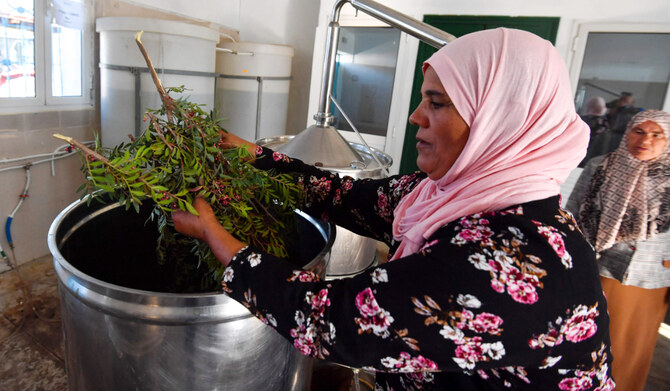

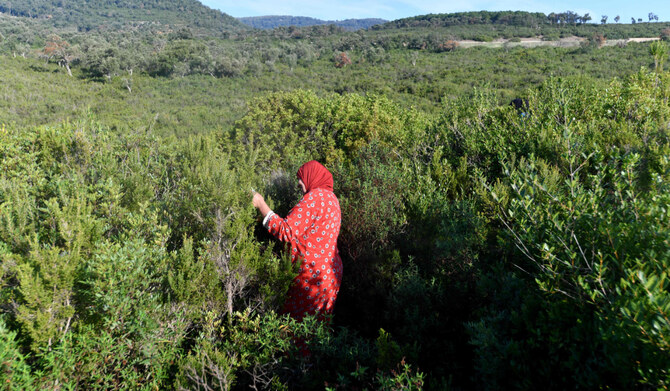

TUNIS: On a hillside in Tunisia’s northwestern highlands, women scour a sun-scorched field for the wild herbs they rely on for their livelihoods, but droughts are making it ever harder to find the precious plants.
Yet the harvesters say they have little choice but to struggle on, as there are few opportunities in a country hit hard by unemployment, inflation and high living costs.
“There is a huge difference between the situation in the past and what we are living now,” said Mabrouka Athimni, who heads a local collective of women herb harvesters named “Al-Baraka.”
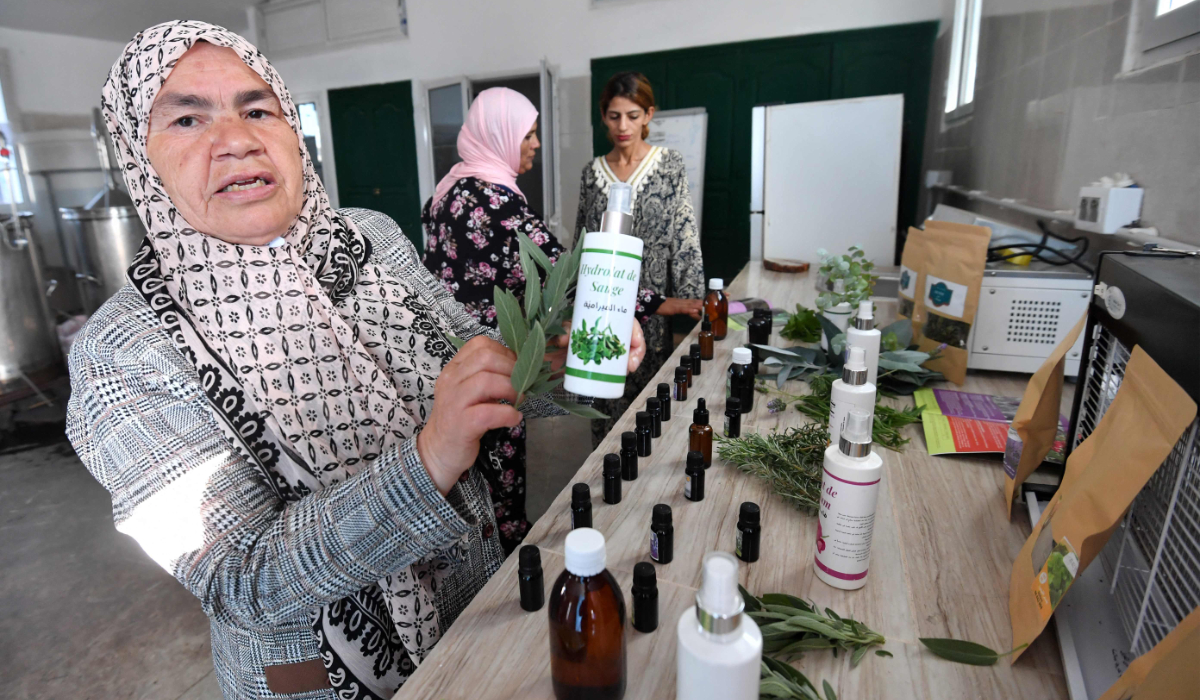
Mabrouka Athimni, who heads a local collective of women herb harvesters named "Al Baraka" ("Blessing") shows oil extracted from plants in a laboratory in Tbainia village near the city of Ain Drahem, in the north west of Tunisia on November 6, 2024. (AFP)
“We’re earning half, sometimes just a third, of what we used to.”
SPEEDREAD
Yet the harvesters say they have little choice but to struggle on, as there are few opportunities in a country hit hard by unemployment and high living costs.
Tunisia produces around 10,000 tonnes of aromatic and medicinal herbs each year, according to official figures.
Rosemary accounts for more than 40 percent of essential oil exports, mainly destined for French and American markets.
For the past 20 years, Athimni’s collective has supported numerous families in Tbainia, a village near the city of Ain Draham in a region with much higher poverty rates than the national average.
Women, who make up around 70 percent of the agricultural workforce, are the main breadwinners for their households in Tbainia.
Tunisia is in its sixth year of drought and has seen its water reserves dwindle, as temperatures have soared past 50 degrees Celsius in some areas during the summer.
The country has 36 dams, mostly in the northwest, but they are currently just 20 percent full — a record low in recent decades.
The Tbainia women said they usually harvested plants like eucalyptus, rosemary and mastic year-round, but shrinking water resources and rare rainfall have siphoned oil output.
“The mountain springs are drying up, and without snow or rain to replenish them, the herbs yield less oil,” said Athimni.
Mongia Soudani, a 58-year-old harvester and mother of three, said her work was her household’s only income. She joined the collective five years ago.
“We used to gather three or four large sacks of herbs per harvest,” she said. “Now, we’re lucky to fill just one.”
Forests in Tunisia cover 1.25 million hectares, about 10 percent of them in the northwestern region.
Wildfires fueled by drought and rising temperatures have ravaged these woodlands, further diminishing the natural resources that women like Soudani depend on.
In the summer of last year, wildfires destroyed around 1,120 hectares near Tbainia.
“Parts of the mountain were consumed by flames, and other women lost everything,” Soudani recalled.
To adapt to some climate-driven challenges, the women received training from international organizations, such as the Food and Agriculture Organization, to preserve forest resources.
Still, Athimni struggles to secure a viable income.
“I can’t fulfil my clients’ orders anymore because the harvest has been insufficient,” she said.
The collective has lost a number of its customers as a result, she said.