

Civilians suffer as rival forces seek foothold in wider Darfur region

1 / 2
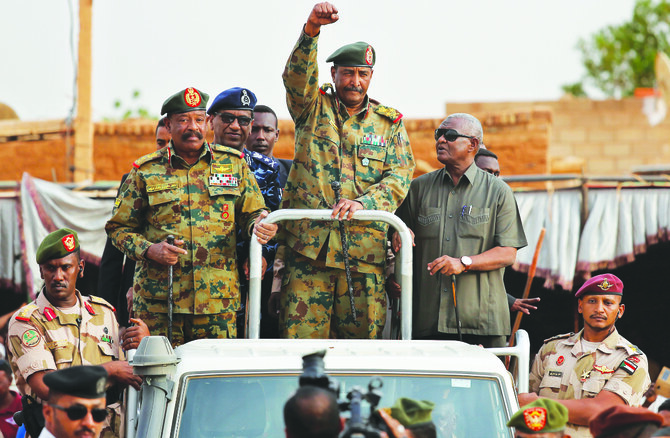
Gen. Abdel-Fattah Al-Burhan, head of Sudan’s military council, waves to supporters in Omdurman district, west of Khartoum. (AP file photo)
2 / 2
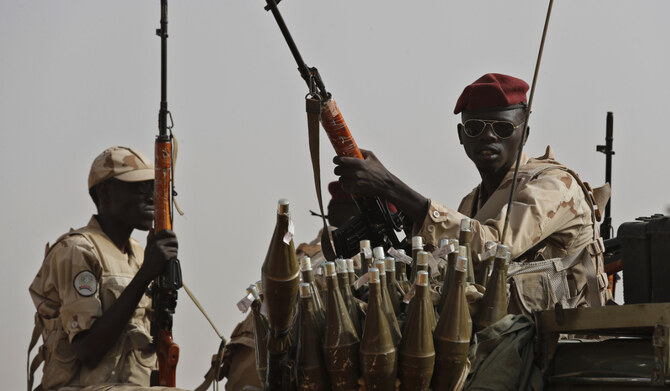
Sudanese soldiers from the Rapid Support Forces unit, led by Gen. Mohammed Hamdan Dagalo, the deputy head of the military council, secure the area where Dagalo attends a military-backed tribe's rally, in the East Nile province, Sudan, on June 22, 2019. (AP)
Short Url
Updated 22 December 2024
Follow

Civilians suffer as rival forces seek foothold in wider Darfur region

  • Rapid Support Forces seize back control of key logistical base

DUBAI/CAIRO: Sudan’s Rapid Support Forces (RSF) seized back control of a key logistical base in North Darfur on Sunday, the paramilitary group said, a day after it was taken by rival forces allied with Sudan’s army.
The conflict between the RSF and the army erupted in April 2023, and some of the fiercest fighting has taken place in North Darfur as the army and allied Joint Forces — a collection of former rebel groups — battle to maintain a last foothold in the wider Darfur region.
The Joint Forces and the army said in statements they had taken control on Saturday of the Al-Zurug base, which the RSF has used during the 20-month war as a logistical base to channel supplies from over the nearby borders with Chad and Libya.

BACKGROUND

• The conflict between the RSF and the army erupted in April 2023, and some of the fiercest fighting has taken place in North Darfur.

• Since fighting picked up in Al-Fashir in mid-April, at least 782 civilians have been killed, according to a UN human rights report.

Dozens of RSF soldiers were killed, vehicles destroyed and supplies captured as they captured the base, they said.
The incident could inflame ethnic tensions between the Arab tribes that form the base of the RSF and the Zaghawa tribe that forms most of the Joint Forces, analysts say.
The RSF accused Joint Forces fighters of killing civilians and burning down nearby homes and public amenities during the raid.
“The Joint Forces carried out ethnic cleansing against innocent civilians in Al-Zurug and intentionally killed children, women, and the elderly and burnt and destroyed wells and markets and homes and the health center and schools,” it said in a statement on Sunday.
The Joint Forces said the base had been used by the RSF as a “launching point for barbaric operations against civilians” in areas including Al-Fashir, the capital of North Darfur state and one of the most active frontlines in the fighting.
Since fighting picked up in Al-Fashir in mid-April, at least 782 civilians have been killed, according to a UN human rights report, the result of attacks via “intense” heavy artillery and suicide drones from the RSF and airstrikes and artillery strikes by the army.
On Sunday, activists from the Al-Fashir Resistance Committee reported an onslaught of at least 30 missiles fired on different parts of the city.
Seizing control of the city would bolster the RSF’s attempt to install a parallel government to the national government in Port Sudan, analysts say.


Iraq says it will prosecute Daesh detainees sent from Syria

Updated 57 min 38 sec ago
Follow

Iraq says it will prosecute Daesh detainees sent from Syria

  • Iraq government says transfer was pre-emptive step to protect national security
  • Prisoners have been held for years in jails and camps guarded by the Kurdish-led SDF

BAGHDAD: Iraq’s Supreme Judicial Council said on Thursday it would begin ​legal proceedings against Daesh detainees transferred from Syria, after the rapid collapse of Kurdish-led forces in northeast Syria triggered concerns over prison security.
More than 10,000 members of the ultra-hard-line militant group have been held for years in about a dozen prisons and detention camps guarded by the Kurdish-led Syrian Democratic Forces (SDF) in Syria’s northeast.
The US military said on Tuesday its forces had transferred 150 Daesh detainees from Syria to Iraq and that the operation could eventually see up to 7,000 detainees moved out of Syria.
It cited concerns over security at the prisons, which also hold thousands more women and children with ties to the militant group, after military setbacks ‌suffered by the ‌SDF.
A US official told Reuters on Tuesday that about 200 low-level ‌Daesh ⁠fighters ​escaped from ‌Syria’s Shaddadi prison, although Syrian government forces had recaptured many of them.
Iraqi officials said Prime Minister Mohammed Shia Al-Sudani mentioned the transfer of Daesh prisoners to Iraq in a phone call with Syrian President Ahmad Al-Sharaa on Tuesday, adding that the transfers went ahead following a formal request by the Iraqi government to Syrian authorities.
Iraqi government spokesperson Basim Al-Awadi said the transfer was “a pre-emptive step to protect Iraq’s national security,” adding that Baghdad could not delay action given the rapid pace of security and political developments in Syria.
Daesh emerged in Iraq and Syria, and at the ⁠height of its power from 2014-2017 held swathes of the two countries. The group was defeated after a military campaign by ‌a US-led coalition.
An Iraqi military spokesperson confirmed that Iraq had received ‍a first batch of 150 Daesh detainees, including ‍Iraqis and foreigners, and said the number of future transfers would depend on security and field assessments. The ‍spokesperson described the detainees as senior figures within the group.
In a statement, the Supreme Judicial Council said Iraqi courts would take “due legal measures” against the detainees once they are handed over and placed in specialized correctional facilities, citing the Iraqi constitution and criminal laws.
“All suspects, regardless of their nationalities or positions within the terrorist ​organization, are subject exclusively to the authority of the Iraqi judiciary,” the statement said.
Iraqi officials say under the legal measures, Daesh detainees will be separated, with senior figures including foreign nationals to ⁠be held at a high-security detention facility near Baghdad airport that was previously used by US forces.
Two Iraqi legal sources said the Daesh detainees sent from Syria include a mix of nationalities, with Iraqis making up the largest group, alongside Arab fighters from other countries as well as European and other ‌Western nationals.
The sources said the detainees include nationals of Britain, Germany, France, Belgium and Sweden, and other European Union countries, and will be prosecuted under Iraqi jurisdiction.