Saudi Joint Forces commander meets Yemeni Presidential Leadership Council member for security cooperation talks

1 / 2
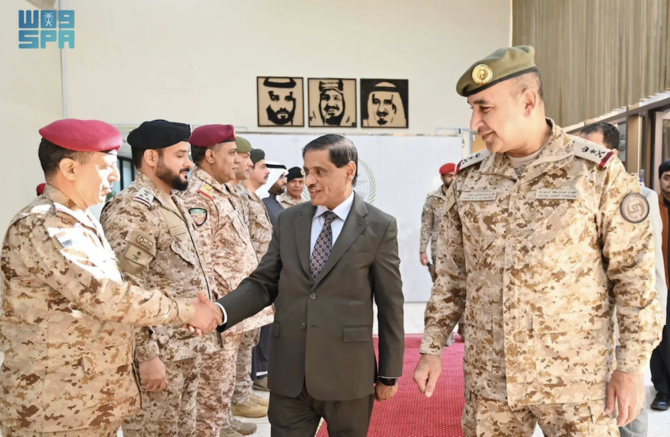
Lieut. Gen. Fahd bin Hamad Al-Salman, commander of the Joint Forces, met with Faraj Salmeen Al-Bahsani, member of the Yemeni Presidential Leadership Council, at the Joint Forces Command headquarters in Riyadh on Sunday. (SPA)
2 / 2
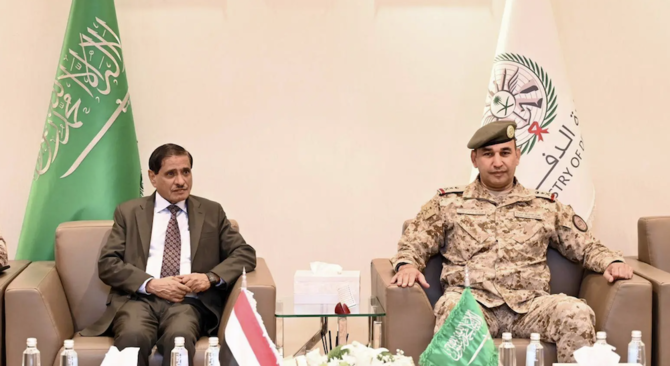
Lieut. Gen. Fahd bin Hamad Al-Salman, commander of the Joint Forces, met with Faraj Salmeen Al-Bahsani, member of the Yemeni Presidential Leadership Council, at the Joint Forces Command headquarters in Riyadh on Sunday. (SPA)
Short Url
Updated 22 December 2024
Follow

Saudi Joint Forces commander meets Yemeni Presidential Leadership Council member for security cooperation talks

  • Meeting focused on strengthening cooperation between Joint Forces Command and Yemeni Presidential Leadership Council

RIYADH: Lieut. Gen. Fahd bin Hamad Al-Salman, commander of the Joint Forces, met with Faraj Salmeen Al-Bahsani, member of the Yemeni Presidential Leadership Council, at the Joint Forces Command headquarters in Riyadh on Sunday.

The meeting focused on strengthening cooperation between the Joint Forces Command and the Yemeni Presidential Leadership Council, the Saudi Press Agency reported.

Discussions also centered on enhancing the ongoing support provided by Saudi Arabia through the Joint Forces to promote security and stability in Yemen.

During the reception, Al-Bahsani commended the Kingdom’s role in supporting Yemen’s efforts to achieve stability.

He emphasized the importance of continuing strategic cooperation between the two countries to address the challenges currently facing Yemen.

Al-Bahsani thanked the Saudi leadership for their unwavering support across various fields, noting that this collaboration plays a vital role in advancing stability in Yemen and the wider region, SPA reported.

The meeting underscored the Kingdom’s commitment to fostering peace and stability in Yemen as part of its broader efforts to address regional security challenges, SPA added.


Pioneering electric bus service takes to the road in Makkah

Updated 19 December 2025
Follow

Pioneering electric bus service takes to the road in Makkah

  • The bus rapid transit project, a system designed to have higher capacity and reliability than conventional bus services, is said to be the first of its kind in the Kingdom
  • The vehicles operate in dedicated bus lanes within a network that includes two main bus stations and 11 stops along the route connecting them

MAKKAH: A pioneering electric bus service took to the road in Makkah this week.

Electromin, the developer and operator of the service in partnership with Umm Al-Qura for Development and Construction, said it is expected to serve more than 125 million passengers over the next 15 years, while cutting carbon dioxide emissions by more than 31,500 tonnes compared with traditional vehicles.

The bus rapid transit project, a system designed to have higher capacity and reliability than conventional bus services, is said to be one of the first of its kind in the Kingdom. It was inaugurated on Wednesday by Amr Al-Dabbagh, chairperson of Al-Dabbagh Group; Samir Nawar, managing director of Petromin; and Yasser Abu Ateeq, CEO of Umm Al-Qura.

The bus rapid transit project is designed to have higher capacity and reliability than conventional bus services. (Supplied)

Electromin, a subsidiary of Petromin specializing in energy and mobility solutions, said the new service, which forms part of the Masar Destination mixed-use real estate development project in Makkah, is one the first transport networks of its kind in the country, and represents a significant shift toward a cleaner, more efficient urban transport model.

It operates in dedicated bus lanes, connecting key hubs within Masar and providing safe, reliable and environmentally friendly transportation for residents and visitors, the company added. The network includes two main bus stations and 11 stops along the route connecting them. It has been designed to serve more than 5 million visitors and pilgrims annually, and to be easily accessible to all users.

Operators say the service is designed as a foundation for Makkah’s future transportation system, through its integration with the broader Masar project, which includes pedestrian walkways, more than 5,000 parking spaces, metro services and other urban infrastructure.