Islamabad urges Afghanistan to boost border security as infiltration attempt kills five

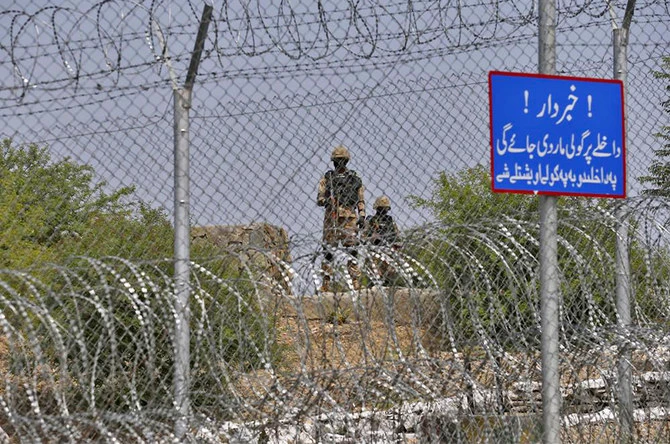
Pakistani troops patrol a fence along the Pak-Afghan border near Torkham in Khyber district on August 3, 2021. (AN Photo/File)
Short Url
Updated 21 December 2024
Follow

Islamabad urges Afghanistan to boost border security as infiltration attempt kills five

  • Military says four TTP fighters and a soldier were killed as militants tried to enter Pakistani territory
  • Statement comes after media reported a deadly attack on a military outpost that killed 16 soldiers

ISLAMABAD: The Pakistan military on Saturday urged the Taliban administration in Kabul to ensure robust border management after a group of militants tried to infiltrate from Afghanistan, leading to a skirmish that left four infiltrators and a soldier dead.
Relations between Islamabad and Kabul have deteriorated in recent years as militant violence surged in Pakistan, fueled by attacks from Tehreek-e-Taliban Pakistan (TTP) militants in the northwestern Khyber Pakhtunkhwa province.
Pakistani officials blame the TTP for the escalating violence, accusing the Afghan authorities of turning a blind eye to militants using their territory to launch cross-border attacks.
However, Kabul denies these allegations, insisting that Pakistan’s internal security is its own responsibility.
“On night 19/20 December, movement of a group of khwarij [TTP militants], trying to infiltrate through Pakistan-Afghanistan border, was picked up by the security forces in general area Rajgal, Khyber District,” the military’s media wing, Inter-Services Public Relations, said in a statement. “Own troops effectively engaged and thwarted their attempt to infiltrate. Resultantly, four Khwarij were sent to hell.”
The statement noted that one of the soldiers, Sepoy Amir Sohail Afridi, also lost his life amid intense exchange of fire.
“Pakistan has consistently been asking Interim Afghan Government to ensure effective border management on their side of the border,” it continued. “Interim Afghan Government is expected to fulfil its obligations and deny the use of Afghan soil by Khwarij for perpetuating acts of terrorism against Pakistan.”
The ISPR statement comes after media reported a deadly attack on a military outpost in Khyber Pakhtunkhwa which was targeted by 30 militants from three sides. According to anonymous intelligence sources, the attack left 16 soldiers dead. The TTP claimed responsibility for targeting the outpost in a statement that described the attack as a retaliation to the recent killings of its top commanders.
The Pakistan military reiterated in its statement it remained committed to securing the borders. It added that its soldiers would also fight to eliminate the menace of militant violence.
Pakistan highlights Gwadar transshipment role as shipping routes face disruption over regional tensions

Updated 05 March 2026
Follow

Pakistan highlights Gwadar transshipment role as shipping routes face disruption over regional tensions

  • Pakistani ports possess “untapped potential” to attract global shipping lines for transshipment operations, says minister
  • Pakistan eyes leveraging Gwadar as regional transshipment hub as Iran’s closure of Strait of Hormuz disrupts global maritime trade

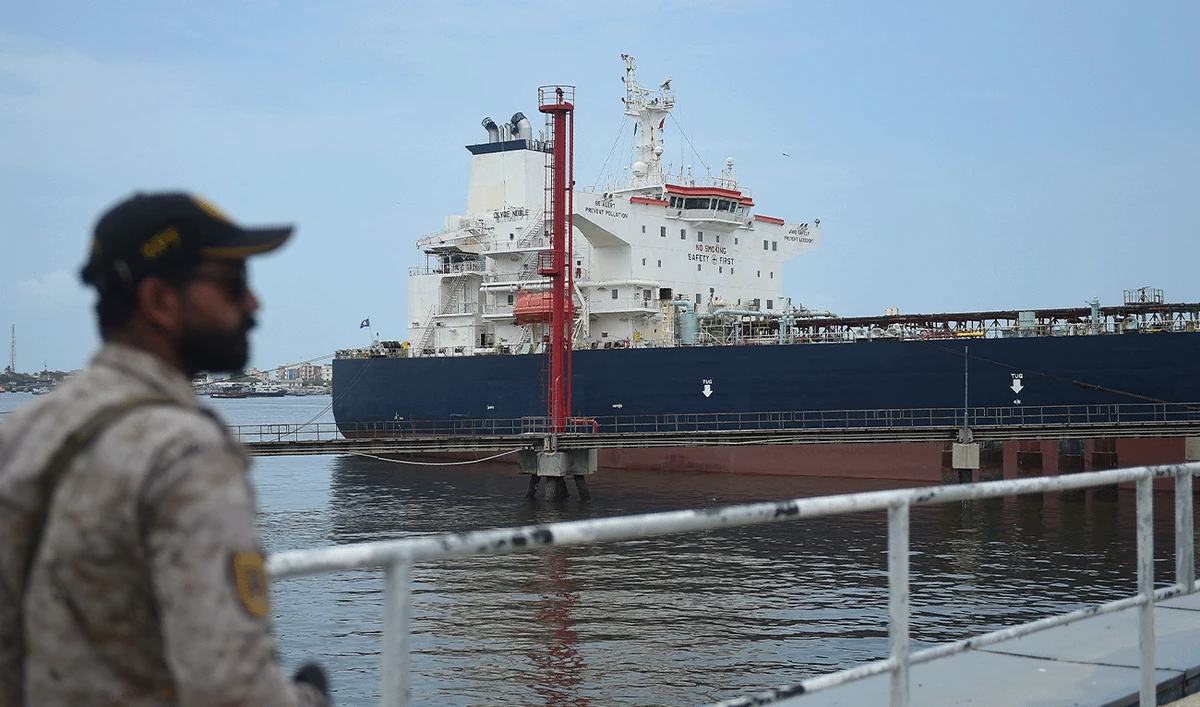
KARACHI: Pakistan’s Maritime Affairs Minister Junaid Anwar Chaudhry on Thursday highlighted the importance of the port city of Gwadar’s transshipment role as major shipping routes, including the Strait of Hormuz, face disruption due to Iran’s ongoing conflict with the US and Israel in the Gulf. 

The meeting takes place as Iran has effectively closed the Strait of Hormuz, a strategic waterway that lies between it and Oman. It is one of the world’s most critical oil transit routes, with roughly 20 percent of global oil supplies passing through it. Iran has vowed it will attack any ship that enters the strait, causing energy prices to rise sharply on Monday amid disruptions to tanker traffic in the waterway.

Gwadar is a deep-sea port in Pakistan’s southwestern Balochistan province that lies close to the Strait of Hormuz. Pakistani officials have in the past highlighted Gwadar’s geostrategic position as the shortest trade route to the Gulf and Central Asia, stressing that it has the potential to become a regional transshipment hub.

Chaudhry chaired a high-level meeting of government officials to assess emerging logistical challenges facing Pakistan’s trade, particularly in the energy sector, amid tensions in the Gulf. 

“Special focus was placed on fully leveraging the potential of Gwadar Port as a regional transshipment hub and positioning it as an alternative of regional instability,” Pakistan’s maritime affairs ministry said in a statement. 

The minister said Pakistani ports possessed “significant untapped potential” to attract international shipping lines for transshipment operations, noting that it could also ensure long-term sustainability and growth of the country’s maritime sector.

Participants of the meeting discussed measures to strengthen Pakistan’s position as a viable alternative transit and transshipment destination, as key waterways are affected by the disruption. 

The committee also reviewed proposals to amend relevant rules and regulations to facilitate international transshipment operations through on-dock and off-dock terminals.

The chairmen of the Port Qasim Authority, Karachi Port Trust and Gwadar Port Authority attended the meeting, briefing committee members on the current operational readiness of their ports. They spoke about the available capacity for container transshipment, bulk cargo handling and refueling services at Pakistani ports. 

The port in Gwadar is a central part of the China-Pakistan Economic Corridor (CPEC), under which Beijing has funneled tens of billions of dollars into massive transport, energy and infrastructure projects in Pakistan.

Pakistan has long eyed the deep-sea port as a key asset that can help boost its trade with Central Asian states, the Gulf region and ensure the country earns valuable foreign exchange.