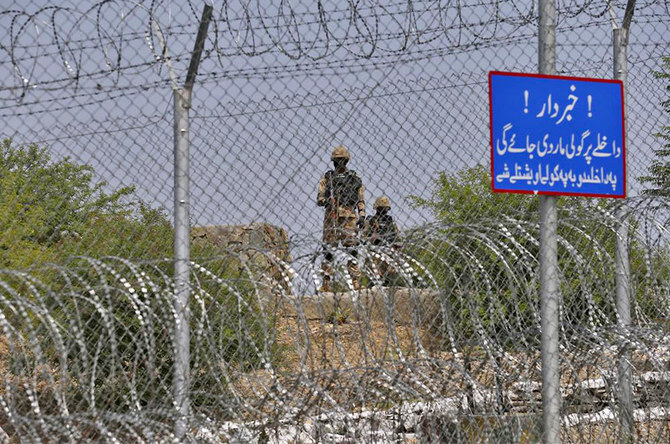
ISLAMABAD: The Pakistan military on Saturday urged the Taliban administration in Kabul to ensure robust border management after a group of militants tried to infiltrate from Afghanistan, leading to a skirmish that left four infiltrators and a soldier dead.
Relations between Islamabad and Kabul have deteriorated in recent years as militant violence surged in Pakistan, fueled by attacks from Tehreek-e-Taliban Pakistan (TTP) militants in the northwestern Khyber Pakhtunkhwa province.
Pakistani officials blame the TTP for the escalating violence, accusing the Afghan authorities of turning a blind eye to militants using their territory to launch cross-border attacks.
However, Kabul denies these allegations, insisting that Pakistan’s internal security is its own responsibility.
“On night 19/20 December, movement of a group of khwarij [TTP militants], trying to infiltrate through Pakistan-Afghanistan border, was picked up by the security forces in general area Rajgal, Khyber District,” the military’s media wing, Inter-Services Public Relations, said in a statement. “Own troops effectively engaged and thwarted their attempt to infiltrate. Resultantly, four Khwarij were sent to hell.”
The statement noted that one of the soldiers, Sepoy Amir Sohail Afridi, also lost his life amid intense exchange of fire.
“Pakistan has consistently been asking Interim Afghan Government to ensure effective border management on their side of the border,” it continued. “Interim Afghan Government is expected to fulfil its obligations and deny the use of Afghan soil by Khwarij for perpetuating acts of terrorism against Pakistan.”
The ISPR statement comes after media reported a deadly attack on a military outpost in Khyber Pakhtunkhwa which was targeted by 30 militants from three sides. According to anonymous intelligence sources, the attack left 16 soldiers dead. The TTP claimed responsibility for targeting the outpost in a statement that described the attack as a retaliation to the recent killings of its top commanders.
The Pakistan military reiterated in its statement it remained committed to securing the borders. It added that its soldiers would also fight to eliminate the menace of militant violence.

Islamabad urges Afghanistan to boost border security as infiltration attempt kills five
https://arab.news/v65wv
Islamabad urges Afghanistan to boost border security as infiltration attempt kills five
- Military says four TTP fighters and a soldier were killed as militants tried to enter Pakistani territory
- Statement comes after media reported a deadly attack on a military outpost that killed 16 soldiers
Pakistan to press ahead with privatization after $441 million net loss in FY2024-25
- National Highway Authority and power distribution companies are major loss contributors
- The government says reforms agenda is shifting ‘from diagnosis to delivery’ after PIA sale
KARACHI: Pakistan is pressing ahead with plans to privatize state-owned enterprises (SOEs) after official data released on Friday showed the sector posted a net loss of PKR 122.9 billion ($441 million) in the year ended June 2025, with the government approving new transactions involving power utilities, an international airport and other major assets.
The Cabinet Committee on State-Owned Enterprises, chaired by Finance Minister Muhammad Aurangzeb, reviewed the Annual Consolidated Performance Report of SOEs for the fiscal year ended June 2025. The report was prepared by the Finance Division’s Central Monitoring Unit, which showed SOEs remain a significant drag on public finances.
“The Committee was informed that during FY 2024-25, aggregate revenues of SOEs stood at approximately PKR 12.4 trillion [$44.6 billion], reflecting a decline largely attributable to reduced profitability in the oil sector following lower international oil prices,” said an official statement circulated by the Finance Division.
“Aggregate profits of profit-making SOEs declined by 13 percent to PKR 709.9 billion [$2.55 billion] compared to PKR 820.7 billion [$2.95 billion in the preceding year], while aggregate losses of loss-making SOEs showed improvement, declining by around 2 percent to PKR 832.8 billion [$2.99 billion],” it added. “Despite this improvement, the net result was an overall net loss of PKR 122.9 billion [$441 million] for the SOE sector, compared to a net loss of PKR 30.6 billion [$110 million] in the previous year.”
It was highlighted that losses remain heavily concentrated in a small number of entities, particularly in the transport and power distribution sectors.
“National Highway Authority and several power distribution companies continued to be major loss contributors, reflecting structural issues, high depreciation, financing costs, and the public service nature of certain operations that are not commercially viable,” the statement said.
It added the cabinet committee directed that the findings of the report be shared with relevant ministries to inform reform measures and that progress on audits, governance reforms, debt rationalization and fiscal risk containment be reviewed regularly.
In a separate post on X, government finance adviser Khurram Schehzad said the SOE reform agenda was shifting “from diagnosis to delivery,” citing recent privatizations including First Women Bank, the shutdown of Utility Stores Corporation and progress on Pakistan International Airlines.
The Privatization Commission also held a meeting during the day, saying it would also move ahead with the privatization of power distribution companies while recommending that Islamabad International Airport be included in the privatization program under an open, competitive concession model.
It also decided to restart the sale process for House Building Finance Company Limited after terminating an earlier negotiated transaction that failed to meet valuation benchmarks.
Pakistan is implementing structural reforms under a $7-billion program agreed with the International Monetary Fund, which has urged Islamabad to rein in losses at state firms and reduce fiscal risks stemming from debt and guarantees.


