

Suspect in deadly Christmas market attack which killed 5 railed against Islam and Germany

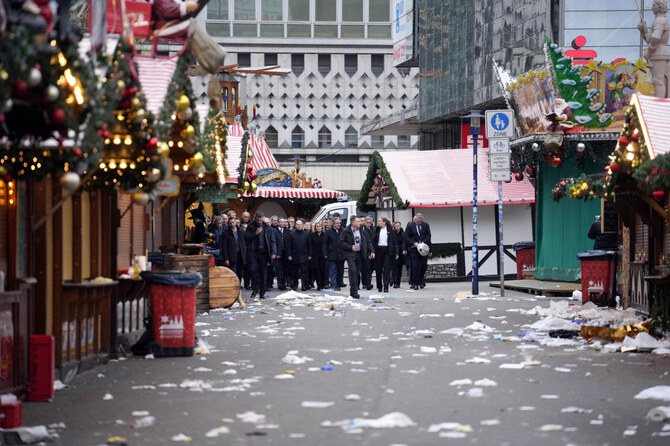
The Chancellor of Germany Olaf Scholz, center left, arrives at a Christmas Market, where a car drove into a crowd on Friday evening, in Magdeburg, Germany, Saturday, Dec. 21, 2024. (AP)
Short Url
Updated 21 December 2024
Follow

Suspect in deadly Christmas market attack which killed 5 railed against Islam and Germany

  • Source: Saudi Arabia had warned German authorities about the attacker
  • Germany’s domestic intelligence agency declined to comment on the ongoing investigation

MAGDEBURG, Germany: At least five people were killed in a car-ramming attack at a German Christmas market in the city of Magdeburg that also left more than 200 injured, officials said, and a Saudi man was arrested on suspicion of driving a car into the crowd.

The Friday evening attack on market visitors gathered to celebrate the pre-Christmas season comes amid a fierce debate over security and migration during an election campaign in Germany, where the far right is polling strongly.

“What a terrible act it is to injure and kill so many people there with such brutality,” Chancellor Olaf Scholz said in the central city, part of the former East Germany, where he laid a white rose at a church in honor of the victims.

“We have now learnt that over 200 people have been injured,” he added. “Almost 40 are so seriously injured that we must be very worried about them.”

German authorities are investigating a 50-year-old Saudi doctor who has lived in Germany for almost two decades in connection with the car-ramming. Police searched his home overnight.

The motive remained unclear and police have not yet named the suspect. He has been named in German media as Taleb A.

Officials said on Saturday he held strongly anti-Islam views and was angry with Germany’s migrant and asylum policy.

A Saudi source told Reuters that Saudi Arabia had warned German authorities about the attacker after he posted extremist views on his personal X account that threatened peace and security.

Der Spiegel reported that the suspect had sympathized with the far-right Alternative for Germany (AfD) party. The magazine did not say where it got the information.

Germany’s domestic intelligence agency declined to comment on the ongoing investigation.

Germany’s FAZ newspaper said it interviewed the suspect in 2019, describing him as an anti-Islam activist.

“People like me, who have an Islamic background but are no longer believers, are met with neither understanding nor tolerance by Muslims here,” he was quoted as saying. “I am history’s most aggressive critic of Islam. If you don’t believe me, ask the Arabs.”

Andrea Reis, who had been at the market on Friday, returned on Saturday with her daughter Julia to lay a candle by the church overlooking the site. She said that had it not been for a matter of moments, they may have been in the car’s path.

“I said, ‘let’s go and get a sausage’, but my daughter said ‘no let’s keep walking around’. If we’d stayed where we were we’d have been in the car’s path,” she said.

Tears ran down her face as she described the scene. “Children screaming, crying for mama. You can’t forget that,” she said.

Scholz’s Social Democrats are trailing both the far-right AfD and the frontrunner conservative opposition in opinion polls ahead of snap elections set for Feb. 23.

The AfD, which enjoys particularly strong support in the former East, has led calls for a crackdown on migration to the country.

Its chancellor candidate Alice Weidel and co-leader Tino Chrupalla issued a statement on Saturday condemning the attack.

“The terrible attack on the Christmas market in Magdeburg in the middle of the peaceful pre-Christmas period has shaken us,” they said.

A leading Social Democrat lawmaker in the Bundestag parliament warned against jumping to conclusions and said it appeared the attacker did not have an Islamist motive.

“Now we have to wait for the investigations. It seems that things are different here than was initially assumed,” Dirk Wiese told the Rheinische Post newspaper.


Venezuelans await political prisoners’ release after government vow

Updated 6 sec ago
Follow

Venezuelans await political prisoners’ release after government vow

  • Rights groups estimate there are 800 to 1,200 political prisoners held in Venezuela

CARACAS: Venezuelans waited Sunday for more political prisoners to be freed as ousted president Nicolas Maduro defiantly claimed from his US jail cell that he was “doing well” after being seized by US forces a week ago.
The government of interim president Delcy Rodriguez on Thursday began to release prisoners jailed under Maduro in a gesture of openness, after pledging to cooperate with Washington over its demands for Venezuelan oil.
The government said a “large” number would be released — but rights groups and the opposition say only about 20 have walked free since, including several prominent opposition figures.
Rights groups estimate there are 800 to 1,200 political prisoners held in Venezuela.
Rodriguez, vice president under Maduro, said Venezuela would take “the diplomatic route” with Washington, after Trump claimed the United States was “in charge” of the South American country.
“Venezuela has started the process, in a BIG WAY, of releasing their political prisoners. Thank you!” Trump said in a post late Saturday on his Truth Social platform.
“I hope those prisoners will remember how lucky they got that the USA came along and did what had to be done.”
Maduro and his wife Cilia Flores were captured in a dramatic January 3 raid and taken to New York to stand trial on drug-trafficking and weapons charges, to which they pleaded not guilty.

Anxiety over prisoners

A detained police officer accused of “treason” against Venezuela died in state custody after a stroke and heart attack, the state prosecution service confirmed on Sunday.
Opposition groups said the man, Edison Jose Torres Fernandez, 52, had shared messages critical of Maduro’s government.
“We directly hold the regime of Delcy Rodriguez responsible for this death,” Justice First, part of the Venezuelan opposition alliance, said on X.
Families on Saturday night held candlelight vigils outside El Rodeo prison east of Caracas and El Helicoide, a notorious jail run by the intelligence services, holding signs with the names of their imprisoned relatives.
Prisoners include Freddy Superlano, a close ally of opposition figurehead Maria Corina Machado. He was jailed after challenging Maduro’s widely contested re-election in 2024.
“He is alive — that was what I was most afraid about,” Superlano’s wife Aurora Silva told reporters.
“He is standing strong and I am sure he is going to come out soon.”
Maduro meanwhile claimed he was “doing well” in jail in New York, his son Nicolas Maduro Guerra said in a video released Saturday by his party.
The ex-leader’s supporters rallied in Caracas on Saturday but the demonstrations were far smaller than Maduro’s camp had mustered in the past, and top figures from his government were notably absent.
The caretaker president has moved to placate the powerful pro-Maduro base by insisting Venezuela is not “subordinate” to Washington.

Pressure on Cuba

Vowing to secure US access to Venezuela’s vast crude reserves, Trump pressed top oil executives at a White House meeting on Friday to invest in Venezuela, but was met with a cautious reception.
Experts say Venezuela’s oil infrastructure is creaky after years of mismanagement and sanctions.
Washington has also confirmed that US envoys visited Caracas on Friday to discuss reopening their embassy there.
Trump on Sunday pressured Caracas’s leftist ally Cuba, which has survived in recent years under a US embargo thanks to cheap Venezuelan oil imports.
He urged Cuba to “make a deal” or face unspecified consequences, warning that the flow of Venezuelan oil and money to Havana would stop now that Maduro was gone.
Cuba’s President Miguel Diaz-Canel retorted on X that the Caribbean island was “ready to defend the homeland to the last drop of blood.”
“No one tells us what to do.”
Venezuela’s government in a statement called for “political and diplomatic dialogue” between Washington and Havana.
“International relations should be governed by the principals of international law — non-interference, sovereign equality of states and the right of peoples to govern themselves.”