

Suspect in German Christmas market attack was ‘not quite what many rushed to assume’, veteran British journalist says

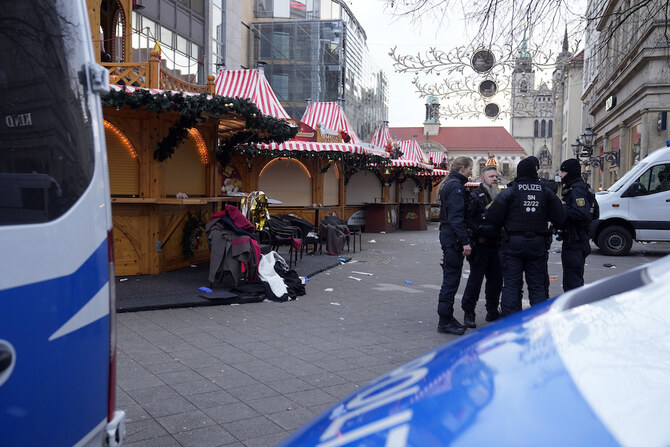
Police officers stand at a cordoned-off Christmas Market, where a car drove into a crowd on Friday evening, in Magdeburg, Germany on Dec. 21, 2024. (AP)
Short Url
Updated 21 December 2024
Follow

Suspect in German Christmas market attack was ‘not quite what many rushed to assume’, veteran British journalist says

  • ‘Evidence from his social media indicates he was an anti-Islam doctor who arrived in Germany in 2006 from Saudi Arabia’

DUBAI: British journalist Andrew Neil said the attacker behind Friday night’s deadly car-ramming at a busy Christmas market in Magdeburg, Germany appeared to be ‘not quite what many on social media rushed to assume.’

“Evidence from his social media indicates he was an anti-Islam doctor who arrived in Germany in 2006 from Saudi Arabia,” the veteran journalist posted on his social media account.

The suspect, who was identified by German authorities as 50-year-old Saudi psychologist Taleb Al-Abdulmohsen, who had permanent residency and had lived in Germany for almost two decades. The motive for the car-ramming remained unknown, and a police operation was under way in the town of Bernburg, south of Magdeburg, where the suspect was believed to have lived.


Reports have noted that Saudi Arabia had warned German authorities about the attacker, who had posted extremist views on his personal X account. Germany’s Der Spiegel said the attacker sympathized with the far-right Alternative for Germany party. The magazine did not say where it got the information.

“Various media reports suggest he helped ex-Muslims, particularly women, to flee Saudi Arabia after turning their backs on Islam,” Neil commented. Neil also noted that the suspect posted tweets in support Elon Musk, jailed far right activist Tommy Robinson and malevolent conspiracy theorist Alex Jones.

“His social media posts also indicate he thought Germany not doing enough to help Saudi female asylum seekers who had rejected Islam – and that the authorities were trying to undermine his work on their behalf,” the British journalist added.

“In his recent social-media posts published days before the attack he claimed the German government was promoting Islamisation and accused authorities of censoring and persecuting him because of his critical views of Islam. On his website, he warned prospective refugees to avoid Germany because of its government’s tolerance of radical Islam,” Neil said.

Christmas markets are a huge part of German culture as an annual holiday tradition, and the violence has prompted other German towns to cancel their weekend events as a precaution and out of solidarity with Magdeburg’s loss.

Berlin kept its markets open but has increased its police presence at them.


Disinformation the new enemy in disaster zones, says Red Cross

Updated 05 March 2026
Follow

Disinformation the new enemy in disaster zones, says Red Cross

  • “Harmful information and dehumanizing narratives” undermines humanitarian aid and putting lives of aid workers at risk
  • Between 2020 and 2024, disasters affected nearly 700 million people, displaced over 105 million, and killed more than 270,000 — doubling the number in need of humanitarian aid

GENEVA: The rise of disinformation is undermining humanitarian aid and putting lives at risk, while disasters are affecting ever more people, the Red Cross warned Thursday.
“Between 2020 and 2024, disasters affected nearly 700 million people, caused more than 105 million displacements, and claimed over 270,000 lives,” the International Federation of Red Cross and Red Crescent Societies said.
The number of people needing humanitarian assistance more than doubled in the same timeframe, the IFRC said in its World Disasters Report 2026.
But the world’s largest humanitarian network said that “harmful information and dehumanizing narratives” were increasingly undermining trust, putting the lives of aid workers at risk.
“In polarized and politically-charged contexts, humanitarian principles such as neutrality and impartiality are increasingly misunderstood, misrepresented or deliberately attacked online,” it said.
The IFRC has more than 17 million volunteers across more than 191 countries.
“In every crisis I have witnessed, information is as essential as food, water and shelter,” said the Geneva-based federation’s secretary general Jagan Chapagain.
“But when information is false, misleading or deliberately manipulated, it can deepen fear, obstruct humanitarian access and cost lives.”
He said harmful information was not a new phenomenon, but it was now moving “with unprecedented speed and reach.”
Chapagain said digital platforms were proving “fertile ground for lies.”
The IFRC report said the challenge nowadays was no longer about the availability of information but its reliability, noting that the production and spread of disinformation was easily amplified by artificial intelligence.

- ‘Life and death’ -

The report cited numerous recent examples of harmful information hampering crisis response.
During the 2024 floods in Valencia, false narratives online accused the Spanish Red Cross of diverting aid to migrants, which in turn fueled “xenophobic attacks on volunteers,” the IFRC said.
In South Sudan, rumors that humanitarian agencies were distributing poisoned food “caused people to avoid life-saving aid” and led to threats against Red Cross staff.
In Lebanon, false claims that volunteers were spreading Covid-19, favoring certain groups with aid and providing unsafe cholera vaccines eroded trust and endangered vulnerable communities, the IFRC said.
And in Bangladesh, during political unrest, volunteers faced “widespread accusations of inaction and political alignment,” leading to harassment and reputational damage, it added.
Similar events were registered by the IFRC in Sudan, Myanmar, Peru, the United States, New Zealand, Canada, Kenya and Bulgaria.
The report underlined that around 94 percent of disasters were handled by national authorities and local communities, without international interventions.
“However, while volunteers, local leaders and community media are often the most trusted messengers, they operate in increasingly hostile and polarized information environments,” the IFRC said.
The federation called on governments, tech firms, humanitarian agencies and local actors to recognize that reliable information “is a matter of life and death.”
“Without trust, people are less likely to prepare, seek help or follow life-saving guidance; with it, communities act together, absorb shocks and recover more effectively,” said Chapagain.
The organization urged technology platforms to prioritize authoritative information from trusted sources in crisis contexts, and transparently moderate harmful content.
And it said humanitarian agencies needed to make preparing to deal with disinformation “a core function” of their operations, with trained teams and analytics.