PALERMO, Italy: A court on Friday acquitted Italian Deputy Prime Minister Matteo Salvini of charges of kidnapping over 100 migrants aboard a boat he had blocked at sea for nearly three weeks in 2019, as part of a policy to curb irregular arrivals.
After a three-year trial, judges rejected a prosecutor’s request to hand a six-year jail term to Salvini, the leader of the far-right League party, who is serving as transport minister in Giorgia Meloni’s government.
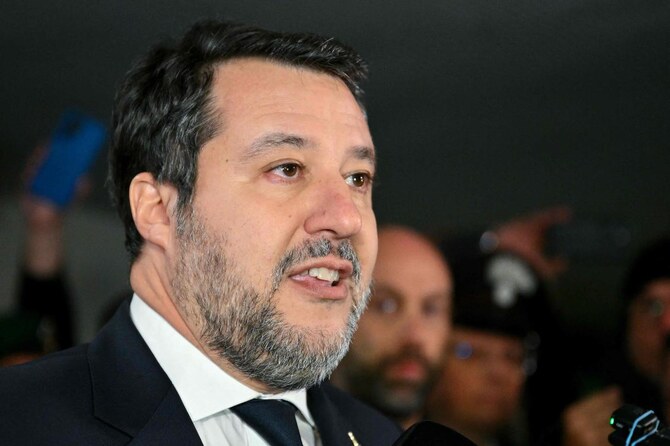
“I’m happy. After three years, common sense won, the League won, Italy won,” Salvini told reporters, saying that protecting national borders “is not a crime, but a right.”
The verdict came against a backdrop of tensions between the government and the judiciary over migration, after a court questioned the legality of a flagship plan to send asylum seekers to Albania, in cases now pending with the European Court of Justice
Salvini had tried to prevent the Spanish charity Open Arms from bringing 147 asylum seekers to Italy in the summer of 2019, when he was interior minister, as part of his policy of closing Italy’s ports to migrant boats.
The not-guilty verdict was greeted with applause from League politicians who gathered in the court room to support their leader. Prime Minister Meloni said it showed the allegations were “unfounded and surreal.”
“Let us continue together, with tenacity and determination, to fight illegal immigration, human trafficking and to defend national sovereignty,” Meloni wrote on social media platform X.
Before judges withdrew to consider their verdict, prosecutor Marzia Sabella told the court that Salvini had exceeded his powers in refusing to let the ship dock and there were no national security considerations justifying him in preventing the disembarkation.
Defense lawyer Giulia Bongiorno, who is also a League senator, said the boats had no automatic right to dock in Italy and the migrants could have been taken elsewhere if the charity had been genuinely concerned for their welfare.
The Open Arms’ ship had picked up mainly African migrants off Libya over a two-week period and then asked to dock in an Italian port. It turned down a request to sail to its home country Spain, saying those on board were too exhausted and needed immediate care.
Magistrates eventually seized the boat and ordered the migrants be brought ashore.
The case drew international attention.
Salvini received backing from far-right allies across Europe this week, including Hungarian Prime Minister Viktor Orban, and also from US billionaire Elon Musk, who is advising US President-elect Donald Trump.
Well over 1 million migrants have reached Italy by boat from North Africa over the past 12 years, seeking a better life in Europe. The migration has boosted support for far-right parties, which have put curbing mass migration from Africa and the Middle East at the top of the political agenda.


![]()

Italian deputy PM Salvini acquitted of migrant kidnapping charges
Short Url
https://arab.news/mbe2r
Italian deputy PM Salvini acquitted of migrant kidnapping charges
- Protecting borders is not a crime, League party chief says
- PM Meloni vows to continue fight against illegal immigration
Latest updates


© 2026 SAUDI RESEARCH & PUBLISHING COMPANY, All Rights Reserved And subject to Terms of Use Agreement.