

In latest challenge to army, Islamabad judge suspends order requiring vetting of TV news analysts

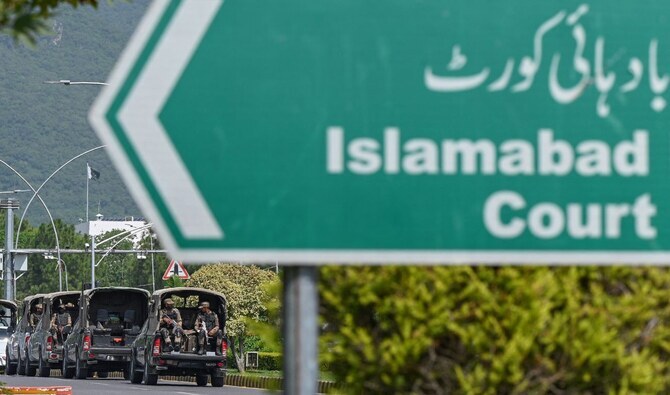
A convoy of Pakistani army passes the Islamabad High Court building in Islamabad on August 29, 2023. (AFP/File)
Short Url
Updated 20 December 2024
Follow

In latest challenge to army, Islamabad judge suspends order requiring vetting of TV news analysts

  • Pakistan’s media regulator had instructed TV channels to seek army media wing’s approval before inviting retired officers as defense analysts 
  • Justice Babar Sattar is among six Islamabad judges who has accused army’s ISI spy agency of coercing them in ‘politically consequential’ cases

ISLAMABAD: Justice Babar Sattar of the Islam­abad High Court (IHC) this week suspended an order by the Pakistan Electronic Media Regulatory Authority instructing TV channels to seek clearance from the military’s media wing before inviting retired military officers on current affairs programs as analysts.

Sattar was hearing a case challenging the much-debated April 2019 PEMRA notification, following which the Inter-Services Public Relations (ISPR) had released a list of 26 retired officers that it said were allowed to appear as defense analysts.PEM

“The Islam­abad High Court has suspen­ded a Pemra’s notification requ­i­ring defense analysts to obtain clearance from the ISPR before appearing on television programs,” Pakistan’s Dawn newspaper reported.

Most major Pakistani media outlets also reported on the development. 

“Based on the presented arguments, the court suspended the notification, stating that it would remain ineffective until a final decision is announced in the case.”

The next hearing is scheduled for Feb. 11, 2025.

At a hearing of the case in September, Sattar had questioned the federal government on the military media wing’s “exclusive right” to decide who qualified to appear on TV as a defense analyst. The court also questioned why PEMRA had issued that notification in the first place and whether it had received a request from within the Pakistan army or ISPR.

PEMRA’s lawyer sought more time from the court to respond.

“Let PEMRA produce before the Court the original noting file on the basis of which the impugned notification was processed, recommended and issued to assist the Court as to why PEMRA felt the need to issue the said notification,” Justice Sattar wrote. 

During that hearing, the court had asked PEMRA’s counsel about the watchdog’s authority to regulate the content of discussions on TV and issue directions for the pre-clearance of individuals by ISPR or others. 

PEMRA’s lawyer pointed to Section 20-A of the PEMRA Ordinance, which relates to the obligation of licensees to uphold the sovereignty, integrity and security of Pakistan. 

“When asked as to what does pre-clearance of individuals providing content on TV have to do with the sovereignty or security of Pakistan and how can PEMRA impose a prior restraint on speech, the learned counsel for PEMRA seeks further time to assist the Court,” the written order had read. 

Pakistani journalist bodies and many journalists have long accused the government and the powerful military of censoring the press. Both deny allegations and insist they do not suppress the freedom of the press.

Sattar’s new order is not his first challenge to the army. He was among six Islamabad High Court judges who earlier this year wrote a letter to the Supreme Judicial Council watchdog and accused the military’s ISI spy agency of intimidating and coercing them over legal cases, particularly “politically consequential” ones.

The judges provided various examples of alleged interference, including a case concerning Pakistan’s imprisoned former prime minister Imran Khan. The letter also mentioned incidents where the judges said their relatives were abducted and tortured and their homes were secretly surveilled, aiming to coerce them into delivering favorable judgments in specific cases.

The army denies it interferes in political matters. It has so far refrained from commenting on the judges’ letter regarding the ISI’s alleged interference and intimidation.


Pakistan’s OGDC ramps up unconventional gas plans

Updated 4 sec ago
Follow

Pakistan’s OGDC ramps up unconventional gas plans

  • Pakistan has long been viewed as having potential in tight and shale gas but commercial output has yet to be proved
  • OGDC says has tripled tight-gas study area to 4,500 square km after new seismic, reservoir analysis indicates potential

ISLAMABAD: Pakistan’s state-run Oil & Gas Development Company is planning a major expansion of unconventional gas developments from early next year, aiming to boost production and reduce reliance on imported liquefied natural gas.

Pakistan has long been viewed as having potential in both tight and shale gas, which are trapped in rock and can only be released with specialized drilling, but commercial output has yet to be proved.

Managing Director Ahmed Lak told Reuters that OGDC had tripled its tight-gas study area to 4,500 square kilometers (1,737 square miles) after new seismic and reservoir analysis indicated larger potential. Phase two of a technical evaluation will finish by end-January, followed by full development plans.

The renewed push comes after US President Donald Trump said Pakistan held “massive” oil reserves in July, a statement analysts said lacked credible geological evidence, but which prompted Islamabad to underscore that it is pursuing its own efforts to unlock unconventional resources.

“We started with 85 wells, but the footprint has expanded massively,” Lak said, adding that OGDC’s next five-year plan would look “drastically different.”

Early results point to a “significant” resource across parts of Sindh and Balochistan, where multiple reservoirs show tight-gas characteristics, he said.

SHALE PILOT RAMPS UP

OGDC is also fast-tracking its shale program, shifting from a single test well to a five- to six-well plan in 2026–27, with expected flows of 3–4 million standard cubic feet per day (mmcfd) per well.

If successful, the development could scale to hundreds or even more than 1,000 wells, Lak said.

He said shale alone could eventually add 600 mmcfd to 1 billion standard cubic feet per day of incremental supply, though partners would be needed if the pilot proves viable.

The company is open to partners “on a reciprocal basis,” potentially exchanging acreage abroad for participation in Pakistan, he said.

A 2015 US Energy Information Administration study estimated Pakistan had 9.1 billion barrels of technically recoverable shale oil, the largest such resource outside China and the United States.

A 2022 assessment found parts of the Indus Basin geologically comparable to North American shale plays, though analysts say commercial viability still hinges on better geomechanical data, expanded fracking capacity and water availability.

OGDC plans to begin drilling a deep-water offshore well in the Indus Basin, known as the Deepal prospect, in the fourth quarter of 2026, Lak said. In October, Turkiye’s TPAO with PPL and its consortium partners, including OGDC, were awarded a block for offshore exploration.

A combination of weak gas demand, rising solar uptake and a rigid LNG import schedule has created a surplus of gas that forced OGDC to curb output and pushed Pakistan to divert cargoes from Italy’s ENI and seek revised terms with Qatar.