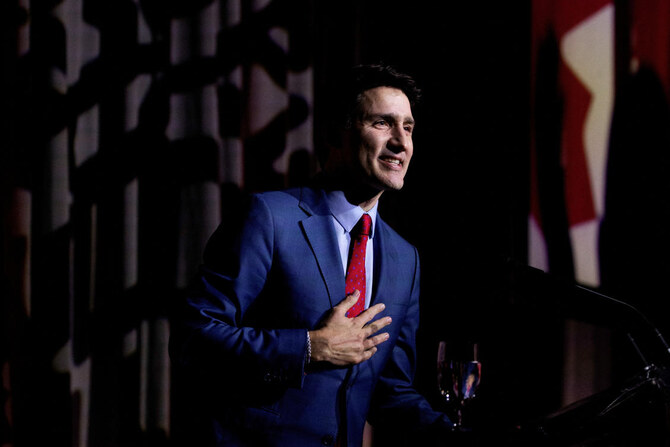
TORONTO: Embattled Canadian Prime Minister Justin Trudeau will shuffle his Cabinet Friday.
The prime minister’s office confirmed late Thursday that Trudeau will participate in the swearing-in ceremony and chair a meeting with his new Cabinet later Friday.
Trudeau is facing rising discontent over his leadership, and the abrupt departure of his finance minister on Monday could be something he can’t recover from.
A rising number of Liberal lawmakers are calling on Trudeau to resign but new Finance Minister Dominic LeBlanc said Thursday Trudeau has the “full support of his Cabinet.”
LeBlanc said he respects the views of Liberal lawmakers who want Trudeau to resign.
“That’s a view they are expressing. The prime minister listened carefully when that view was expressed to him,” LeBlanc said. “He listened, in some cases responded to specific things that were raised, and he said he would reflect carefully.”
LeBlanc said the government will remain focused on work and addressing the threat by President-elect Donald Trump to impose a 25 percent tariff on all Canadian products when he is inaugurated next month.
“We shouldn’t be looking inward. We shouldn’t be worrying about ourselves,” LeBlanc said.
LeBlanc said he will meet with Tom Homan, Trump’s incoming “border czar,” after Christmas to discuss Canada’s plan to secure the border as part of a bid to avoid the tariffs.
Trudeau has led the country for nearly a decade, but has become widely unpopular in recent years over a wide range of issues, including the high cost of living and rising inflation.
There is no mechanism for Trudeau’s party to force him out in the short term. He could resign, or his Liberal party could be forced from power by a “no confidence” vote in Parliament that would trigger an election that would very likely favor the opposing Conservative Party.
As rising numbers of Liberal lawmakers called for Trudeau to resign this week, Natural Resources Minister Jonathan Wilkinson said, “We all need to give him a little time to reflect.”
Concerns about Trudeau’s leadership were exacerbated Monday when Chrystia Freeland, Trudeau’s finance minister and deputy prime minister, resigned from the Cabinet. Freeland was highly critical of Trudeau’s handling of the economy in the face of steep tariffs threatened by Trump. Shortly before Freeland announced her decision, the housing minister also quit.
Because Trudeau’s Liberals don’t hold an outright majority in the Parliament, they have for years depended on the support of the leftist New Democratic Party to pass legislation and stay in power. But that support has all but vanished — the NDP’s leader has called on Trudeau to resign — and that might clear the way for Parliament to vote “no confidence.”
NDP leader Jagmeet Singh, however, would not commit to bringing down the government at the first opportunity in part because Trump could impose crippling tariffs and Parliament might need to respond with tariffs in retaliation.
Parliament is now shut for the holidays until late next month, and a “no confidence” vote could be scheduled sometime thereafter.
“It appears Trudeau will be stepping down, but no one knows exactly when,” said Nelson Wiseman, professor emeritus at the University of Toronto. “The need to fill vacant posts and to relieve some ministers of carrying multiple portfolios is the drive behind the shuffle but it will not boost the Liberal party’s polling numbers; it’s too late in the day for that to happen.”
LeBlanc also said Mark Carney won’t be joining Cabinet. Trudeau has been trying to recruit Carney, the former head of the Bank of England and Bank of Canada, to join his government. Carney has long been interested in entering politics and becoming the leader of the Liberal Party.
“Mr. Carney isn’t about to become Canada’s finance minister in the short term,” LeBlanc said. “The prime minister asked me to start that work and to get ready for a budget in the spring.”


![]()

Canada’s Trudeau to shuffle his Cabinet amid resignation calls and rising discontent
Short Url
https://arab.news/93h6y
Canada’s Trudeau to shuffle his Cabinet amid resignation calls and rising discontent
- Trudeau is facing rising discontent over his leadership
- Rising number of Liberal lawmakers are calling on Trudeau to resign


Latest updates


Recommended


© 2026 SAUDI RESEARCH & PUBLISHING COMPANY, All Rights Reserved And subject to Terms of Use Agreement.