US disagrees with HRW ‘genocide’ accusation against Israel

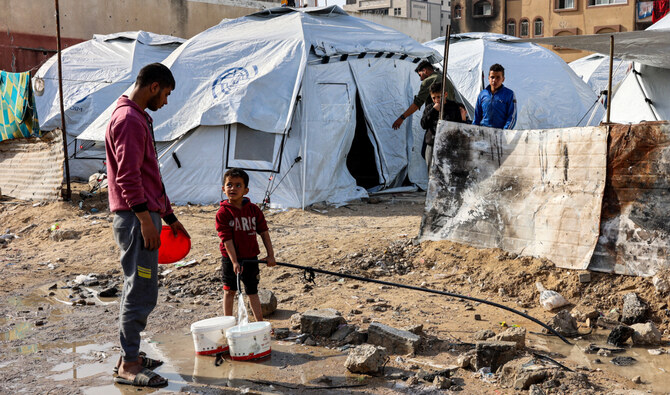
A youth speaks to a boy filling up buckets with water from a hose near tents at a shelter for displaced Palestinians in Gaza City on December 11, 2024. (AFP/File)
Short Url
Updated 20 December 2024
Follow

US disagrees with HRW ‘genocide’ accusation against Israel

  • US official: ‘When it comes to a determination of something like genocide, the legal standard is just incredibly high, and so the finding in this scenario we just disagree with’

WASHINGTON: The United States said Thursday it disagreed with New York-based Human Rights Watch’s accusation that Israel was carrying out “acts of genocide” in the Gaza Strip by damaging water infrastructure.
“When it comes to a determination of something like genocide, the legal standard is just incredibly high, and so the finding in this scenario we just disagree with,” State Department spokesman Vedant Patel told reporters.
“That does not take away from the fact that there is a dire humanitarian crisis in Gaza.”
The report released Thursday by the Human Rights Watch follows a similar accusation by London-based Amnesty International.
In a separate report on Thursday, Doctors Without Borders (MSF) accused Israel of “ethnic cleansing” in its 14-month war in Gaza launched after a massive Hamas attack.
The medical group said it documented 41 attacks on MSF staff including air strikes on health facilities and direct fire on humanitarian convoys.
Patel distanced the United States from the finding but, in contrast to Israel, stressed the value of non-governmental organizations.
“Even within their report, they make pretty clear that they don’t have the legal authority to determine intentionality” in the strikes on MSF, Patel said.
“But we continue to appreciate the important role that’s played by civil society organizations, including Doctors Without Borders, and we’re deeply concerned about the scale of civilian harm in this conflict,” he said.



Top US defense official hails ‘model ally’ in South Korea talks

Updated 5 sec ago
Follow

Top US defense official hails ‘model ally’ in South Korea talks

SِEOUL: The Pentagon’s number three official hailed South Korea as a “model ally” as he met with local counterparts in Seoul on Monday, days after Washington’s new defense strategy called for reduced support for partners overseas.
Under Secretary of Defense for Policy Elbridge Colby arrived in South Korea on Monday and is seen as a key proponent of President Donald Trump’s “America First” foreign policy.
That policy — detailed in Washington’s 2026 National Defense Strategy (NDS) released last week — calls for the United States to prioritize deterring China and for long-standing US allies to take “primary responsibility” for their own defense.
Arriving in Seoul on his first overseas trip as the Pentagon’s number three official, Colby in a post on X called South Korea a “model ally.”
And he praised President Lee Jae Myung’s pledge to spend 3.5 percent of the country’s GDP on the military.
That decision, he told a forum, “reflects a clear-eyed and sage understanding of how to address the security environment that we all face and how to put our storied and historic alliance on sound footing for the long haul,” according to South Korea’s Yonhap News Agency.
“Such adaptation, such clear-eyed realism about the situation that we face and the need for greater balance in the sharing of burdens, will ensure that deterrence remains credible, sustainable and resilient in this changing world,” he added, according to the agency.
Colby also met Monday with South Korea’s defense and foreign ministers, who touted Seoul’s development of nuclear-powered attack submarines as proof the country was taking more responsibility for its defense.
Details remain murky on where the nuclear submarines will be built, however.
South Korea’s leader said last month it would be “extremely difficult” for them to be built outside the country.
But Trump has insisted they will be built in the United States.
Longstanding treaty allies, ties between the United States and South Korea were forged in the bloodshed of the Korean War.
Washington still stations 28,500 troops in South Korea as a deterrent against the nuclear-armed North.