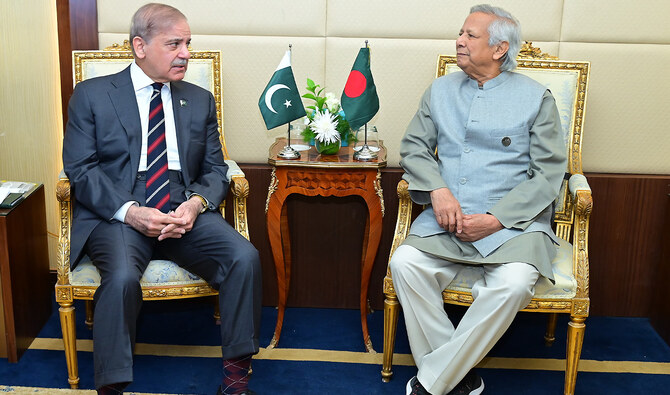
ISLAMABAD: Pakistan Prime Minister Shehbaz Sharif and Muhammad Yunus, head of the Bangladeshi interim government, on Thursday agreed to deepen bilateral cooperation in all areas of mutual interest, Sharif’s office said, following a meeting between the two leaders on the sidelines of the 11th Summit of the Developing Eight (D-8) countries in Cairo.
The meeting took place in a cordial environment, truly reflecting the existing goodwill and fraternal ties between Pakistan and Bangladesh, according to PM Sharif’s office.
The Pakistan premier expressed Pakistan’s keen desire to enhance bilateral cooperation, particularly in the areas of trade, people-to-people contacts and cultural exchanges.
“The two leaders expressed satisfaction over recent positive developments in bilateral relations and noted with satisfaction the increasing frequency of high-level contacts,” Sharif’s office said in a statement.
Established together as one independent nation in 1947, Bangladesh won liberation from then-West Pakistan in 1971. Relations between the two countries continued to deteriorate during former Bangladesh prime minister Sheikh Hasina’s administration, which prosecuted several members of the Jamaat-e-Islami (JI) party for war crimes relating to the 1971 conflict.
However, relations between Pakistan and Bangladesh have improved since Hasina was ousted in a bloody student-led protest in August. Islamabad’s ties with Dhaka have also improved as Bangladesh’s relations with India, where Hasina has sought refuge, have deteriorated.
During the meeting, Sharif’s office said the premier emphasized on the need to make joint efforts to explore new avenues of economic cooperation and to take advantage of their potential in sectors such as chemicals, cement clinkers, surgical goods, leather goods and information technology.
“The prime minister expressed his gratitude to Bangladesh for the recent steps taken for facilitation of trade and travel between Pakistan and Bangladesh,” Sharif’s office said.
“This includes waiving off the condition of 100 percent physical inspection of the consignments from Pakistan and abolishment of special security desk at the Dhaka airport earlier established to scrutinize Pakistani passengers. Prime Minister also thanked Bangladesh for doing away with additional clearance requirement for Pakistani visa applicants.”
The two leaders acknowledged importance of people-to-people contacts and cultural exchanges, including enhanced exchange of artists, sportspersons, academics, and students, according to the statement. Both sides agreed to forge greater cooperation at various multilateral fora, including D-8.
Sharif arrived in Cairo on Wednesday to lead the Pakistan delegation at the D-8 summit on December 18-19. Founded in 1997 in Istanbul, D-8 is an organization for development co-operation among Bangladesh, Egypt, Indonesia, Iran, Malaysia, Nigeria, Pakistan, and Türkiye. The 11th summit of the bloc is themed as “Investing in Youth and Supporting SMEs: Shaping Tomorrow’s Economy.”
He will address the summit today, Thursday, and highlight the importance of investing in youth and small medium enterprises (SMEs) for building a strong and inclusive economy, creating jobs, advancing innovation, and promoting local entrepreneurship, according to his office.
The prime minister will also attend a special session of D-8 on the humanitarian crisis and reconstruction challenges in Gaza and Lebanon to deliberate on the situation resulting from Israeli military actions in the Middle East.
Also on Thursday, Sharif held a meeting with Indonesian President Prabowo Subianto and congratulated him on assuming the office. The two figures exchanged views on a wide range of issues of mutual interest, including bilateral ties covering political, trade and economic matters as well as cooperation at the multilateral fora, according to Sharif’s office.
“Both the leaders reaffirmed their unwavering support for the Palestinian cause and called for a ceasefire in Gaza urging for a comprehensive approach for resolution of the Palestinian question, with the establishment of a sovereign and independent State of Palestine,” it added.


![]()

Pakistan, Bangladesh leaders agree to expand bilateral ties on sidelines of D-8 summit in Cairo
Short Url
https://arab.news/nwy4e
Pakistan, Bangladesh leaders agree to expand bilateral ties on sidelines of D-8 summit in Cairo
- Pakistan, Bangladesh have sought to improve bilateral ties since former PM Hasina’s ouster as a result of a mass movement
- PM Shehbaz Sharif thanked Bangladesh for the recent steps taken for facilitation of trade and travel between the two nations
Latest updates






© 2026 SAUDI RESEARCH & PUBLISHING COMPANY, All Rights Reserved And subject to Terms of Use Agreement.