SEOUL: South Korea’s acting leader said Thursday he would veto a spate of contentious bills sponsored by the main opposition party, deepening political strife in the wake of parliament’s impeachment of President Yoon Suk Yeol.
The ruling and opposition parties have been bickering over how much authority Prime Minister Han Duck-soo, the country’s No. 2 official, has assumed since the opposition-controlled National Assembly last Saturday voted to suspend Yoon’s presidential powers over his short-lived Dec. 3 martial law. The Constitutional Court is to determine whether to formally dismiss the conservative Yoon as president or reinstate him.
Law enforcement authorities are also separately investigating whether Yoon’s martial law enforcement amounted to rebellion. Yoon’s defense minister, police chief and several other military commanders have already been arrested over the case. The main liberal opposition Democratic Party earlier considered impeaching Han as well for failing to stop Yoon’s martial law declaration, but shelved the idea after he became acting leader.
Four of the six bills to be vetoed by Han were meant to introduce greater state financial assistance programs for the country’s agriculture and fisheries industries.
The most contentious bill is the Grain Management Act, which would require the government to buy surplus rice if the price drops too sharply to protect the country’s farming industry and promote its food sovereignty. Han said the bill would cause “immense” financial burdens on the government and eventually lead to further drops in rice prices.
Another controversial bill is the National Assembly Testimony Appraisal Act, which would give lawmakers more power to request people to attend parliament hearings and submit documents. Under the proposed legislation, individuals could no longer decline such requests by citing the protection of trade secrets or personal information.
The Democratic Party said the bill is necessary to determine the full details of Yoon’s martial law decree. But Han said the bill would likely infringe upon people’s privacy and that there are concerns among business leaders that key technology and company secrets could be leaked.
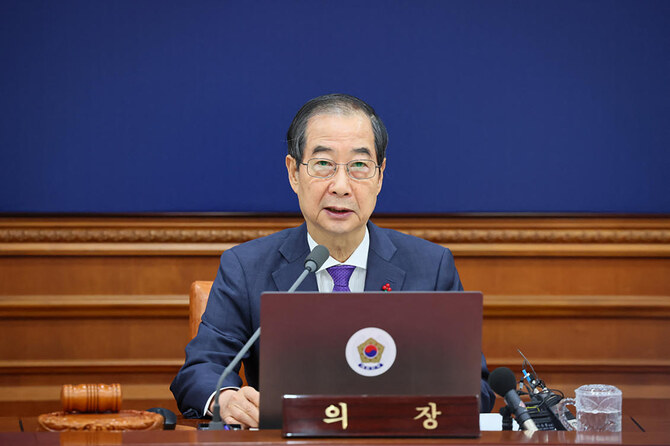
“I’m heavy-hearted because I’ve asked the National Assembly to discuss and act on the six bills again at a time when we desperately need cooperation among the government and the ruling and opposition parties,” Han said in televised comments at the start of a Cabinet Council meeting on Thursday. “But the government should make a responsible decision that prioritizes the principles of the Constitution and the future of our country.”
Democratic lawmaker and spokesperson Noh Jongmyun quickly criticized Han, warning him “not to cross a line,” adding, “We’ll immediately drag him down if he’s found to have collaborated with the rebellion.”
Observers earlier speculated the Democratic Party would reconsider impeaching Han if he vetoed the bills.
Another source of contention between the rival parties is whether Han has the right to appoint three vacant justices’ seats at the Constitutional Court, as filling the vacancies could affect the court’s decision on Yoon.
The martial law enactment lasted only six hours, but it caused huge political turmoil in South Korea and set off alarms from its neighbors and diplomatic partners. Yoon sent hundreds of troops to the National Assembly to block its vote on his decree. But many lawmakers managed to enter a parliament hall and unanimously voted it down, forcing Yoon’s Cabinet to lift it.


![]()

South Korea’s acting president to veto opposition-sponsored bills, deepening political strife
Short Url
https://arab.news/r8kp6
South Korea’s acting president to veto opposition-sponsored bills, deepening political strife
- Prime Minister Han Duck-soo assumed since the National Assembly voted to suspend Yoon Suk Yeol’s presidential powers over his short-lived Dec. 3 martial law


Latest updates


© 2026 SAUDI RESEARCH & PUBLISHING COMPANY, All Rights Reserved And subject to Terms of Use Agreement.