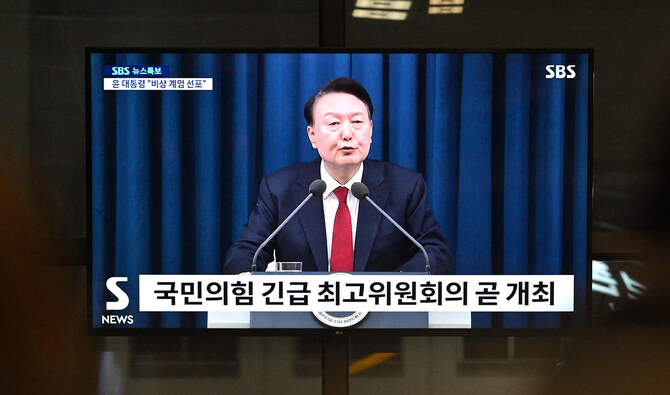
SEOUL: South Korea’s President Yoon Suk Yeol on Tuesday declared emergency martial law, saying the step was necessary to protect the country from “communist forces” amid parliamentary wrangling over a budget bill.
“To safeguard a liberal South Korea from the threats posed by North Korea’s communist forces and to eliminate anti-state elements... I hereby declare emergency martial law,” Yoon said in a live televised address to the nation.
“With no regard for the livelihoods of the people, the opposition party has paralyzed governance solely for the sake of impeachments, special investigations, and shielding their leader from justice,” he added.
The surprise move comes as Yoon’s People Power Party and the main opposition Democratic Party continue to bicker over next year’s budget bill. Opposition MPs last week approved a significantly downsized budget plan through a parliamentary committee.
“Our National Assembly has become a haven for criminals, a den of legislative dictatorship that seeks to paralyze the judicial and administrative systems and overturn our liberal democratic order,” Yoon said.
He accused opposition lawmakers of cutting “all key budgets essential to the nation’s core functions, such as combatting drug crimes and maintaining public security... turning the country into a drug haven and a state of public safety chaos.”
Yoon went on to label the opposition, which holds a majority in the 300-member parliament, as “anti-state forces intent on overthrowing the regime” and called his decision “inevitable.”
“I will restore the country to normalcy by getting rid of anti-state forces as soon as possible.”

South Korea president declares emergency martial law
https://arab.news/jb95t
South Korea president declares emergency martial law
- The surprise move comes as the ruling and opposition parties continue to bicker over next year’s budget bill
- Opposition MPs last week approved a significantly downsized budget plan through a parliamentary committee
Australian state parliament reconvenes to push through stricter gun laws after Bondi mass shooting
- The state parliament was recalled for two days from Monday to debate the firearm legislation, which would cap the number of firearms a person can own at four
SYDNEY: Australia’s New South Wales state parliament was recalled on Monday to vote on proposed new laws that would impose major curbs on firearm ownership, ban the display of terror symbols and restrict protests, following a mass shooting at Bondi Beach.
The state parliament was recalled for two days from Monday to debate the firearm legislation, which would cap the number of firearms a person can own at four, or up to 10 for certain groups, such as farmers.
There is currently no limit to firearm ownership if the reason can be justified to police, and there are more than 50 people in the state who own more than 100 guns, the Australian Broadcasting Corp. said in a report, citing police data.
One of the alleged Bondi gunmen, Sajid Akram, 50, was shot dead by police and owned six firearms. His 24-year-old son Naveed Akram has been charged with 59 offenses, including murder and terrorism, according to police.
Fifteen people were killed and dozens injured in the mass shooting at a Jewish Hanukkah celebration at Sydney’s Bondi Beach on December 14. The attack has shocked the nation and sparked calls for tougher gun laws and heightened efforts to stop antisemitism.
The proposed legislation would also give police more powers to remove face coverings during protests or rallies. The state government has vowed to ban the chant “globalize the intifada” which it says encourages violence in the community.
Jewish leaders on Sunday called for a royal commission, the most powerful type of Australian government inquiry, to be set up to investigate the attack at Bondi.
The opposition Liberal Party leader Sussan Ley backed those calls on Monday, and told a news conference that she has called on Prime Minister Anthony Albanese to meet with her to review the terms of reference for a royal commission.
ALBANESE APPROVAL DIPS
Albanese has faced mounting criticism from opponents who argue his government has not done enough to curb a rise in antisemitism. He was booed by sections of the crowd during a memorial event in Bondi attended by tens of thousands of people on Sunday, one week after the shooting.
Albanese’s government has said it has consistently denounced antisemitism and highlighted legislation passed over the last two years to criminalize hate speech and doxxing. It also expelled Iran’s ambassador earlier this year after accusing Tehran of directing antisemitic attacks in Sydney and Melbourne.
“You’ve seen us crack down on hate speech. You’ve seen us criminalize doxxing. You’ve seen us be very clear about counterterrorism laws banning Nazi salutes and so forth,” Foreign Minister Penny Wong told ABC Radio on Monday.
A poll conducted for the Sydney Morning Herald newspaper among 1,010 voters released on Monday found Albanese’s approval rating slumped 15 points to -9 from +6 at the beginning of December, the lowest since his resounding election win in May.
Authorities on Monday started clearing flowers, candles, letters and other items placed by the public at Bondi Beach.
The tributes would be preserved for display at the Sydney Jewish Museum and the Australian Jewish Historical Society, authorities said.
Thirteen people remain in hospital, including four in critical but stable condition, health officials said.


