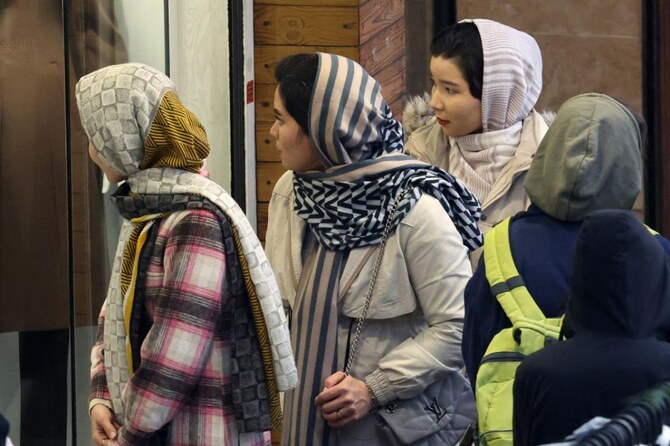
TEHRAN: Iranian lawmakers have asked to amend a bill that would impose tougher penalties on women who refuse to wear the mandatory hijab, local media reported on Wednesday.
The bill, already approved in parliament but not yet submitted to the government for final confirmation, has stirred a heated debate in Iran more than two years since nationwide protests erupted in part over the Islamic republic’s dress code for women.
Shahram Dabiri, Iran’s vice president for parliamentary affairs, has requested to hold off on sending the bill for approval, according to news agency ISNA.
“We requested that the law of chastity and hijab not be referred to the government,” Dabiri was quoted by ISNA as saying, adding that “the parliament speaker requested an amendment to the bill.”
Dabiri did not specify the nature of the amendment or provide a timeline for the process.
Lawmakers in September 2023 had approved the bill, officially the “Law on Supporting the Family through the Promotion of the Culture of Chastity and Hijab.”
It has since won the approval of the Guardian Council, a body empowered to vet legislation.
The bill was initially meant to be referred to President Masoud Pezeshkian in December.
Pezeshkian, who could sign it into law, has expressed “reservations” about the text, citing numerous “ambiguities.”
The 74-article bill tightens restrictions over women’s public attire and threatens action against businesses who fail to enforce the dress code, according to the text carried by local media.
It also imposes hefty penalities of up to 10 years in prison or fines equivalent to more than $6,000 for promoting “nudity” or “indecency.”
Since the early years of the republic following the 1979 Islamic Revolution, women in Iran have been required by law to cover their head and neck.
In late 2022, a wave of protests erupted following the death in custody of 22-year-old Iranian-Kurd Mahsa Amini, who had been arrested for allegedly violating the Islamic dress code.
The months-long unrest saw hundreds of people, including dozens of security personnel, killed. Thousands of demonstrators were arrested.


![]()


Iran lawmakers request changes to strict hijab bill: media
Short Url
https://arab.news/gbnyt
Iran lawmakers request changes to strict hijab bill: media

Israeli settlers torch West Bank mosque
- Attacker spray-paint offensive phrases on the Abu Bakr Al-Siddiq Mosque in the town of Tell
- Religious affairs ministry says settlers vandalized or attacked 45 mosques in the West Bank last year
TELL, West Bank: Israeli settlers vandalized a mosque in the Israeli-occupied West Bank early Monday, spray-painting offensive phrases and setting a fire, according to the Palestinian Authority’s Ministry of Religious Affairs Ministry.
Worshippers coming for the first prayers of the day found the damage and a still smoldering fire, which spewed black smoke across the entrance of the Abu Bakr Al-Siddiq Mosque in the town of Tell, near Nablus, and stained the ornate doorway.
“I was shocked when I opened the door,” said Munir Ramdan, who lives near the mosque. “The fire had been burning here in the area, the glass was broken here, and the door was broken.”
Security camera footage shows two people walking toward the mosque carrying gasoline and a can of spray paint, and running away a few minutes later, Ramdan said.
The Religious Affairs Ministry said that settlers vandalized or attacked 45 mosques in the West Bank last year. The incident came as Muslims observe the holy month of Ramadan.
“The provocation is directed especially at the person who is fasting, because you are fasting and entering a month of mercy and forgiveness from God,” said Salem Ishtayeh, a resident of Tell. “So they like to provoke you with words — it’s not that they are attacking you personally, they are attacking your religion, the Islamic faith.”
The Israeli military and police said that they responded to the incident and were searching for suspects. The military said that it “strongly condemns” harm done to religious institutions.
Palestinians and rights groups say that Israeli authorities routinely fail to prosecute settlers or hold them accountable for violence.
There has been a recent surge in violence from settlers against Palestinians in the West Bank. Last week, settlers killed a 19-year-old Palestinian-American man, Nasrallah Abu Siyam.
Worshippers coming for the first prayers of the day found the damage and a still smoldering fire, which spewed black smoke across the entrance of the Abu Bakr Al-Siddiq Mosque in the town of Tell, near Nablus, and stained the ornate doorway.
“I was shocked when I opened the door,” said Munir Ramdan, who lives near the mosque. “The fire had been burning here in the area, the glass was broken here, and the door was broken.”
Security camera footage shows two people walking toward the mosque carrying gasoline and a can of spray paint, and running away a few minutes later, Ramdan said.
The Religious Affairs Ministry said that settlers vandalized or attacked 45 mosques in the West Bank last year. The incident came as Muslims observe the holy month of Ramadan.
“The provocation is directed especially at the person who is fasting, because you are fasting and entering a month of mercy and forgiveness from God,” said Salem Ishtayeh, a resident of Tell. “So they like to provoke you with words — it’s not that they are attacking you personally, they are attacking your religion, the Islamic faith.”
The Israeli military and police said that they responded to the incident and were searching for suspects. The military said that it “strongly condemns” harm done to religious institutions.
Palestinians and rights groups say that Israeli authorities routinely fail to prosecute settlers or hold them accountable for violence.
There has been a recent surge in violence from settlers against Palestinians in the West Bank. Last week, settlers killed a 19-year-old Palestinian-American man, Nasrallah Abu Siyam.
Latest updates


Recommended


© 2026 SAUDI RESEARCH & PUBLISHING COMPANY, All Rights Reserved And subject to Terms of Use Agreement.