

Imran Khan’s party temporarily calls off civil disobedience movement in Pakistan

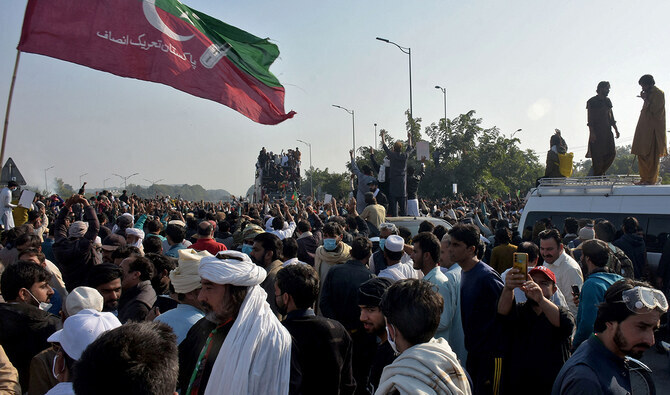
Supporters of jailed former Pakistani Prime Minister Imran Khan’s party Pakistan Tehreek-e-Insaf (PTI) attend a rally demanding his release, in Islamabad on November 26, 2024. (REUTERS/File)
Short Url
Updated 18 December 2024
Follow

Imran Khan’s party temporarily calls off civil disobedience movement in Pakistan

  • Demands government release political prisoners, set up judicial commissions to investigate two protests
  • Khan has been in jail since August 2023 on charges he says are motivated to keep him away from politics

ISLAMABAD: Jailed former Prime Minister Imran Khan has instructed his party to temporarily postpone a planned civil disobedience movement in Pakistan, his sister said on Tuesday, calling on the government to release all political prisoners and set up judicial commissions to investigate what his party says were arrests and killings of supporters during two protests.

On Dec. 5, Khan, jailed since August 2023 on charges he says are politically motivated to keep him away from power, said in a message to supporters that he was setting up a five-member negotiations committee to hold talks with the federal government for the release of political prisoners. He also demanded judicial commissions to investigate protests on May 9 last year and Nov. 24 this year in which the government says supporters of Khan’s Pakistan Tehreek-e-Insaf (PTI) party partook in violence and caused vandalism. If the two demands were not met, Khan said, the party would launch a civil disobedience movement from Dec. 14.

However, speaking to reporters on Tuesday after meeting Khan in prison, his sister Aleema Khan said the jailed leader had been advised by aides that a civil disobedience movement, including a call to overseas Pakistanis who largely support Khan to stop sending remittances, would damage the economy. 

“Party leaders have said this will really affect the economy so Imran Khan has said, “I will wait for a few days, the government should meet these two demands’,” Aleema told the media outside Adiala jail. “Otherwise, if these demands are not met, he will announce a call to stop remittances.”

Pressure on Khan’s PTI party, already at loggerheads with the government and military, has increased since last month when thousands of its supporters stormed Islamabad, demanding Khan’s release. 

The government says protesters killed four security officers in clashes while the PTI says at least 12 of its supporters died and “hundreds” were injured and arrested as security agencies used live ammunition rounds to disperse protesters, which authorities deny. The Prime Minister Shehbaz Sharif coalition government says it will take legal action against the rioters and bring to justice suspects behind what it has described as a “malicious campaign” to spread fake online news, images and video content against the state and security forces.

Previously, the government and military have accused Khan supporters of attacking and damaging government and military buildings after his brief arrest on May 9, 2023.

Hundreds of PTI supporters and dozens of leaders were subsequently arrested while police registered cases against the party’s top leaders, including Khan. The army is also holding military trials of over a 100 people arrested in connection with the May riots.


Return of millions of Afghans from Pakistan and Iran pushes Afghanistan to the brink, UN warns

Updated 5 sec ago
Follow

Return of millions of Afghans from Pakistan and Iran pushes Afghanistan to the brink, UN warns

  • Afghan authorities provide care packages for those returning that include food aid, cash, a telephone SIM card and transportation
  • But the returns have strained resources in a country struggling with a weak economy, severe drought and two devastating earthquakes

GENEVA: The return of millions of Afghans from neighboring Pakistan and Iran is pushing Afghanistan to the brink, the U.N. refugee agency said on Friday, describing an unprecedented scale of returns.

A total of 5.4 million people have returned to Afghanistan since October 2023, mostly from the two neighboring countries, UNHCR’s Afghanistan representative Arafat Jamal said, speaking to a U.N. briefing in Geneva via video link from Kabul, the Afghan capital.

“This is massive, and the speed and scale of these returns has pushed Afghanistan nearly to the brink,” Jamal said.

Pakistan launched a sweeping crackdown in Oct. 2023 to expel migrants without documents, urging those in the country to leave of their own accord to avoid arrest and forcible deportation and forcibly expelling others. Iran also began a crackdown on migrants at around the same time.

Since then, millions have streamed across the border into Afghanistan, including people who were born in Pakistan decades ago and had built lives and created businesses there.

Last year alone, 2.9 million people returned to Afghanistan, Jamal said, noting it was “the largest number of returns that we have witnessed to any single country.”

Afghanistan’s Taliban rulers have criticized the mass expulsions.

Afghanistan was already struggling with a dire humanitarian situation and a poor human rights record, particularly relating to women and girls, and the massive influx of people amounting to 12% of the population has put the country under severe strain, Jamal said.

Already in just the month and a half since the start of this year, about 150,000 people had returned to Afghanistan, he added.

Afghan authorities provide care packages for those returning that include some food aid, cash, a telephone SIM card and transportation to parts of the country where they might have family. But the returns have strained resources in a country that was already struggling to cope with a weak economy and the effects of a severe drought and two devastating earthquakes.

In November, the U.N. development program said nine out of 10 families in areas of Afghanistan with high rates of return were resorting to what are known as negative coping mechanisms — either skipping meals, falling into debt or selling their belongings to survive.

“We are deeply concerned about the sustainability of these returns,” Jamal said, noting that while 5% of those who return say they will leave Afghanistan again, more than 10% say they know of someone who has already left.

“These decisions, I would underscore, to undertake dangerous journeys, are not driven by a lack of a desire to remain in the country, on the contrary, but the reality that many are unable to rebuild their viable and dignified lives,” he said.