- State Bank museum has large collection including first cheque issued by Pakistani founder Muhammad Ali Jinnah at Habib Bank
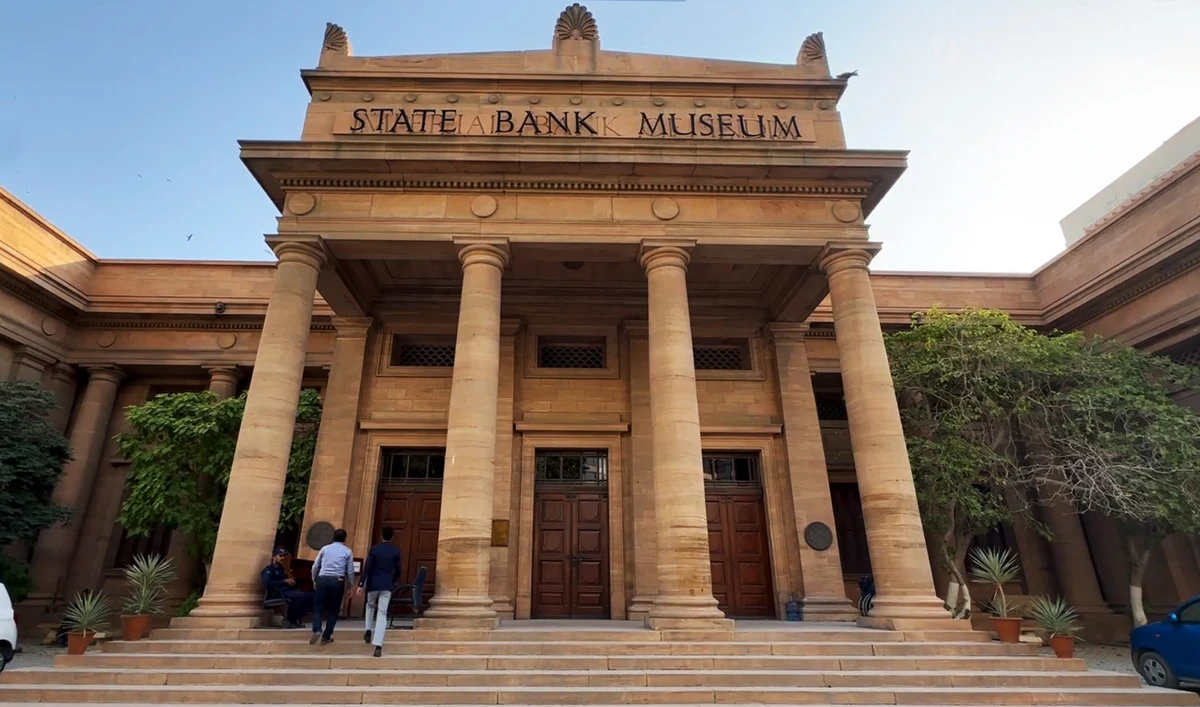
- Museum is housed in a hundred-year-old building of the former Imperial Bank of India on Karachi’s famed I.I. Chundrigar Road
KARACHI: Nestled in the heart of Pakistan’s commercial capital of Karachi, the State Bank (SBP) Museum and Art Gallery stands as a testament to the region’s monetary history, with an extensive collection of artefacts like ancient coins, currency notes and rare documents, including cheques signed by the nation’s founding father.
The museum — housed in the hundred-year-old building of the former Imperial Bank of India on Karachi’s I.I. Chundrigar Road — takes visitors through a journey of the evolution of finance, from ancient barter systems to sophisticated financial instruments available today.
Notable exhibits displayed at the museum include the first cheque issued at Habib Bank from the personal account of Pakistan’s founder, Muhammad Ali Jinnah, and his original account-opening form.
“This State Bank Museum is the first and only specialized money museum of Pakistan which covers the theme of the evolution of money, starting from barter trade till e-banking,” museum official Jibran Ali told Arab News.
“One of the specialties of this museum is the coins ... Starting from the 6th century BC up to the coins of Pakistan today, we have all of the different dynasties’ coins available in this museum.”
One gallery displays a collection of coins from emperors that once ruled the region, including the British, the Mughals and the Arab rulers of Sindh. The first currency notes printed by the Reserve Bank of India after India and Pakistan’s independence from British rule in 1947 are also on display.
One of the highlights is Hajj notes, specially designed for pilgrims from 1949 to the 1980s, which could be used in Saudi Arabia.
“On the same note, we can see that the Government of Pakistan [logo] is also mentioned alongside the Reserve Bank of India,” Ali said.
A range of cowrie shells, Indus seals and Ratti seeds as well as coins from various ancient cultures such as the Indo-Greek and Kushan eras are also on display.
“Cowrie shells were initially used as money and also as ornaments in jewelry until the 19th century in different parts of the world,” Ali explained. “We have a vast collection of more than 7,000 rare coins available today.”
Old minting machines are another interesting part of the collection.
“These machines used to produce coins and paper money and give visitors a rare glimpse into the craftsmanship behind currency production before modern technology took over,” the museum in-charge added.
The original office furniture of the central bank’s first governor, Zahid Hussain, and the bank’s inaugural account ledger are also showcased. Visitors can also view antique coin-minting machines, a currency printing press, and the first automated teller machine (ATM) in Pakistan, introduced by Habib Bank in 1988.
“We have the first ATM as well,” Ali said. “And we have original vaults of the 1920s.”
“PAST ECONOMIES”
The building itself is a historical marvel, featuring a Greco-Roman design with a stunning glass ceiling and intricately preserved Burma teak doors. Built in the 1920s for the Imperial Bank of India, the structure is crafted from Jodhpuri Red Sandstone and a grand example of colonial-era architecture.
Professor Altaf Aseem, a heritage and archaeology expert, said the museum was important both for its building and the collection inside.
“From cowrie shells to modern-day currency, the museum has a wide array of items on display. However, the building that houses these coins and currencies is equally significant, as it is itself a heritage site. In a way, we can say that heritage is housed within heritage,” Aseem told Arab News.
The currency notes and metal coins on display showed an impressive array of art and calligraphy from different periods also, the historian said.
“For example, some display Khat-e-Kufi, others use Nasta’liq, and some feature the Naskh script,” Aseem added, referring to different calligraphy styles.
“This variety is a key highlight of the collection. Even though details are often missing such as who made these designers, the collection remains remarkable.”
Babar Ali, a visitor, said the museum offered a “deep dive into the history of money.”
“One of the most impressive sections is the collection of rare coins, including those from the era of Alexander the Great, the Arab rulers, and other significant historical empires,” the retired government official said.
“The display also includes precious metal coins like gold and silver, which highlight their importance in past economies.”