

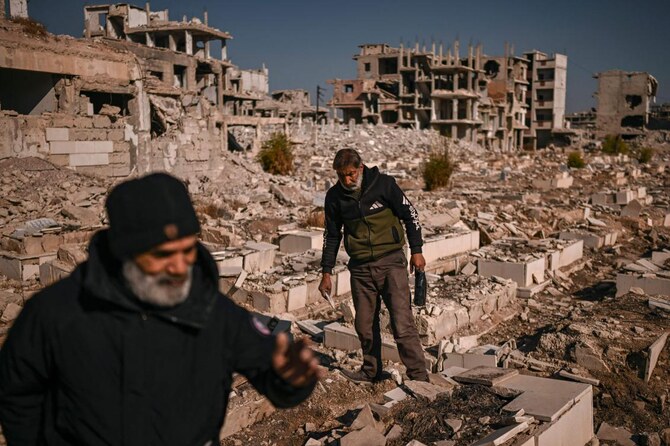

YARMUK: In a war-ravaged Palestinian refugee camp in Syria, Radwan Adwan was stacking stones to rebuild his father’s grave, finally able to return to Yarmuk cemetery after Bashar Assad’s fall.
“Without the fall of the regime, it would have been impossible to see my father’s grave again,” said 45-year-old Adwan.
“When we arrived, there was no trace of the grave.”
It was his first visit there since 2018, when access to the cemetery south of Damascus was officially banned.
Assad’s fall on December 8, after a lightning offensive led by Islamist rebels, put an end to decades of iron-fisted rule and years of bloody civil war that began with repression of anti-government protests in 2011.
Yarmuk camp fell to rebels early in the war before becoming a jihadist stronghold. It was bombed and besieged by Assad’s forces, emptied of most of its residents and reduced to ruins before its recapture in 2018.
Assad’s ouster has allowed former residents to return for the first time in years.
Back at the cemetery, Adwan’s mother Zeina sat on a small metal chair in front of her husband’s gravesite.
She was “finally” able to weep for him, she said. “Before, my tears were dry.”
“It’s the first time that I have returned to his grave for years. Everything has changed, but I still recognize where his grave is,” said the 70-year-old woman.
Yarmuk camp, established in the 1950s to house Palestinians who fled or were expelled from their land after Israel’s creation, had become a key residential and commercial district over the decades.
Some 160,000 Palestinians lived there alongside thousands of Syrians before the country’s conflict erupted in 2011.
Thousands fled in 2012, and few have found their homes still standing in the eerie wasteland that used to be Yarmuk.
Along the road to the cemetery, barefoot children dressed in threadbare clothes play with what is left of a swing set in a rubble-strewn area that was once a park.
A steady stream of people headed to the cemetery, looking for their loved ones’ gravesites after years.
“Somewhere here is my father’s grave, my uncle’s, and another uncle’s,” said Mahmud Badwan, 60, gesturing to massive piles of grey rubble that bear little signs of what may lie beneath them.
Most tombstones are broken.
Near them lay breeze blocks from adjacent homes which stand empty and open to the elements.
“The Assad regime spared neither the living nor the dead. Look at how the ruins have covered the cemetery. They spared no one,” Badwan said.
There is speculation that the cemetery may also hold the remains of famed Israeli spy Eli Cohen and an Israeli solider.
Cohen was tried and hanged for espionage by the Syrians in 1965 after he infiltrated the top levels of the government.
A Palestinian source in Damascus, who spoke on condition of anonymity given the sensitivity of the subject, told AFP contacts were underway through mediators to try to find their remains.
Camp resident Amina Mounawar leaned against the wall of her ruined home, watching the flow of people arriving at the cemetery.
Some wandered the site, comparing locations to photos on their phones taken before the war in an attempt to locate graves in the transformed site.
“I have a lot of hope for the reconstruction of the camp, for a better future,” said Mounawar, 48, as she offered water to those arriving at the cemetery.


