LUANDA: Talks due Sunday between the leaders of Rwanda and the Democratic Republic of Congo to end conflict in the eastern DRC were called off after negotiations deadlocked, officials said.
Since 2021 a Rwanda-backed rebel militia has seized swathes of the eastern DRC, displacing thousands and triggering a humanitarian crisis.
There had been high hopes that the summit hosted by Angola’s President Joao Lourenco – the African Union mediator to end the conflict – would end with a deal to end the conflict.
But around midday Sunday the head of the Angolan presidency’s media office said it would not go ahead.
“Contrary to what we expected, the summit will no longer be held today,” media officer Mario Jorge told journalists.
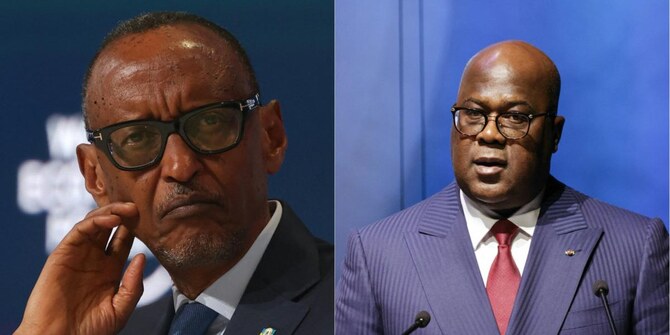
Lourenco was meeting with DRC leader Felix Tshisekedi and without Rwandan President Paul Kagame, he said.
The Congolese presidency said that negotiations had hit deadlock over a Rwandan demand that the DRC hold direct dialogue with the Kigali-backed and largely ethnic Tutsi M23 rebels who have since 2021 seized swathes of the eastern DRC.
“There is a stalemate because the Rwandans have set as a precondition for the signing of an agreement that the DRC hold a direct dialogue with the M23,” Giscard Kusema, the Congolese presidency spokesman present in Luanda, said.
Rwanda’s Foreign Minister Olivier Nduhungirehe said Friday that his country wanted “a firm commitment from the DRC to resume direct talks with the M23 within a well-defined framework and timeframe.”
The Congolese government says, however, that the M23 only exists because of Rwandan military support.
“If Kigali is in good faith in the negotiations and on its promise to withdraw... its troops from Congolese soil, the conflict will end with the M23, and at the same time it will stop with Rwanda,” a Congolese government source said.
Kagame and Tshisekedi last saw each other in October in Paris but did not speak, though they have maintained dialogue through the mediation of Luanda.
In early August, Angola mediated a fragile truce that stabilized the situation at the front line, but both sides continued to exchange fire and clashes have intensified since late October.
Home to a string of rival armed groups, the mineral-rich eastern DRC has been plagued by internal and cross-border violence for the past three decades.
“Our country continues to face persistent rebellions, including the aggression by the Rwandan army and the M23 terrorists,” Tshisekedi said in parliament Wednesday, calling the militants and Rwanda “enemies of the Republic.”
The capital of DRC’s North Kivu province Goma, home to about one million people and another million displaced by war, is now nearly surrounded by M23 rebels and the Rwandan army.
Early in November, the two central African neighbors launched a committee to monitor ceasefire violations, led by Angola and including representatives from both the DRC and Rwanda.
Kinshasa and Kigali a few weeks later approved a document setting out the terms by which Rwandan troops will disengage from Congolese territory.
A previous draft dated in August listed the dismantling of the FDLR militia, created by ethnic Hutus involved in the Rwandan genocide in 1994, as a precondition for Rwanda’s withdrawal.
Often portrayed by Kigali as a threat to its security, the Democratic Forces for the Liberation of Rwanda (FDLR) is one of various disparate militias fighting alongside the Congolese army against the M23.
The August draft was rejected by the DRC, which demanded that the withdrawal occur at the same time as the FDLR’s dismantling.
The final strategic document, seen by AFP, planned for a period of 90 days to “conclude the neutralization of the FDLR and the lifting of Rwanda’s defensive measures.”

DR Congo, Rwanda peace talks canceled
https://arab.news/y4ybv
DR Congo, Rwanda peace talks canceled
- Since 2021 a Rwanda-backed rebel militia has seized swathes of the eastern the Democratic Republic of Congo
- The Congolese government says that the M23 rebels only exist because of Rwandan military support
Starmer and Xi call for deeper UK-China ties as Trump shakes up global relations
- Neither Prime Minister Keir Starmer nor President Xi Jinping publicly mentioned Donald Trump
- But the US president’s challenge to the post-Cold War order was clearly on their minds
BEIJING: The leaders of Britain and China called Thursday for a “strategic partnership” to deepen ties between their nations at a time of growing global turbulence as they sought to thaw relations after years of chill.
Neither Prime Minister Keir Starmer nor President Xi Jinping publicly mentioned Donald Trump, but the US president’s challenge to the post-Cold War order was clearly on their minds.
“I think that working together on issues like climate change, global stability during challenging times for the world is precisely what we should be doing as we build this relationship in the way that I’ve described,” Starmer told Xi at the start of their meeting in Beijing.
The two met for 80 minutes — double the scheduled time — in the Great Hall of the People as their nations try to improve relations after several years of acrimony. Relations have deteriorated over allegations of Chinese spying in Britain, China’s support for Russia in the Ukraine war and the crackdown on freedoms in Hong Kong, the former British colony that was returned to China in 1997. Starmer is the first British prime minister to visit in eight years.
Xi said that “China-UK relations experienced twists and turns in previous years, which was not in the interests of either country.”
“In the current turbulent and ever-changing international situation ... China and the UK need to strengthen dialogue and cooperation to maintain world peace and stability,” he said.
Chinese state broadcaster CCTV said Xi had stressed, without mentioning the US directly, that “major powers” must adhere to international law or the world would regress into a “jungle.”
Relationship is in ‘a good place’
Starmer’s Downing Street office said Britain wanted “a consistent, long-term, and strategic partnership that will benefit both countries.”
After the meeting, Starmer said the leaders had made “really good progress” on issues including slashing Chinese tariffs on Scotch whisky and introducing visa-free travel for British visitors.
“The relationship is in a good place, a strong place,” the British leader said.
Xi appeared to acknowledge the criticism that Starmer has faced for reaching out to China despite national security and human rights concerns. The UK recently approved controversial plans for a huge Chinese Embassy in London, removing a sticking point in relations but also overriding fears that the “mega-embassy” would make it easier for China to conduct espionage and intimidate dissidents.
“Good things often come with difficulties,” Xi said. “As long as it is the right thing to do in accordance with the fundamental interests of the country and its people, leaders will not shy away from difficulties and will forge ahead bravely.”
Starmer’s visit comes less than two months after a Hong Kong court convicted Jimmy Lai, a former newspaper publisher and British citizen, under a national security law that Beijing imposed on the territory after massive pro-democracy protests in 2019.
Starmer said he raised human rights issues with Xi and the two men had a “respectful discussion.”
Starmer, who was elected in July 2024, has said he will protect national security while keeping up diplomatic dialogue and economic cooperation with China. He told Xi that it has “been far too long” since a UK prime minister visited.
“I made a promise 18 months ago when we were elected into government, that I would make Britain face outward again,” the leader of the center-left Labour Party said. “Because as we all know, events abroad affect everything that happens back in our home countries, from prices on the supermarket shelves to how secure we feel.”
Starmer’s government has struggled to deliver the economic growth it promised and ease a cost-of-living crisis for millions of households and he sees China as a potential source of growth.
More than 50 UK business executives have joined him on the trip, along with the leaders of major cultural organizations, as he seeks to expand opportunities for British companies in China and secure Chinese investment in the UK
Trump tariffs spur new trade talks
The disruption to global trade under Trump has made expanding trade and investment more imperative for many governments. Vietnam and the European Union upgraded ties to a comprehensive strategic partnership Thursday, two days after the EU and India announced a free trade accord.
“At a moment when the international rules-based order is under threat from multiple sides, we need to stand side by side as reliable and predictable partners,” European Council President Antonio Costa said in Hanoi, Vietnam.
Starmer is the fourth leader of a US ally to visit Beijing this month, following those of South Korea, Canada and Finland. The German chancellor is expected to visit next month.
The UK leader also met Thursday with Zhao Leji, the chairman of China’s legislature, the National People’s Congress, and Premier Li Qiang, who told Starmer his efforts to improve relations had been “widely welcomed” in both countries.
The two countries were expected to sign a number of agreements. One will try to disrupt the trade in Chinese boat engines used by smugglers to bring people across the English Channel to Britain. More than half the engines come from China, the British government said. Under the agreement, U.K law enforcement agencies will work with Chinese authorities and manufacturers to prevent engines from ending up in the hands of criminal gangs.


