

Asian Development Bank approves $330 million loan for social protection in Pakistan

Staff members of the Asian Development Bank step out of the Manila-based lender's headquarters on February 17, 2009. (AFP/File)
Short Url
Updated 14 December 2024
Follow

Asian Development Bank approves $330 million loan for social protection in Pakistan

  • This financing will support objectives of inclusive growth, poverty reduction, skills development and health care access
  • The ADB has committed over $52 billion to Pakistan, one of its founding members, since 1966 in public, private sector loans

ISLAMABAD: The Pakistani government has signed a loan agreement with the Asian Development Bank (ADB) for the Integrated Social Protection Development Program (ISPDP) additional financing amounting to $330 million, the government said on Saturday.
The ISPDP builds on the ongoing ADB-funded program for strengthening and expanding social protection systems in Pakistan through the Benazir Income Support Programme (BISP), according to the Pakistani government’s Press Information Department (PID).
In Pakistan, the federal government disburses billions of rupees annually to the underprivileged and vulnerable people through the BISP. The agreement was signed by Secretary Economic Affairs Dr. Kazim Niaz and ADB Country Director Emma Fan from respective sides.
“In his remarks, the Secretary, Ministry of Economic Affairs highlighted the importance of this additional financing from concessional lending for enhancing institutional capacity and improving access to education and health care, particularly among women, adolescent girls, and children from low-income families,” the PID said in a statement.
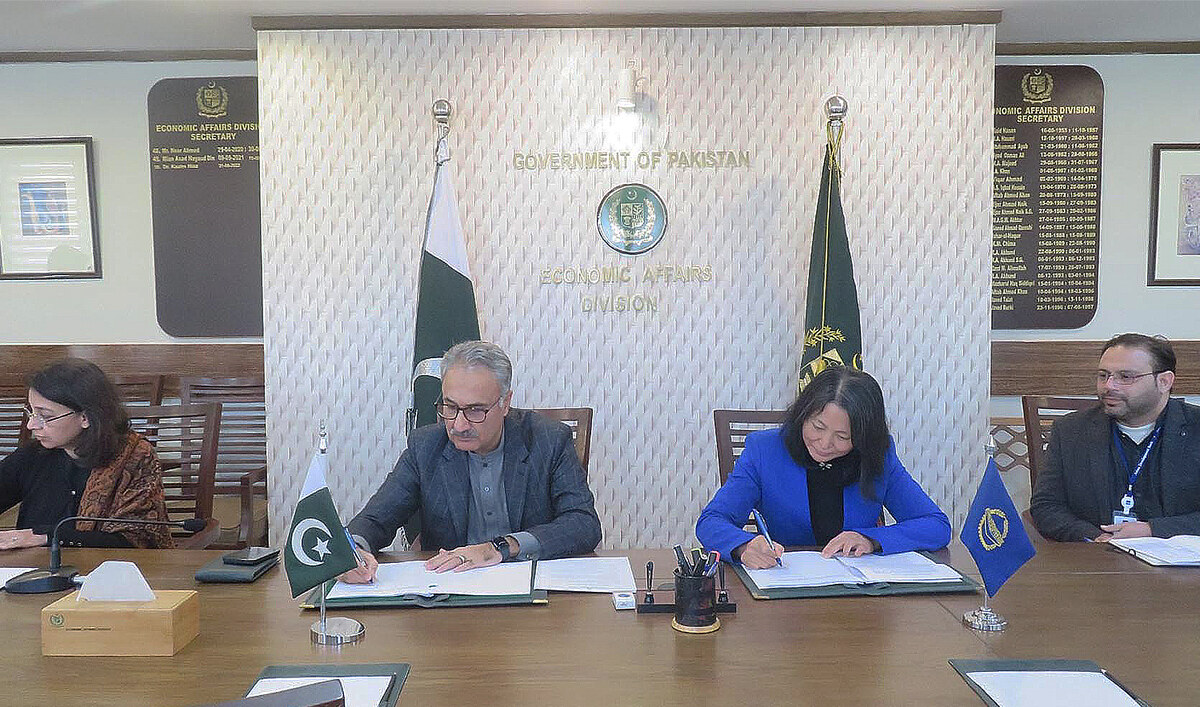


Pakistan's Economic Affairs Secretary Dr. Kazim Niaz (second left) and Asian Development Bank Country Director Emma Fan (second right) are signing a loan agreement for the Integrated Social Protection Development Program (ISPDP) in Islamabad, Pakistan, on December 14, 2024. (PID)

The ADB country director reaffirmed the bank’s commitment to supporting Pakistan’s objectives in strengthening social safety nets.
“This additional financing will support in achieving the program objectives of achieving inclusive growth, poverty reduction skills development and health care access for vulnerable populations,” Fan was quoted as saying.
The regional development bank has committed over $52 billion to Pakistan, one of its founding members, since 1966 in public and private sector loans, grants, and other forms of financing to promote inclusive economic growth in the country.
Last month, Pakistan and the Asian Development Bank (ADB) signed a $500 million loan agreement under the ‘Climate and Disaster Resilience Enhancement Program,’ according to Pakistani state media.
The program is aimed at strengthening Pakistan’s capacity for climate change adaptation and disaster risk management and will address the country’s vulnerabilities to natural disasters and climate impacts.


Death toll in Pakistan shopping plaza fire rises to 67, officials say

Updated 22 January 2026
Follow

Death toll in Pakistan shopping plaza fire rises to 67, officials say

  • Rescue teams still searching for damaged Gul Plaza in Karachi where blaze erupted on Saturday, says police surgeon
  • Karachi has a long history of deadly fires, often linked to poor safety standards, weak regulatory enforcement

KARACHI: The death toll from a devastating fire at a shopping plaza in Pakistan’s southern port city of Karachi jumped to 67 on Thursday after police and a hospital official confirmed that the remains of dozens more people had been found.

Police surgeon Dr. Summaiya Syed said rescue teams were still searching the severely damaged Gul Plaza in the Karachi, where the blaze erupted on Saturday.

Most remains were discovered in fragments, making identification extremely difficult, but the deaths of 67 people have been confirmed, she said. Asad Raza, a senior police official in Karachi, also confirmed the death toll. Authorities previously had confirmed 34 deaths.

Family members of the missing have stayed near the destroyed plaza and hospital, even after providing their DNA for testing. Some have tried to enter the building forcibly, criticizing the rescue efforts as too slow.

“They are not conducting the search properly,” said Khair-un-Nisa, pointing toward the rescuers. She stood outside the building in tears, explaining that a relative who had left to go shopping has been missing since the blaze.

Another woman, Saadia Saeed, said her brother has been trapped inside the building since Saturday night, and she does not know what has happened to him.

“I am ready to go inside the plaza to look for him, but police are not allowing me,” she said.

There was no immediate comment from authorities about accusations they have been too slow.

Many relatives of the missing claim more lives could have been saved if the government had acted more swiftly. Authorities have deployed police around the plaza to prevent relatives from entering the unstable structure, while rescuers continue their careful search.

Investigators say the blaze erupted at a time when most shop owners were either closing for the day or had already left. Since then, the Sindh provincial government has said around 70 people were missing after the flames spread rapidly, fueled by goods such as cosmetics, clothing, and plastic items.

The cause of the fire remains under investigation, though police have indicated that a short circuit may have triggered the blaze.

Karachi has a long history of deadly fires, often linked to poor safety standards, weak regulatory enforcement, and illegal construction.

In November 2023, a shopping mall fire killed 10 people and injured 22. One of Pakistan’s deadliest industrial disasters occurred in 2012, when a garment factory fire killed at least 260 people.